











Short answer
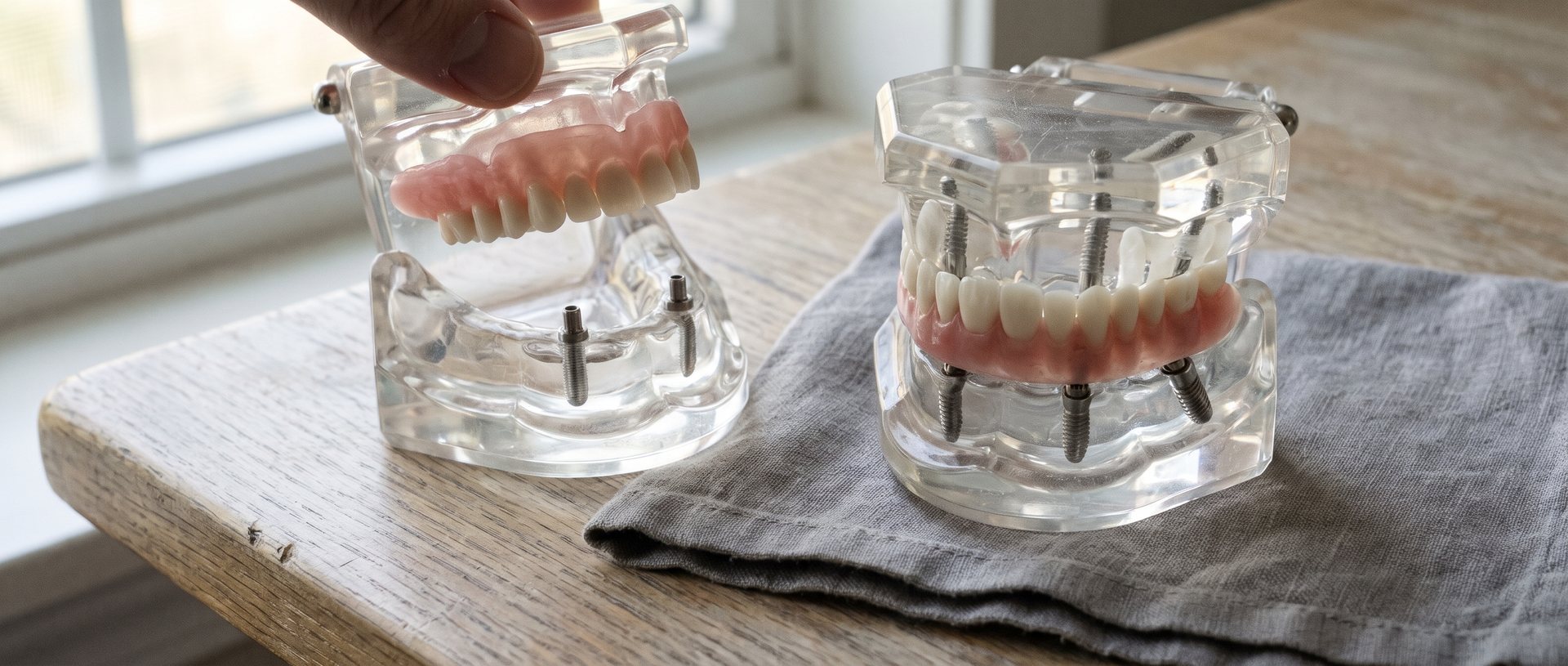
So-called permanent dentures are fixed full-arch bridges screwed onto dental implants, usually four to six per jaw, that only your dental team can remove. The word means fixed, not forever. Under the definition the American College of Prosthodontists uses, a fixed prosthesis is one the patient cannot remove, and in long-term studies the implants mostly stay while the teeth on top wear and get repaired or remade.
What do you call a permanent denture?
A permanent denture is usually called a fixed full-arch implant bridge, or in dental terms an implant-supported fixed complete denture. Fixed dentures, screw-in dentures, hybrid dentures and All-On-4 bridges all describe the same idea. The one question that separates every name, according to the American College of Prosthodontists, is whether you can take it out yourself.
Searchers use about eight names for two designs. The Glossary of Prosthodontic Terms, quoted in an American College of Prosthodontists white paper, calls a prosthesis fixed when it "cannot be removed by the patient" and removable when you can "readily" put it in and take it out. The paper notes "excessive inconsistencies" in implant terms and says patients tend to hear "denture" as something removable, which is why "permanent dentures" confuses people. For the treatments side by side, see our dental implants vs dentures comparison.
| Name you may search | What it usually means | Same thing as | Can you take it out? |
|---|---|---|---|
| "Permanent dentures" | A full-arch bridge screwed onto four to six implants | Fixed, screw-in or hybrid dentures | No, only your dental team |
| Fixed dentures | The same fixed full-arch bridge | "Permanent" or screw-in dentures | No |
| Screw-in dentures | A fixed bridge held on by small screws | Fixed dentures | No |
| Hybrid denture, fixed hybrid denture | A fixed bridge with denture-style teeth and pink gum on a rigid frame | A fixed denture | No |
| All-On-4, All-On-6, All-On-X | How many implants hold the fixed bridge | Fixed or hybrid dentures | No |
| Implant-supported denture | Used for both designs, so ask which | A fixed bridge or a snap-in | Depends |
| Snap-in denture, implant overdenture, mini implant denture | A denture that clips onto implants, often two in the lower jaw | Implant-retained denture | Yes |
| "Permanent dentures without implants" | Not fixed: with no teeth or implants to anchor to, a denture rests on the gums | A conventional denture | Yes |
What is a hybrid denture implant?
A hybrid denture is a fixed full-arch bridge with denture-style teeth and pink gum material on a rigid frame, screwed onto implants. It is a type of bridge, not a different treatment from All-On-4. All-On-4 describes how the implants are placed; hybrid describes what sits on top of them. One All-On-4 bridge can be a hybrid.
The name comes from mixing a denture's look with a bridge's fixed attachment. The American College of Prosthodontists lists builds such as a metal frame covered in denture acrylic, a milled titanium frame, or milled zirconia with or without a porcelain layer, and says each has its own advantages and disadvantages. Its white paper puts "hybrid" in quotation marks and accepts that slang terms will keep being used with patients.
All-On-4 is a placement technique. ANEWU's All-On-4 page describes four implants carrying one fixed bridge, with the rear two tilted to reach firmer bone. So asking "hybrid or All-On-4?" is like asking "sedan or four-door?": often the same thing, named from two angles. The bridge material is its own decision, made with your surgeon at the planning stage.

Do permanent dentures ever come out?
Permanent dentures come out only when your dental team unscrews them, and the American College of Prosthodontists discourages doing that at routine visits. Its 2023 position statement says a fixed, screw-retained bridge does not need removal unless there are signs of implant infection, you cannot keep it clean, or a part needs repair. You do not take it out at home.
What does come out regularly is plaque, at maintenance visits. The schedule below combines the College's 2016 clinical practice guideline and its 2023 position statement on full-arch maintenance. Most of the 2016 guideline is graded D, its lowest strength level, largely built on expert opinion, so treat the intervals as professional consensus, not trial results. Your own schedule is set by your risk.
- Every day: brush at least twice and clean under the bridge with floss, interdental cleaners or a water irrigator.
- About 2 weeks after the final bridge: baseline gum measurements and x-rays.
- Every 2 to 6 months: a maintenance visit, more often if you smoke, had gum disease or have limited dexterity. The 2016 guideline sets at least one exam every 6 months, for life.
- Every 1 to 2 years: repeat x-rays, or sooner if infection is suspected.
- Only when needed: the bridge is unscrewed for infection, cleaning access or repairs, with new screws.
- If you show signs of grinding: a night guard.
How long do permanent dentures last?
Permanent dentures have parts with different lifespans: the implants are meant to stay, while screws, teeth and eventually the whole bridge get repaired or remade. In a 2019 study in Clinical Oral Implants Research that followed 24 lower bridges for an average of 18.5 years, cumulative survival was 91.8% for implants and 80% for bridges, and 75% of patients had worn acrylic teeth.
That study was small, its bridge estimate had a wide margin of error (44.1% to 94.1%), and every bridge was metal and acrylic opposite an upper denture, but few studies run that long. It also found loosening in 8.1% and fracture in 11.3% of the small retaining screws, and acrylic tooth fractures in 45.8% of patients. The College's 2023 statement says screws on a bridge that works well should not be routinely retightened or replaced; new screws go in when the bridge has to come off.
Whole bridges get replaced too. In a 2024 study of 84 metal and acrylic arches made by residents at a US dental school clinic, an estimated 54% went without replacement at 5 years and 32% at 10 years. Acrylic fractures (61%) and heavy wear (19%) drove most replacements, and implant loss only 7%. Results differ by material and clinic, and our guide to the downsides of All-On-4 gives repair rates by material.
| Part | What a long-term study found | What usually happens next |
|---|---|---|
| The implants | 91.8% still in place at 16.9 years (2019) | Meant to stay in place |
| Screws and connectors | Loosening in 8.1% and fracture in 11.3% of retaining screws (2019) | Replaced when the bridge comes off, not at routine visits |
| The teeth on top | Acrylic wear in 75% and fractures in 45.8% of patients (2019) | Adjusted, repaired or replaced |
| The whole bridge | 80% in use at 19.6 years (2019); an estimated 54% at 5 years at one teaching clinic (2024) | Remade when damage is beyond repair |
What is the downside to permanent dentures?
The downsides of permanent dentures are surgery, months of healing, cost, daily cleaning under the bridge, and repairs over the years. Removing teeth for a fixed arch also cannot be undone: a 2014 systematic review in the Journal of Dentistry, which called these bridges "hybrid prostheses", warned that taking out teeth with a good outlook just to fit one "should be avoided".
The FDA lists difficulty cleaning around implants, infection, nerve numbness and implant failure among the risks, and says healing "may take several months or longer". The 2014 review also found too few true long-term studies to judge survival past 10 years. A fixed arch may not suit you if any of these apply:
- You still have healthy teeth that can be kept and treated.
- You cannot clean under a bridge every day or attend visits every few months.
- You have uncontrolled diabetes or smoke, which the FDA links to infection and slower healing.
- You want the smallest surgery, or teeth you can take out.
- Your bone needs grafting first and you would rather avoid another procedure.
Snap in vs permanent implant dentures: who should choose a snap-in?
A snap-in denture suits you if you want fewer implants, need the denture's pink flange to support your lips and face, or want to lift your teeth out to clean them. A 2025 meta-analysis of 16 upper-jaw studies found four-implant snap-ins lost less bone than fixed bridges but had more complications, and 85.0% of the snap-ins survived against 99.9% of fixed bridges.
In that review, which required at least 5 years of follow-up, implant survival was 94.5% under snap-ins and 98.5% under fixed bridges. Snap-ins lost 0.27 mm of bone around the implants at 5 years against 1.20 mm, and their most common problem was loss of grip. The College's white paper says dentists choose between designs on ease of cleaning, facial support, dexterity and implant position. Our snap-in dentures pros and cons guide goes deeper. Questions to ask your surgeon:
- How many implants does my scan support, and why that number?
- Will my final teeth be fixed or removable, and who can take them out?
- What will the final bridge be made of, and how is a chipped tooth repaired?
- How often will I come in, and when would the bridge be unscrewed?
- What happens if one implant fails?
- Do I need a night guard?
How much do permanent dentures usually cost, and are they covered by insurance?
The cost of permanent dentures is set by your case: the number of implants, any bone grafting first, one arch or two, and the material of the final bridge. ANEWU does not publish prices for that reason. Expect dental insurance to pay toward part of the work at most, such as extractions or the replacement teeth, rather than the whole implant treatment.
Insurers usually class implant work as elective, and a yearly maximum limits what a plan pays. Medical insurance is a separate system that covers dental work only in specific situations, so ask both insurers in writing; some plans offer a predetermination, a written estimate before treatment. For payment, ANEWU takes CareCredit and Proceed Finance, and a monthly plan can be set up with the practice before your procedure; the financing page lists the details.
What happens at a permanent denture consultation at ANEWU?
At ANEWU, a permanent denture starts with a free consultation and a 3D scan taken in the office. Dr. Abtin Shahriari goes over the scan with you and tells you which designs your bone can carry. The implant count, All-On-4, All-On-6 or All-On-X, comes from that scan rather than a package chosen in advance. Nothing is booked until you decide.
If the scan shows enough bone and the implants are firm when placed, you can leave surgery with a provisional (temporary) fixed bridge screwed onto them. Once the implants have healed, ANEWU's on-site lab makes the final bridge, which replaces the temporary on the same implants. If the implants are not stable enough, the fixed teeth wait until after healing, possibly with a removable temporary in between. If bone is short, grafting or zygomatic or pterygoid implants are the usual routes. You can book a consultation at the Buckhead, Cumming or Dawsonville office.
- Check in and review your medical history and medications.
- Have a 3D scan of your jaw taken in the office.
- Review the scan and your options with Dr. Abtin Shahriari, who performs the surgery.
- Go over cost and payment, including CareCredit and Proceed Finance.
- Decide in your own time; a spouse or friend is welcome.
When should you call right away about a fixed bridge?
Call your implant office the same day if your fixed bridge feels loose, rocks, cracks or hurts when you bite. The FDA advises telling your dental provider right away if an implant feels loose or painful. Go to an emergency room for trouble breathing or swallowing, swelling spreading toward your eye or neck, or a high fever.
A loose or twisting feeling can mean a screw has backed off, which the FDA lists as a known risk. Gum signs matter too: the College lists redness, swelling, bleeding and pus around an implant as signs of inflammation to check. For emergencies, the NHS advises urgent help for difficulty breathing, speaking or swallowing, a swollen eye, or a lot of swelling in the mouth. Call the office for:
- A bridge that clicks, shifts or meets your other teeth differently.
- A cracked or missing tooth on the bridge.
- Pus, a bad taste or bleeding at an implant.
Sources and further reading
- Long-Term Comprehensive Results of Four-Implant-Supported Overdentures and Fixed Complete Dentures: A Systematic Review and Meta-analysis International Journal of Oral and Maxillofacial Implants, 2025
- Treatment of edentulous mandible with metal-resin fixed complete dentures: A 15- to 20-year retrospective study Clinical Oral Implants Research, 2019
- Prosthetic complications and survival rates of metal-acrylic implant fixed complete dental prostheses: A retrospective study up to 10 years Journal of Prosthetic Dentistry, 2024 (online 2022)
- Systematic review of short- (5-10 years) and long-term (10 years or more) survival and success of full-arch fixed dental hybrid prostheses and supporting implants Journal of Dentistry, 2014
- Mandibular two implant-supported overdentures as the first choice standard of care for edentulous patients: the York Consensus Statement British Dental Journal, 2009
- Clinical Practice Guidelines for Recall and Maintenance of Patients with Tooth-Borne and Implant-Borne Dental Restorations American College of Prosthodontists, Journal of Prosthodontics, 2016
- Maintenance of Full-Arch Implant Restorations (position statement) American College of Prosthodontists, 2023
- White Paper: Definitions of Implant Dental Prostheses American College of Prosthodontists, undated PDF (file dated 2019)
- Dental Implants: What You Should Know U.S. Food and Drug Administration, content current as of 10/29/2021
- Dental abscess NHS (UK National Health Service)
This article is general information about dental and facial procedures, not a diagnosis or medical advice. Every jaw and every health history is different, so the right plan for you can only be set after an exam and imaging with a surgeon.