













Short answer
Loose dentures usually mean the bone and gums under them have shrunk, the denture itself has worn, or both. A reline refits a sound denture; a worn one needs remaking. If a lower denture still lifts, anchoring it to implants is the next step: in a 2013 randomized trial of dissatisfied wearers, implant-retained lower dentures improved oral health-related quality of life, while relining showed almost no gain.
Why won't my dentures stay in place?
Dentures stop staying in place mainly because the jaw ridge under them keeps shrinking after teeth are lost, so a denture that fit at delivery no longer matches your gums. A 2003 review in the Journal of the Canadian Dental Association describes most of that change in the first year after extractions, then continuing throughout life. Worn teeth and an aging denture add to it.
The NHS says dentures may loosen as your gums and jawbone shrink or change shape with age, and may wear or get damaged over time. The fix depends on which of those is happening, so match the cause before you choose the repair. The table is the decision ladder: start at the top row that fits you.
| Cause | Sign you may notice | Usual fix | How long the fix tends to hold |
|---|---|---|---|
| Ridge shrinking under a sound denture | Slow loosening, food slipping under it, new sore spots | Hard reline by your dentist | Until the ridge changes again; bone loss continues for life |
| Sore, thin gums | Pain when chewing on a hard base | Soft reline | Shorter than a hard reline (2024 review) |
| Old or damaged base, teeth and bite still right | Thin, rough or repaired pink base | Rebase | No set interval; checked at yearly visits |
| Worn teeth or a denture past its life | Flat teeth, harder chewing, cracks, over 5 years old | New denture | Mean 5.5 to 6.5 years to replacement (2023 study) |
| Lower ridge too flat to hold a denture | Lifts when you talk or eat; adhesive needed to eat | Anchor the denture to implants | Gains held at 2 years (2013 trial) |
What exactly is a denture reline, and how is it different from a rebase or a new denture?
A denture reline adds a new layer of material to the side of the denture that touches your gums, so it matches their current shape. A rebase replaces the whole pink base but keeps your existing teeth. A new denture replaces everything. A reline is the smallest fix and only makes sense when the teeth and bite are still in good shape.
Relines come in two kinds. A hard reline uses rigid acrylic like the original base. A soft reline is a cushioning acrylic or silicone layer for tender gums. A 2024 systematic review in the Journal of Prosthodontic Research found soft relines improved satisfaction, quality of life and chewing, but lasted a shorter time than hard relines and picked up more microbial contamination over the long term. Its authors rated the risk of bias in the included studies as tending to be high.
So a soft reline is often a comfort step, not a long-term fix. A rebase suits a denture whose base is worn or repaired but whose teeth still meet correctly. If the teeth are worn flat, relining only refits a denture that still chews poorly.
How do I stop my bottom dentures from moving when I eat?
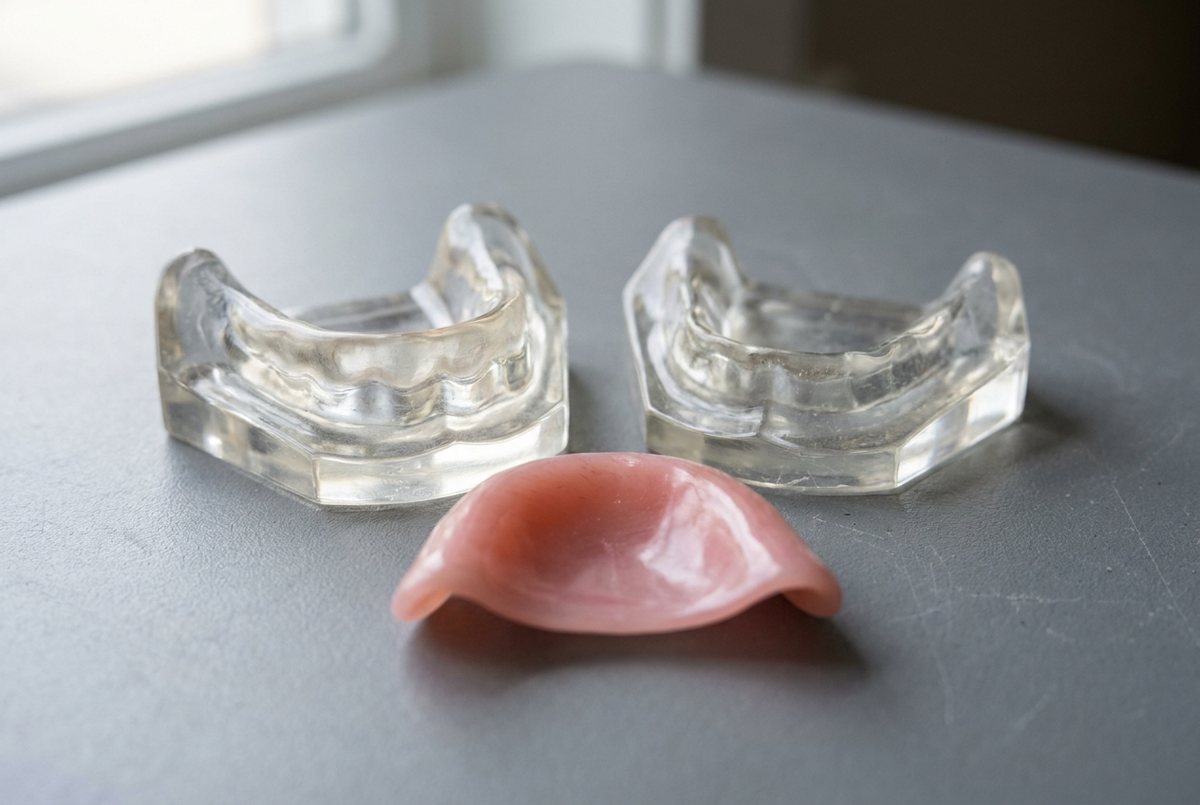
Bottom dentures move more because the lower ridge shrinks faster and offers less to grip. A 2003 review describes a 25-year study, published in 1972, that found bone loss in people without teeth was four times greater in the lower jaw than in the upper. A refit helps for a while; when the ridge is nearly flat, anchoring to implants is the option the trials support.
That review links falling ridge height to denture instability, "particularly in the mandible", the lower jaw. In a 2012 study in the Journal of Oral Rehabilitation of 326 denture wearers aged 60 to 78, how much the lower ridge had shrunk was the most important factor raising dissatisfaction with the lower denture, though the link showed up in women and not in men. The 2003 review also notes that the face-height changes caused by lower bone loss were not corrected by relining the lower denture. In the meantime, softer foods and a small amount of adhesive, which the ADA says to start with, can help. If your lower ridge is already thin, our guide to dental implants with bone loss explains the options.
Can loose dentures be tightened up with adhesive?
Denture adhesive can improve grip, but it does not fix a poor fit. A 2021 meta-analysis of 39 clinical studies in the Journal of Dentistry found adhesives raised retention, bite force and chewing performance. The American Dental Association says adhesives are not a remedy for ill-fitting dentures, which may need relining or replacing to prevent sores.
Use is meant to be modest. The ADA passes on the American College of Prosthodontists advice of 3 to 4 pea-sized dollops per denture, and, citing the FDA, says a 2.4-ounce tube used for upper and lower dentures should last about seven to eight weeks. Some adhesives contain zinc, which can build up if overused; zinc-free products exist, and the College advises avoiding zinc-containing ones as a precaution. The College's 2011 guideline also notes evidence on adhesive use beyond 6 months is lacking, so long-term use should come with fit checks.
The clearest signal is how much you need. The ADA lists needing adhesive to eat, to keep the denture in socially, or more than once a day as reasons to have the denture evaluated for replacement.
Is it worth getting dentures relined?
Relining is worth it when the denture is in good shape and the fit has drifted, such as in the first year after extractions, when the ridge changes most. It is less worth it when a lower denture keeps lifting on a flat ridge. In a 2013 randomized trial of 60 dissatisfied lower denture wearers, relining brought almost no significant improvement, while anchoring the same dentures to implants did.
That trial, in the International Journal of Prosthodontics, followed people for 2 years. The implant group's oral health scores improved within 3 months and held at 2 years; the relined group's barely moved. It was small, with 54 people finishing, so treat it as a strong hint, not the last word. The decision rules below sum up when a reline is the right size of fix:
- Reline if the denture is under about 5 years old, the teeth meet evenly and only the fit has changed.
- Rebase or remake if the base is cracked or the teeth are worn flat.
- Ask about implants if you have relined before and the lower denture still lifts, or you need adhesive to eat.
How do you know when it's time to get new dentures?
It is time to have dentures checked for replacement when they are more than 5 years old, cracked, stained or missing teeth, no longer stable, or causing ongoing irritation. Those are the American College of Prosthodontists criteria, as summarized by the ADA. In a 2023 study of 187,227 complete dentures, the mean time to replacement was 5.5 to 6.5 years.
That study, in Community Dentistry and Oral Epidemiology, tracked subsidized dentures in Australia over 20 years: the mean time to replacement was 5.5 years for dentures from public clinics and 6.5 years from private clinics, and only 25.9% of the public-clinic dentures were replaced during the study at all. The College's 2011 guideline also advises a yearly check of fit, sores, bone loss and overall oral health. Signs to book that check sooner:
- The denture rocks, clicks or drops when you speak.
- You need adhesive to eat or more than once a day.
- Sores keep coming back in the same spot.
- The teeth look flat or your chin seems closer to your nose.
Can loose dentures be fixed by anchoring them to implants?
Yes. A loose denture can often be anchored to implants so it snaps into place and still lifts out for cleaning. The 2009 York consensus statement called a lower denture held by two implants the first-choice standard of care for people with no lower teeth. Sometimes your current denture can be fitted with the attachments; sometimes a new one is needed first.
Be clear on what anchoring does and does not do. It steadies the denture, but it is no proof against shrinkage: in a 2020 meta-analysis in the International Journal of Prosthodontics, dentures held by two implants did not lose measurably less bone in the rear of the lower jaw than ordinary dentures, as our implants vs dentures guide explains. Our snap-in dentures pros and cons guide covers the upkeep and trade-offs, and mini implant dentures are one way to do it. A fixed full-arch bridge, which you do not take out, is a separate and larger step. Questions to ask your surgeon:
- Can my current denture be retrofitted, or does it need remaking first?
- How many implants does my lower or upper ridge support?
- Do I have enough bone, or would I need a graft?
- How often will the attachment parts need replacing?
- What happens to my denture while the implants heal?
What happens at ANEWU if your denture no longer fits?
Relines and remakes are general dentistry, so ask your dentist about those. What ANEWU's pages describe for a loose denture is a free consultation with a 3D scan, where Dr. Abtin Shahriari checks whether your ridge can hold mini implants. If it can, the implants go in and your denture gets snap attachments that clip onto them.
Your path depends on what the scan shows. If your bone has enough width, the mini implants go in during one visit, and your current denture is converted or a new one is made to fit them. A denture that is heavily worn, or that did not fit properly from the start, may have to be remade before conversion. If your ridge is too thin, bone grafting or zygomatic implants in the upper jaw are the usual routes. The price turns on the number of mini implants and on whether your denture can be reused or must be remade; CareCredit, Proceed Finance and monthly plans are accepted. You can book a consultation at the Buckhead, Cumming or Dawsonville office.
- Check in and go over your medical history.
- Have a 3D scan of your jaw taken in the office.
- Review the scan with Dr. Abtin Shahriari and hear which options your bone supports.
- If you go ahead: mini implants placed, denture fitted with attachments, then fit and bite adjusted.
- Take it home with written post-op instructions and a follow-up visit to check the seating.
When should you call a dentist right away about a denture?
Call your dentist promptly if a sore under your denture lasts more than 3 weeks, bleeds, or gets redder and more painful, or if the denture cracks and leaves a sharp edge. The NHS lists badly fitting dentures as a cause of mouth ulcers and says a long-lasting ulcer is sometimes a sign of mouth cancer, so it needs checking.
Go to an emergency room if you have trouble breathing or swallowing, swelling that spreads toward your eye or neck, or a high fever. The NHS also says an ulcer that looks different from ones you have had before should be checked. Call your dentist's office for:
- A sore that has not healed in 3 weeks.
- A sore that bleeds or becomes more painful and red, which can mean infection.
- A cracked denture or a broken-off piece.
- Swelling of the gums, face or jaw.
Sources and further reading
- A Review of the Functional and Psychosocial Outcomes of Edentulousness Treated with Complete Replacement Dentures Journal of the Canadian Dental Association, 2003
- Residual ridge resorption, lower denture stability and subjective complaints among edentulous individuals Journal of Oral Rehabilitation, 2012
- The influence of relining or implant retaining existing mandibular dentures on health-related quality of life: a 2-year randomized study of dissatisfied edentulous patients International Journal of Prosthodontics, 2013
- Effect of soft denture liners on complete denture treatments: A systematic review Journal of Prosthodontic Research, 2024
- A systematic review and meta-analysis to evaluate the efficacy of denture adhesives Journal of Dentistry, 2021
- Differences in complete denture longevity and replacement in public and private dental services: a propensity score-matched analysis of subsidised dentures in adult Australians across 20 years Community Dentistry and Oral Epidemiology, 2023
- Bone Loss in the Posterior Edentulous Mandible with Implant-Supported Overdentures vs Complete Dentures: A Systematic Review and Meta-Analysis International Journal of Prosthodontics, 2020
- Mandibular two implant-supported overdentures as the first choice standard of care for edentulous patients: the York Consensus Statement British Dental Journal, 2009
- Evidence-based guidelines for the care and maintenance of complete dentures American College of Prosthodontists, Journal of Prosthodontics, 2011
- Denture Care and Maintenance (Oral Health Topics) American Dental Association, updated 2023
- Dentures NHS (UK National Health Service)
- Mouth ulcers NHS (UK National Health Service)
This article is general information about dental and facial procedures, not a diagnosis or medical advice. Every jaw and every health history is different, so the right plan for you can only be set after an exam and imaging with a surgeon.