











Short answer
Snap-in dentures are removable dentures that click onto implants in your jaw. In studies of the lower jaw, a denture held by two implants scored higher than a conventional denture for satisfaction, comfort and stability. The trade-offs are surgery, higher cost, attachment parts that wear, and a denture you still take out. In the upper jaw, no clear advantage over a well-made conventional denture has been shown.
What are snap-in dentures and how do they work?
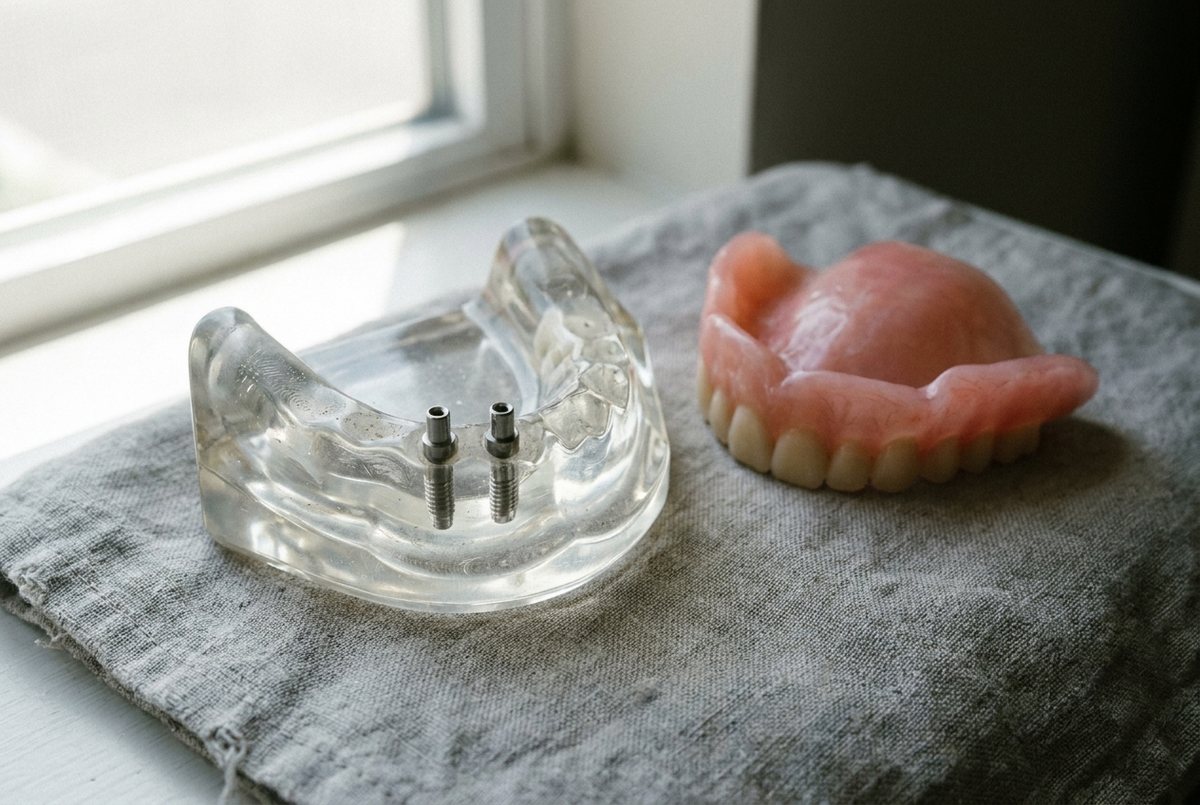
Snap-in dentures are implant-retained overdentures: removable dentures with attachments that click onto implants placed in your jawbone. The implants hold the denture steady, so it does not rest on the gums alone, and you still lift it out to clean it. Consensus statements point to two implants for the lower jaw, and one 2021 review advises four to six for the upper jaw.
ANEWU describes its version on its mini implant-supported dentures page. A few narrow implants go into the jaw, the denture is fitted with ball or stud attachments, and the two lock together. Mini implants are narrower than standard ones (under 3 mm in a 2024 review of lower-jaw trials, cited below), and the page gives that as the reason placement is often less invasive. The page is plain that the denture stays removable.
The 2009 York consensus statement from the British Society for the Study of Prosthetic Dentistry, a follow-up to the 2002 McGill consensus statement, concluded that a two-implant lower overdenture should be the minimum offered to edentulous patients as a first choice of treatment. Both statements are expert consensus rather than new trials, and both cover the lower jaw only.
Video transcript
A silent animation in five steps. Step 1: a few narrow implants go into the jaw. Step 2: ball or stud attachments sit on top of the implants. Step 3: the denture is fitted to match. Step 4: the denture clicks onto the attachments. Step 5: it stays removable, so you lift it out to clean it. The illustration is general. Your surgeon decides the number and position of the implants from your scan.
What are the pros of snap-in dentures?
For the lower jaw, the studies point the same way. A 2021 meta-analysis of eight studies found people with a two-implant overdenture rated overall satisfaction, comfort, speech, chewing and stability significantly higher than people with a conventional denture. Appearance and hygiene did not score higher, so the gain is about how the denture works and feels.
That 2021 meta-analysis covered 400 conventional denture wearers and 412 overdenture wearers. Its authors note that the trials were few, of low quality and short in follow-up. In its before-and-after scores, hygiene got worse in the overdenture group. Its trials used standard-size implants: the review excluded mini, short and narrow implants, so it does not settle how mini implants compare.
Against a fixed implant bridge, patients reported similar gains. A 2023 meta-analysis of 28 studies and 1,457 patients, pooled from studies that tracked people before and after treatment rather than head-to-head trials, found large improvements in patient-reported outcomes for both fixed implant dentures and implant overdentures, with no significant difference overall. Denture stability was the only item rated significantly higher for the fixed type.
What are the downsides and problems of snap-in dentures?
The main downsides are surgery, higher cost and ongoing upkeep. The denture is still removable, and the attachment parts wear. In a 2025 five-year study of upper-jaw overdentures, replacing the nylon retentive parts was the most common complication, about four times per patient. Implants also bring surgical risks that a conventional denture does not have.
That study followed four-implant upper overdentures. Only nine patients were evaluated at year 5. Implant survival was 100 percent and implant success was 86 percent, and quality-of-life scores improved and stayed stable. Its authors say fully powered studies are needed. A 2018 Cochrane review found only six randomized trials on attachment systems, all in the lower jaw, and concluded there was insufficient evidence to say which attachment needs less maintenance or costs less.
The FDA lists risks of dental implant systems, including injury to surrounding tissues during surgery, implant body failure, difficulty cleaning the gums around the implant and untreated gum disease. It adds that failure from infection may be more likely with uncontrolled diabetes, and from delayed healing in people who smoke.
Do snap-in dentures stay in all the time, and can you sleep in them?
No. Snap-in dentures are removable by design: the implants hold them more steadily than gums alone while you eat and talk, but you lift them out to clean them. General denture advice, including NIH's MedlinePlus, is to take dentures out at night. Whether that applies to your implant denture is your surgeon's call, so follow the written instructions you are given.
NIH's MedlinePlus advises taking dentures out at night and keeping them in water or a denture-cleansing liquid. A July 2025 WebMD guide to snap-in dentures gives the same advice and the reason: it lets gum tissue recover from wearing the dentures all day. Both are general advice for removable dentures, not trial results on implant overdentures.
The sources checked for this post include no trial that tests overnight wear in people with implant overdentures, so there is no evidence-based rule to quote either way. If your instructions are unclear, ask for them in writing. A fixed bridge such as All-On-4 is the design meant to stay in: ANEWU's page says the bridge is screwed down, so it does not come out at night.
Do upper snap-in dentures cover the roof of your mouth?
It depends on the design. Some upper snap-in dentures are made palateless, which leaves the roof of your mouth open. A 2021 overview of 36 reviews advised four to six implants for an upper overdenture. A fixed full-arch bridge has no plate over the palate at all. Your surgeon decides from your scan.
The same 2025 five-year study followed four-implant palateless upper overdentures. Its authors say palateless designs offer better taste and retention than conventional dentures. That is the premise they state at the start of the abstract, not a result it reports, and only nine patients were evaluated at year 5.
Whether the upper jaw needs implants at all is less settled. A 2025 systematic review of six studies found no significant difference in satisfaction or quality of life between a new conventional upper denture and an implant-assisted one, except for people who already preferred implants. Its conclusion was that no evidence supports the superiority of either option. A 2021 overview of 36 systematic reviews advised four to six implants for an upper overdenture and called mini implants in the upper jaw inadvisable.
How do snap-in dentures compare with regular dentures and All-On-4?
Snap-in dentures sit between the two. A regular denture rests on the gums and uses no implants. A snap-in denture adds a few implants but still comes out. An All-On-4 bridge is fixed onto four implants and cleaned in place. Which suits you depends on bone volume, budget and how much you want to handle each day.
A fixed bridge needs enough bone for its implants. ANEWU's All-On-4 page says the 3D scan settles that in a single appointment, and that bone grafting or zygomatic implants are the usual routes when it does not. In the lower jaw the studies above used as few as two implants, and the mini implant page says mini implants can suit ridges too thin for standard ones. Neither page is a promise for your jaw: the scan decides. For the fixed side in more detail, see the All-On-4 pros and cons post; for the wider choice, see dental implants vs dentures.
| Feature | Regular denture | Snap-in denture | All-On-4 bridge |
|---|---|---|---|
| Held in place by | Gum ridge, suction, often adhesive | Attachments snapped onto implants | Bridge screwed onto four implants |
| Comes out at home | Yes | Yes, for cleaning | No, cleaned in place |
| Implants used | None | Two in the lower jaw studies; four to six advised for the upper jaw | Four |
| Roof of the mouth | Upper plate covers it | Plate can be cut away (palateless) | Not covered |
| Upkeep | Relines as the ridge changes | Attachment parts wear; relines possible | Checked at follow-up visits |
| Study findings | Baseline | Lower jaw: higher satisfaction. Upper jaw: no proven edge | Fixed implant dentures rated more stable than overdentures in a 2023 meta-analysis |
How much do snap-in dentures cost, and are they worth it?
A July 2025 WebMD guide says some sources put snap-in dentures at $3,000 to $12,000 per row of teeth before insurance, and that you may pay more or less. It does not name those sources. Your price varies by case and location. Research on lower overdentures puts the initial cost at two to three times a conventional denture, so the question is whether the extra stability is worth it to you.
A 2021 review of 17 articles on overdenture economics found a two-implant lower overdenture initially costs two to three times as much as a conventional denture. One included study, which estimated its long-term costs rather than recording them, put the ratio below two over 17.9 years. The review also warned that its sources used many different methods, and that it remains unclear whether the added benefit outweighs the added cost, which depends on how you value oral health outcomes.
ANEWU does not publish implant prices, because the figure depends on your case. Its mini implant page says cost depends on how many mini implants you need and whether your current denture can be retrofitted or remade. Dental insurance rarely covers implant treatment in full. ANEWU accepts CareCredit and Proceed Finance and can arrange a monthly payment plan before your procedure; approval for outside financing is the lender's decision. For wider numbers, read how much dental implants cost in Georgia.
Who should consider something other than snap-in dentures?
Consider another option if you want nothing to take out, if your bone cannot hold the implants a snap-in denture needs, or if surgery carries extra risk for you. In the upper jaw, a new, well-made conventional denture may serve you as well, according to a 2025 systematic review. Ask your surgeon which option your scan supports.
The FDA says your overall health helps decide whether you are a good candidate for implants and how long healing takes, and that smoking may affect healing. Bone is the other gate, covered in dental implants with bone loss. ANEWU's page says not every ridge has the bone volume for mini implants, and that a scan and exam, not a phone call, settle it. If stability matters most to you, the 2023 meta-analysis suggests a fixed bridge may suit you better.
Several studies above were short or small: the lower-jaw mini implant trials followed patients for 12 months or less, and the upper-jaw reviews drew on few studies. Bring these questions to your surgeon at the consultation:
- Is my bone enough for the number of implants you plan, and what is the plan if one does not heal?
- Will you use mini or standard-size implants in my jaw, and why?
- Can my current denture be fitted with attachments, or does it need remaking?
- Which parts wear, how often are they replaced, and what does that cost?
- Should I take the denture out at night, and what applies in the first weeks?
- What brand and model of implant system will be used? The FDA suggests keeping that for your records.
- Would a fixed bridge suit me better, and what would it involve?
What does this look like at ANEWU?
ANEWU's site describes its snap-in denture option as mini implant-supported dentures, planned from a 3D scan of your jaw at a free consultation. Dr. Abtin Shahriari plans the number and position of the implants and performs the procedure himself. The implants are placed in a single appointment, and your existing denture is retrofitted or a new one is made.
Dr. Abtin Shahriari is an oral and maxillofacial surgeon with a DMD and an MPH and eight years of specialty training, including the University of Pennsylvania and Emory University. The surgeon who reads your scan at the consultation is the one who treats you. The consultation is free and reviews your examination, 3D scan, treatment plan and payment options together, so you leave knowing which options your anatomy supports. After placement, the bite and fit are adjusted until the denture seats cleanly.
ANEWU accepts CareCredit and Proceed Finance, can arrange a monthly payment plan before your procedure, and takes Visa, MasterCard and Discover. If you would like to talk through whether snap-in dentures, mini implants or a fixed bridge fits your jaw, you can book a free consultation at the Buckhead, Cumming or Dawsonville office.
Sources and further reading
- Mandibular two implant-supported overdentures as the first choice standard of care for edentulous patients: the York Consensus Statement British Dental Journal, 2009 (British Society for the Study of Prosthetic Dentistry)
- Evaluation of the quality of life and satisfaction in patients using complete dentures versus mandibular overdentures: systematic review and meta-analysis Clinical and Experimental Dental Research, 2021
- Are patient-reported outcomes improved by implant-assisted maxillary prostheses compared to conventional maxillary dentures? A systematic review Journal of Dentistry, 2025
- Treatment effect of implant-supported fixed complete dentures and implant overdentures on patient-reported outcomes: a systematic review and meta-analysis Clinical Oral Implants Research, 2023
- Interventions for replacing missing teeth: attachment systems for implant overdentures in edentulous jaws Cochrane Database of Systematic Reviews, 2018
- Treatment outcomes of four-implant-retained maxillary palateless overdenture: a 5-year observational study Journal of Oral Rehabilitation, 2025
- Different interventions for rehabilitation of the edentulous maxilla with implant-supported prostheses: an overview of systematic reviews International Journal of Prosthodontics, 2021
- Retention of mandibular complete overdentures using mini dental implants and standard diameter implants: a systematic review and meta-analysis of randomised controlled trials Oral Health and Preventive Dentistry, 2024
- What is the evidence on the added value of implant-supported overdentures? A review Clinical Implant Dentistry and Related Research, 2021
- Dental implants: what you should know U.S. Food and Drug Administration, content current as of October 2021
- Dentures (health topic) MedlinePlus, National Library of Medicine, NIH, accessed October 2026
- What are snap-in dentures? WebMD, July 2025
This article is general information about dental and facial procedures, not a diagnosis or medical advice. Every jaw and every health history is different, so the right plan for you can only be set after an exam and imaging with a surgeon.