











Short answer
Implants usually suit you better if you want a denture that stays put, are healthy enough for surgery and can plan for a higher upfront cost. Dentures remain a sound choice if you want to avoid surgery or already have one that fits. In the lower jaw, research favors anchoring a denture on implants. In the upper jaw, studies have not shown a clear advantage.
Which one is better, dental implants or dentures?
It depends on the jaw and the kind of implant treatment. In the lower jaw, a 2021 meta-analysis found overdentures held by two implants scored higher than conventional dentures for overall satisfaction, comfort, speech, chewing and stability. In the upper jaw, a 2025 systematic review found no proven advantage over a new, well-made denture.
The 2021 meta-analysis included eight studies of lower dentures, covering 400 conventional denture wearers and 412 overdenture wearers, though each pooled comparison used only some of those trials. Overdenture wearers did not rate appearance or denture cleaning significantly higher, so the gain is about function and comfort, not everything. A lower denture also has very little to hold onto, which is why anchoring it can matter.
The upper jaw looks different. The 2025 systematic review of six studies found no significant difference in satisfaction or quality of life between a new conventional upper denture and an implant-assisted one, except for people who already preferred implants. It set aside studies that compared new implants with an old, unsatisfactory denture, because that is not a like-for-like test. It also noted that implants may cost more and carry more surgical burden, and that a well-made denture can help plan treatment.
What are your options for replacing a full arch of teeth?
There are four common routes: a conventional denture that rests on the gums, a denture that snaps onto implants, a denture that snaps onto narrow mini implants, and a fixed bridge screwed onto four to six implants. The first three come out for cleaning. The fixed bridge stays in and is cleaned in place.
All four replace the same teeth. What differs is the foundation, and only the implant-based options carry chewing force down into the jaw. For a fixed arch, Dr. Abtin Shahriari sets the implant count from your 3D scan, which is why the same full-arch restoration is called All-On-4, All-On-6 or All-On-X. Which one suits you comes down to bone volume, budget and how much upkeep you want.
| Option | Held in place by | Taken out for cleaning | Surgery |
|---|---|---|---|
| Conventional denture | Suction, the gum ridge and often adhesive | Yes, daily | None |
| Snap-in overdenture | Attachments clipped onto implants | Yes | Implants placed |
| Mini implant overdenture | Attachments on narrow implants | Yes | Narrow implants, often less invasive |
| Fixed full arch (All-On-4, All-On-6, All-On-X) | A bridge screwed onto four to six implants | No, brushed in the mouth | Implants placed |
Can you get dentures that do not fall out?
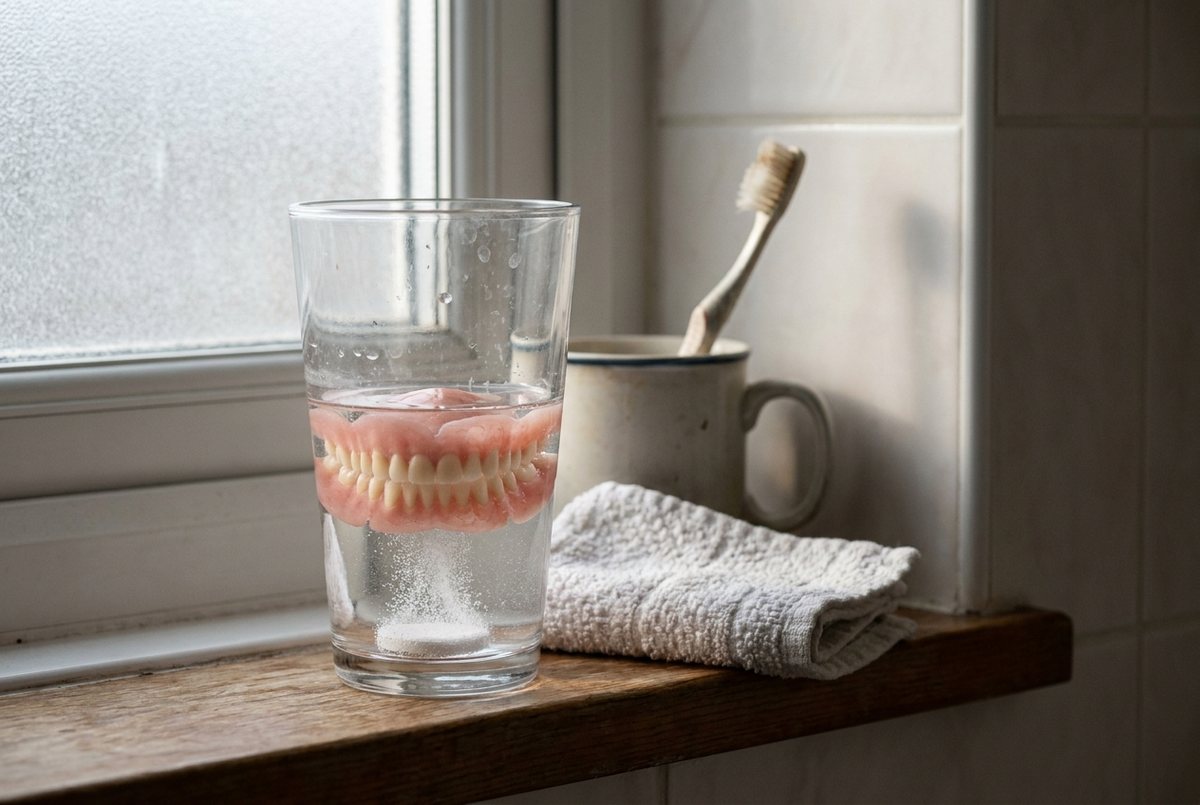
Yes, by anchoring them to implants. A snap-in overdenture clips onto implants but still lifts out for cleaning. A fixed bridge on four to six implants is screwed in and is not removed at home. In a 2023 meta-analysis of 28 studies, stability was the only measure rated significantly higher for fixed dentures than for removable implant dentures.
That 2023 meta-analysis included 1,457 patients and tracked how much their own ratings improved after treatment. Fixed and removable implant dentures both produced large improvements, with no significant difference overall. For lower-jaw overdentures, a second implant added a significant improvement over a single one. The authors concluded that implant treatment helps whatever the type of prosthesis, and that fixed bridges may be preferable if high stability matters most to you.
For fixed bridges on four implants, an overview of eight systematic reviews, published between 2013 and 2021, reported cumulative survival rates of 94.8 to 99.3 percent for the All-On-4 approach, with mean bone loss around the implants of 1.1 to 1.5 mm. None found it significantly worse than designs with more implants. Most of those reviews had a high risk of bias, so treat the figures as encouraging, not settled. Our guide to All-On-4 vs All-On-6 explains how the choice is made.
Fixed does not have to mean months without teeth. For qualifying cases, ANEWU attaches a provisional fixed bridge on the day of surgery through its same-day smiles approach, and the final bridge is made after the implants have healed and is fitted to the same implants. Bone volume and bite decide who qualifies.
Are mini dental implants worth it?
They can be, mostly for holding a lower denture. Mini implants are under 3 mm wide. In two randomized trials, 89 to 98 percent of mini implants survived, against 99 to 100 percent of standard implants, but follow-up lasted only up to 12 months. In the upper jaw, one 2021 review put mini implant survival at 77.1 percent.
ANEWU's mini implant dentures page describes narrow implants that snap onto your denture, often placed with a less invasive procedure than standard implants, and able to suit some ridges that are too thin for standard ones. The denture still comes out for cleaning. A 3D scan, not a phone call, settles whether your ridge can hold them.
The lower-jaw survival figures come from two of the five randomized trials in a 2024 meta-analysis, whose authors called for trials lasting at least five years. The upper-jaw review, from 2021, pooled six studies of 173 people followed for 1.79 years on average. Its 77.1 percent figure carried a wide margin of error (64.7 to 89.5 percent), and its authors found survival lower than values reported for traditional implants. Participants in all of those studies reported better quality of life and satisfaction, so mini implants can help, but their long-term odds are less well known.
How long do dental implants last compared with dentures?
A 2019 systematic review of 18 prospective studies estimated that 96.4 percent of modern implants were still in place after 10 years. A more cautious analysis that accounted for patients lost to follow-up put it at 93.2 percent. Dentures do not fail the same way. Your mouth changes, and they may need adjusting or replacing over time.
The 2019 systematic review also suggested that the risk of implant loss may double at age 65 and over. Implants need care too. A 2022 meta-analysis of 57 articles found peri-implantitis, a destructive inflammation of the gum and bone around an implant, in 19.53 percent of patients, though estimates varied widely between studies, partly because definitions differ.
An NIH health topic notes that over time your mouth will change and you may need your dentures adjusted or replaced. With implants, the FDA says regularly cleaning the implant and surrounding teeth is very important for long-term success, and that you should tell your provider right away if an implant feels loose or painful.
Do dental implants stop the jawbone from shrinking?
The evidence is mixed. The FDA lists helping keep the jawbone from shrinking as a benefit of implants. But a 2020 meta-analysis found no significant difference in bone loss at the back of the lower jaw between two-implant overdentures and conventional dentures. Four-implant overdentures lost significantly less bone than two-implant ones.
The 2020 meta-analysis pooled seven two-arm studies, and the results varied a lot between them, so its authors called for well-designed randomized trials. Bone preservation is a fair thing to weigh, but it is not a promise that any implant denture will stop shrinkage.
Timing still matters. The FDA notes that tooth loss can bring rapid bone loss, and a change in bone volume can alter which treatment is possible later. The upper back jaw loses height quickly once the molars are gone. If you have been told you do not have enough bone, grafting or implants anchored in other bone may still work, as our guide to dental implants with bone loss explains.
What is the cheapest way to replace all teeth?
Among these options, a conventional denture costs the least up front, because it needs no implants. Implant treatment costs more: a 2021 review of economic studies found a lower two-implant overdenture cost two to three times as much as a conventional denture at the start, a gap that narrowed over time but did not close. ANEWU does not publish prices, because your figure depends on your case.
The 2021 review of economic studies cautions that its sources used a wide variety of methods, and the starting-cost ratio rests on two studies, one Canadian and one Swiss, so treat it as a sense of scale, not a quote. It also found it remains unclear whether the added health benefits outweigh the higher costs, which depends on how much you value comfort, chewing and confidence.
Dental insurance usually does not cover implant treatment, so payment is typically financing, monthly payments or a mix. ANEWU accepts CareCredit and Proceed Finance, can arrange a monthly payment plan before your procedure, and takes Visa, MasterCard and Discover. Approval for outside financing is the lender's decision. Our financing page lays out each option. Whatever you choose, six things move the number for an implant case:
- How many implants your jaw needs to support the restoration
- Whether any remaining teeth have to be removed first
- Whether bone grafting or a sinus procedure is needed before placement
- Which restoration is planned
- Whether one arch or both are being treated
- Whether any part of the work falls under your dental benefits
Who should choose dentures, and who should choose implants?
Implants suit people who are healthy enough for surgery, have enough bone or can rebuild it, and want a denture that stays put. Dentures suit people who want to avoid surgery, have a tighter budget, or already wear one that fits. The FDA names smoking and uncontrolled diabetes among the factors that may make implant problems more likely.
The FDA says your overall health helps decide whether you are a candidate and how long healing takes, which can run several months or longer. Untreated gum disease is also on its list of risks. None of this rules a treatment in or out on its own, and a well-made denture is not a failed plan. It is why a consultation starts with an exam and a 3D scan.
| Option | Often suits you if | Think twice if |
|---|---|---|
| Conventional denture | You want to avoid surgery, keep the upfront cost low, or your upper denture already fits | Your lower denture keeps slipping |
| Snap-in overdenture | A lower denture is loose and you are comfortable taking it out daily | You want nothing removable |
| Mini implant overdenture | Your ridge is thin and the denture is for the lower jaw | It is for the upper jaw, where one review put mini implant survival at 77.1 percent |
| Fixed full arch | You want high stability and your scan shows enough bone, or grafting is an option | You cannot have surgery, or may struggle to keep the area around the implants clean |
What happens at a consultation at ANEWU?
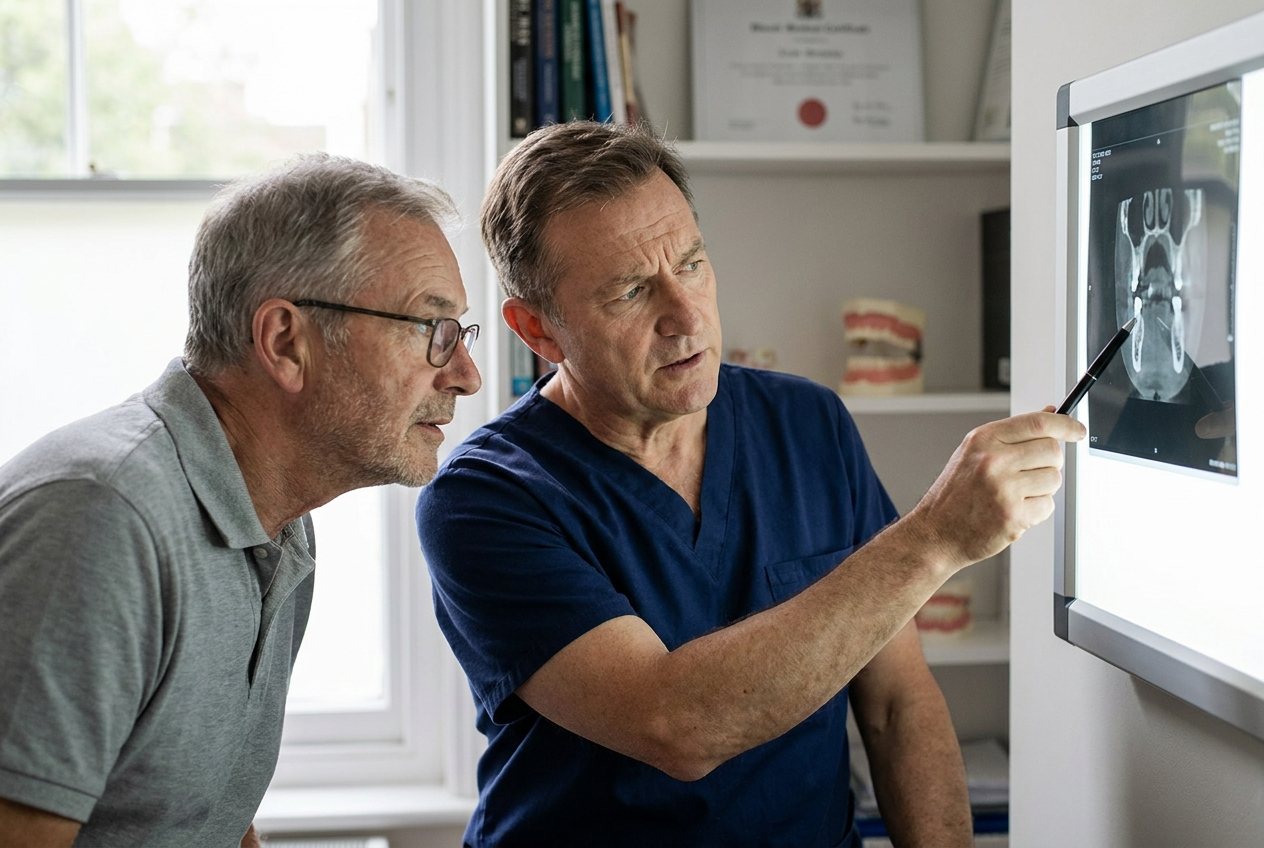
A free consultation has three parts: the front desk reviews your history, a 3D scan maps your jaw, and an oral surgeon examines you and explains your options in plain language. Your treatment plan and payment options are reviewed in the same visit. No treatment is performed that day.
Dr. Abtin Shahriari reviews your scan at the Buckhead, Cumming and Dawsonville offices. The implant count, any extractions and whether grafting is needed all come out of that scan. If you wear a denture now, ask whether it can be fitted with attachments, because that depends on its condition and how much the ridge underneath has changed. Alternatives worth considering are part of the conversation. You can book a free consultation whenever you are ready, and what to expect at your first visit lists what to bring.
Sources and further reading
- Evaluation of the quality of life and satisfaction in patients using complete dentures versus mandibular overdentures. Systematic review and meta-analysis Clinical and Experimental Dental Research, 2021
- Are patient-reported outcomes improved by implant-assisted maxillary prostheses compared to conventional maxillary dentures? A systematic review Journal of Dentistry, 2025
- Treatment effect of implant-supported fixed complete dentures and implant overdentures on patient-reported outcomes: A systematic review and meta-analysis Clinical Oral Implants Research, 2023
- Rehabilitation of edentulous jaws using the All-on-Four treatment concept: an overview of systematic reviews Oral and Maxillofacial Surgery, 2025
- Retention of Mandibular Complete Overdentures using Mini Dental Implants and Standard Diameter Implants: A Systematic Review and Meta-Analysis of Randomised Controlled Trials Oral Health and Preventive Dentistry, 2024
- Mini-Implant-Retained Overdentures for the Rehabilitation of Completely Edentulous Maxillae: A Systematic Review and Meta-Analysis International Journal of Environmental Research and Public Health, 2021
- Long-term (10-year) dental implant survival: A systematic review and sensitivity meta-analysis Journal of Dentistry, 2019
- What is the prevalence of peri-implantitis? A systematic review and meta-analysis BMC Oral Health, 2022
- Bone Loss in the Posterior Edentulous Mandible with Implant-Supported Overdentures vs Complete Dentures: A Systematic Review and Meta-Analysis International Journal of Prosthodontics, 2020
- What is the evidence on the added value of implant-supported overdentures? A review Clinical Implant Dentistry and Related Research, 2021
- Dental Implants: What You Should Know U.S. Food and Drug Administration, content current as of October 2021
- Dentures MedlinePlus, National Library of Medicine (NIH), accessed October 2026
This article is general information about dental and facial procedures, not a diagnosis or medical advice. Every jaw and every health history is different, so the right plan for you can only be set after an exam and imaging with a surgeon.