










Short answer
All-On-4 anchors a full fixed arch on four implants, angling the back two to use bone that is already present. All-On-6 uses six, spreading load across more points. The choice is driven by how much bone the jaw has and how it is distributed, not by preference.
What does the number actually refer to?
The number is how many implants carry the bridge. Four or six posts are placed into the jaw, then one fixed bridge spans the whole arch on top. In both cases the patient ends up with a full set of fixed teeth on that jaw, not a removable denture.
Because the bridge is fixed, it stays in place for cleaning and eating rather than coming out at night.
Read more about All-On-4.
Read more about All-On-6.
Am I a candidate for All-On-4 or All-On-6?
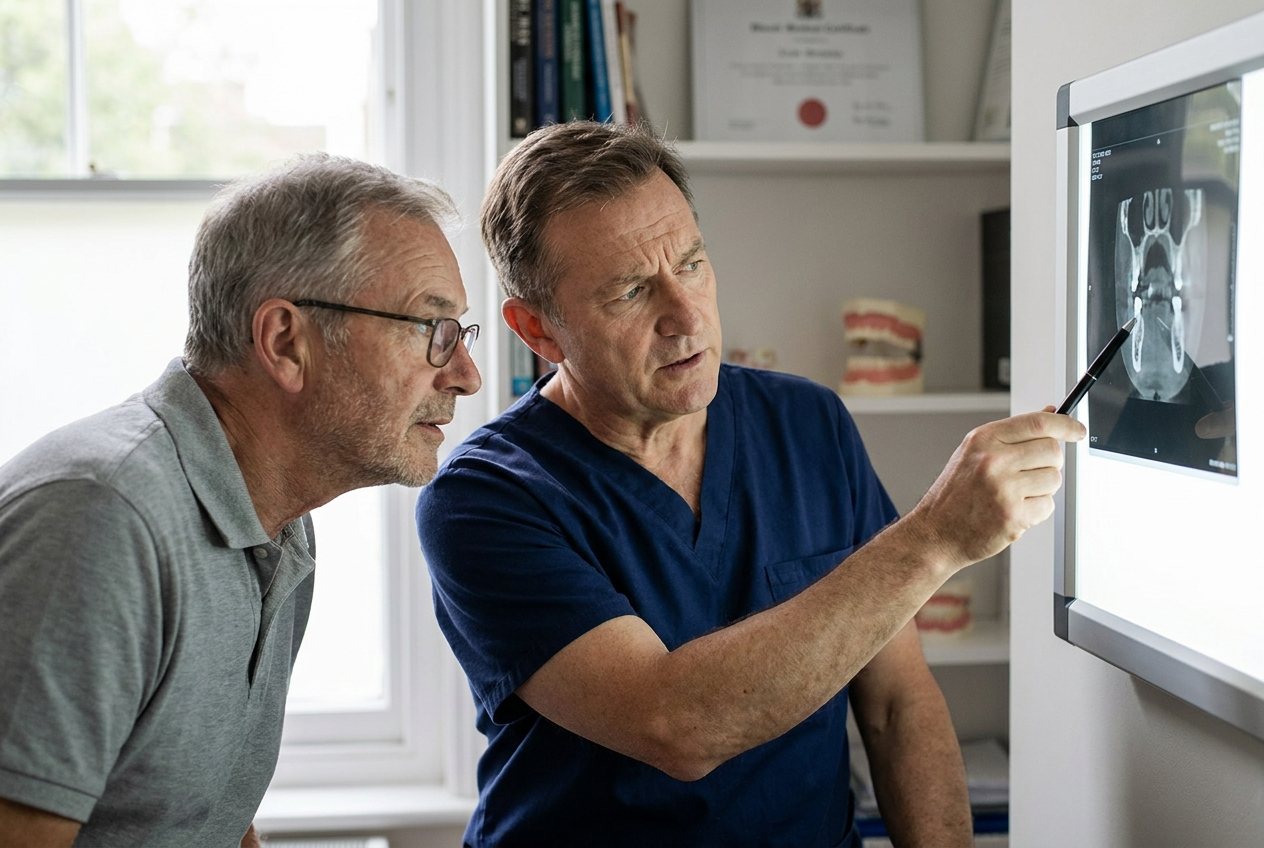
Candidacy comes down to bone volume and bone quality, which a 3D scan shows directly. Jaws with reasonable bone in the front and some loss at the back often suit All-On-4 because the rear implants can be angled. Jaws with more even bone across the arch may take six.
Neither option is a consolation prize. They are two answers to two different jaws.
Read more about 3D imaging and guided surgery.
What if I have been told I do not have enough bone?
That is common and it rarely ends the conversation. Options include grafting to rebuild the site first, or techniques that anchor into bone further back such as zygomatic or pterygoid implants. A scan is what separates a genuine no from a not this way.
A second opinion is worth having here, because what one practice cannot do with the bone available is sometimes a matter of technique rather than biology.
Read more about zygomatic implants.
Read more about pterygoid implants.
Does more implants mean a better result?
Not by itself. Six implants placed into poor bone are not better than four placed into good bone where the load is planned properly. What matters is how the load spreads across the jaw and whether each implant sits in bone that can hold it.
Planning is done from the scan before surgery, so the number is an output of the plan rather than a starting decision.
How long does the whole process take?
A provisional fixed bridge usually goes in the same day or the next morning, so patients do not leave without teeth. The final restoration comes several months later, after the implants have integrated with the bone, across a small number of visits.
The waiting period is biological rather than administrative. Bone needs time to grow around the implant surface.
Read more about same day smiles.