








Short answer
Clean an All-On-4 bridge in place every day. Brush all surfaces and the gum line at least twice a day, and clean under and between the teeth with interdental brushes, floss or a water flosser, as your team shows you. You do not take the bridge out at home. The American College of Prosthodontists advises professional checkups every 2 to 6 months, set by your risk, so inflammation is caught early.
How do I clean my All-On-4 dental implants?
Clean the bridge where it sits, every day, and give the gum line around and under it the same attention as the teeth you can see. The American College of Prosthodontists advises brushing at least twice daily plus floss, interdental cleaners and a water irrigator. Your surgeon's written instructions come first, and your team should show you the technique on your own bridge.
At ANEWU the All-On-4 bridge is fixed to the implants and stays in place, so you clean it in your mouth rather than taking it out at night. The Scottish Dental Clinical Effectiveness Programme says patients with an implant-supported bridge need personalised training in oral hygiene, using tools such as interdental brushes, single tufted brushes and floss, plus toothbrushing at the cervical/mucosal edge of the restoration, the line where the bridge meets the gum. The prosthodontists add that the bridge itself should have hygienic contours and sections between implants that can be cleaned. Here is a daily routine built on that guidance; step 5 is our own addition. It is for upkeep, not for gums that are already red, swollen or producing pus, which need an exam.
- Step 1, morning: brush the outer, inner and chewing surfaces of the bridge, then brush along the edge where the bridge meets the gum.
- Step 2: clean between the teeth and under the bridge with the interdental brush or floss your team chose, without forcing floss below the gum edge.
- Step 3: if your team recommends a water flosser, use it along the gum line and under the bridge as they showed you.
- Step 4, evening: brush again, and repeat step 2 or 3 if your team advises it.
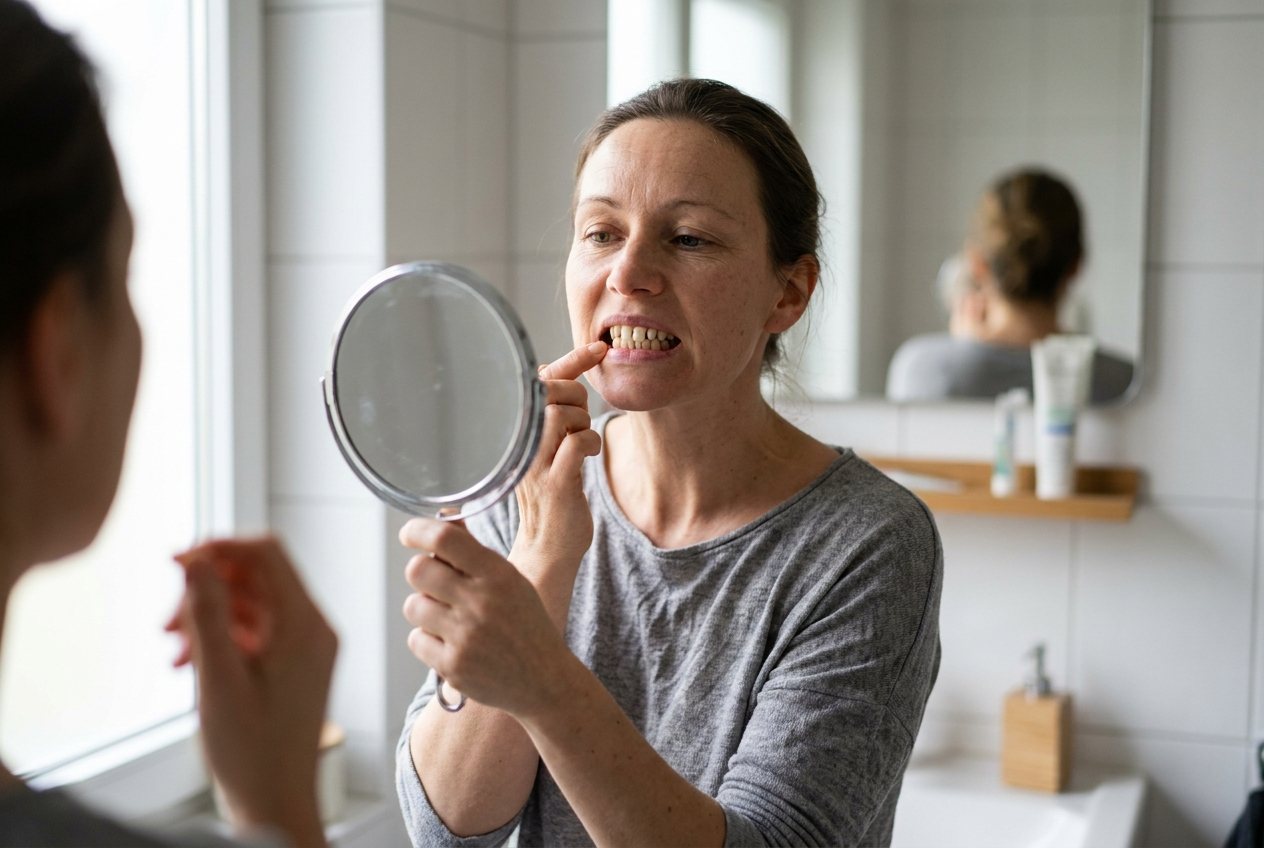
- Step 5: check your gums in a mirror. Redness, swelling, bleeding or pus is a reason to call the office.
- Step 6, every few months: keep your maintenance visits so your team can check the tissue and the bridge.
Video transcript
A silent animation in five steps for cleaning a fixed bridge on implants. Step 1: brush the bridge and along the gum edge. Step 2: clean between the teeth and under the bridge with the tools your team chose. Step 3: use a water flosser if your team recommends one. Step 4: if you see redness, swelling or bleeding, call the office. Step 5: keep your maintenance visits. Your surgeon's written instructions come first.
What should you clean dental implants with?
Use a toothbrush plus one interdental tool that fits your restoration, such as an interdental brush, floss or a water flosser. Research has not settled on a single winner. A 2025 systematic review of six studies found every interproximal device helped to some degree, but called the evidence limited. Your team chooses the tool for the shape of your gums and restoration.
That review covered people with peri-implant mucositis. Oral irrigators and interdental brushes did slightly better than floss, but not by a statistically significant margin, and adding a water irrigator to toothbrushing did not significantly change bleeding or plaque in the two studies that could be pooled. Most of its trials involved implants with single crowns, and it found no data on other restoration types, so it says little about a full-arch bridge. A 2024 crossover trial of 40 people with peri-implant mucositis tried interdental brushes and floss for 14 days each. Both lowered plaque and gum inflammation, interdental brushes removed plaque more effectively whatever a person's manual dexterity, and floss seemed to do better only in people with good dexterity.
The Scottish guidance leaves the choice to the clinical team: the right interdental aid depends on the soft tissue contour around the restoration and access to its margins. Interdental brushes should fit snugly without the wire rubbing against the restoration, and rechargeable powered toothbrushes may help anyone who cannot clean well by hand. Choose the tool you can use correctly each day.
Is it hard to keep dental implants clean?
It takes a daily routine, and a fixed bridge is cleaned in your mouth because you do not take it out. The FDA lists difficulty cleaning the gums around the implant among the risks of dental implants. Plaque matters because it drives gum inflammation: a 2025 AO/AAP systematic review of 102 studies found peri-implant mucositis in 46% of patients with implants and peri-implantitis in 21%.
Peri-implant mucositis is inflammation of the gum around an implant, and its main sign is bleeding on gentle probing. A 2018 consensus report found strong evidence that plaque is its cause. Peri-implantitis adds progressive loss of the bone that supports the implant. The American College of Prosthodontists describes mucositis as a reversible inflammatory process in the soft tissues.
For full-arch restorations specifically, a 2021 systematic review of 18 trials and prospective studies found peri-implantitis in 1.5% to 29.7% of fully edentulous patients, depending on the study, and concluded that edentulous patients with fixed or removable restorations were frequently affected. The spread is wide, so treat any single percentage as a rough guide. Our failure rate overview covers implant loss separately.
How often do you need professional cleanings and checkups?
The American College of Prosthodontists says in-office implant maintenance visits should be scheduled every 2 to 6 months, based on your risk profile, such as smoking, past gum disease, other health conditions, or limited vision and dexterity. A 2016 meta-analysis of 13 clinical trials suggested recall visits at least every 5 to 6 months. Your care team sets the schedule for you.
The College says professional maintenance includes examining the tissue around each implant for redness, swelling, bleeding on probing and pus, and checking for plaque and calculus, with x-rays retaken once every 1 to 2 years or whenever infection is suspected. The European Federation of Periodontology's 2023 guideline also recommends individually tailored oral hygiene instructions, and regular supportive care for people whose implant tissue is healthy.
Skipping visits has a measurable cost, with limits on how far the data go. In an 11-year prospective study of 80 partially edentulous people, 51 stayed in a maintenance program. Among the 24 who attended irregularly, 70.8% developed peri-implant mucositis and 37.5% developed peri-implantitis, against 37.0% and 11.1% among the 27 who attended regularly. The sample was small, all of it partially edentulous rather than full-arch, and the study cannot prove that missed visits alone caused the gap. Even with maintenance, the 2016 meta-analysis noted, complications can occur.
How often is an All-On-4 bridge removed for cleaning?
Usually not at routine visits. The American College of Prosthodontists discourages removing a full-arch implant bridge at regular maintenance intervals, and says removal is not needed unless there are signs of peri-implantitis, the bridge cannot be kept clean, or a mechanical problem requires it. Designs and clinicians vary, so ask your surgeon what to expect for your own bridge.
That position covers fixed, screw-retained bridges. Taking one off has costs: the College says that once the bridge is assembled, tightening screws at recall visits is inappropriate and may reduce the stability of the connection, and that frequent screw replacement to prevent problems may lead to more severe mechanical complications. If the bridge is working and free of mechanical complications, it says there is no indication to remove it.
ANEWU describes its bridge as fixed and not removed for cleaning, and the team shows you the cleaning technique at your follow-up. As the College notes, removal can still be needed for a mechanical problem or signs of infection, so ask. Questions to ask your surgeon about upkeep:
- Which tools fit my bridge, and can you watch me use them at my follow-up?
- How often will I be seen for maintenance, and what does each visit include?
- Is my bridge screw-retained, and when would you remove it?
- What is the final bridge made of, and does that change how I clean it?
- Which signs mean I should call the same day?
- How do smoking, gum disease, diabetes or night grinding change my schedule?
What are the early signs of a problem with a dental implant?
Red or swollen gums, bleeding when you clean, pus, an implant or bridge that feels loose, or pain are all reasons to call. The 2018 World Workshop consensus names bleeding on gentle probing as the main sign of peri-implant mucositis, with redness, swelling or pus possible. Peri-implantitis adds deeper pockets, a receding gum line and bone loss on x-ray.
Do not wait for pain before you call. The FDA says to tell your dental provider right away if an implant feels loose or painful, but the consensus criteria also rest on findings, such as deeper pockets and bone loss on x-ray, that only an examination can measure. Bleeding when you clean is not the same test as a clinician's probe, but it is a sign you can see at home. The FDA notes complications can occur soon after placement or much later.
ANEWU's post-op page tells surgical patients to call (470) 567-6415 right away for uncontrolled bleeding, severe swelling, difficulty breathing or swallowing, or a reaction to medication, and to call during office hours if pain, swelling or bleeding increases after the first day or two. The offices are open Monday to Saturday, 7am to 5pm.
Can peri-implantitis be treated successfully?
Often it can be controlled, but it is not reliably resolved. A 2025 review of 17 studies that followed surgically treated patients for at least five years found a mean disease resolution rate of 58.6%, retreatment in 27.2% of cases and a mean implant survival of 88.6%. Results were less predictable when bone loss was advanced, which is why early reporting matters.
That review pooled no numbers because the 17 studies differed too much, so read the averages as rough guides. It reported that progressive bone loss of more than 1 mm was arrested in a mean of 69.6% of cases, and that the odds of recurrence were about eight times higher when residual pathogenic pockets remained after surgery.
The EFP guideline also covers what happens afterward: it suggests supportive visits every 3 to 4 months for the first 12 months after treatment, then tailored to you, and recommends cleaning methods that you demonstrate to your clinician and have reinforced over time. For people planning implants, its risk-profile checklist includes blood sugar control in diabetes, quitting smoking, regular supportive care, oral hygiene, and reducing teeth grinding or clenching. Which treatment you need, from professional cleaning to surgery, depends on how far the disease has gone, and your surgeon makes that call.
What does caring for implants look like at ANEWU?
At ANEWU, Dr. Abtin Shahriari performs every All-On-4 case, the bridge is fixed in place and cleaned in your mouth, and the team shows you the technique at your follow-up. You go home with written aftercare instructions, and the offices ask you to call with any question before assuming something is wrong. The first consultation is free and includes a 3D scan.
Treatment runs in order: a consultation with 3D imaging, a written plan that sets the implant count, implant placement in one outpatient visit, then the final bridge after healing. For qualifying cases a temporary bridge is attached the day of surgery. That bridge is provisional, and the final bridge is made in the on-site lab after healing. Follow-up visits are scheduled around how the site is expected to heal, and because records move between the Buckhead, Cumming and Dawsonville offices, follow-up can happen at whichever address is closer. All-On-4 is not for every jaw: ANEWU's All-On-4 page says some jaws lack the bone volume for four implants, and the 3D scan settles it.
For the early weeks, the post-op page gives general guidance, and the sheet your team gave you takes priority if the two differ. Smoking is one habit with outside evidence behind it. The FDA says it may affect healing and decrease long-term success, and the 2025 AO/AAP review found that periodontitis and smoking were risk indicators for both mucositis and peri-implantitis, though it could identify only risk indicators, not proven causes. To have a surgeon look at your own situation, book a free consultation.
Sources and further reading
- Maintenance of Full-Arch Implant Restorations American College of Prosthodontists, position statement, revised August 2023
- Recommendations for the prevention of peri-implant diseases (graphic summary of the EFP S3 clinical practice guideline) European Federation of Periodontology, adapted from Herrera et al., Journal of Clinical Periodontology, 2023
- Dental Implants: What You Should Know U.S. Food and Drug Administration, content current as of 10/29/2021
- Implant oral hygiene Scottish Dental Clinical Effectiveness Programme, periodontal care guidance, accessed October 2026
- Peri-implant diseases and conditions: Consensus report of workgroup 4 of the 2017 World Workshop on the Classification of Periodontal and Peri-Implant Diseases and Conditions Journal of Clinical Periodontology, 2018
- Prevalence, incidence, systemic, behavioral, and patient-related risk factors and indicators for peri-implant diseases: An AO/AAP systematic review and meta-analysis Journal of Periodontology, 2025
- Prevalence of Peri-implant Diseases in Patients with Full-Arch Implant-Supported Restorations: A Systematic Review International Journal of Prosthodontics, 2021
- Impact of Maintenance Therapy for the Prevention of Peri-implant Diseases: A Systematic Review and Meta-analysis Journal of Dental Research, 2016
- Long-term impact of patients' compliance to peri-implant maintenance therapy on the incidence of peri-implant diseases: An 11-year prospective follow-up clinical study Clinical Implant Dentistry and Related Research, 2023
- Optimizing implant hygiene: the added value of interproximal cleaning devices around implant-supported restorations-a systematic review and meta-analysis International Journal of Implant Dentistry, 2025
- Evaluation of the efficacy of inter-dental brush and dental floss for peri-implant mucositis: A crossover randomized clinical trial International Journal of Dental Hygiene, 2024
- Long-term surgical treatment outcomes of peri-implantitis Periodontology 2000, 2025
This article is general information about dental and facial procedures, not a diagnosis or medical advice. Every jaw and every health history is different, so the right plan for you can only be set after an exam and imaging with a surgeon.