









Short answer
The main downsides of All-On-4 are upkeep, repairs and risk. The bridge needs careful daily cleaning and regular checkups, its teeth can chip or loosen and need repair, and an implant can be lost. A 2022 meta-analysis of full-arch bridges on tilted and straight implants, followed for 3 to 18 years, found 93.91% of implants and 99.31% of bridges survived. Removing remaining teeth cannot be undone.
What are the downsides of All-On-4 dental implants?
The main downsides are the daily cleaning effort, repairs to the bridge over the years, a small chance of losing an implant, and limits on who qualifies. The surgery also cannot be undone, because the remaining teeth in that arch are removed. These trade-offs are real, and they are easier to plan around when you know them in advance.
Ask for the evidence behind any claim, including the ones here. A 2017 systematic review of 24 studies on the technique called the evidence limited, citing thin information on study quality, short follow-up and patients dropping out. Two long-term retrospective series from 2019 lost 20.4% of upper-arch patients and 31.6% of lower-arch patients to follow-up. Missing patients make long-term results harder to judge.
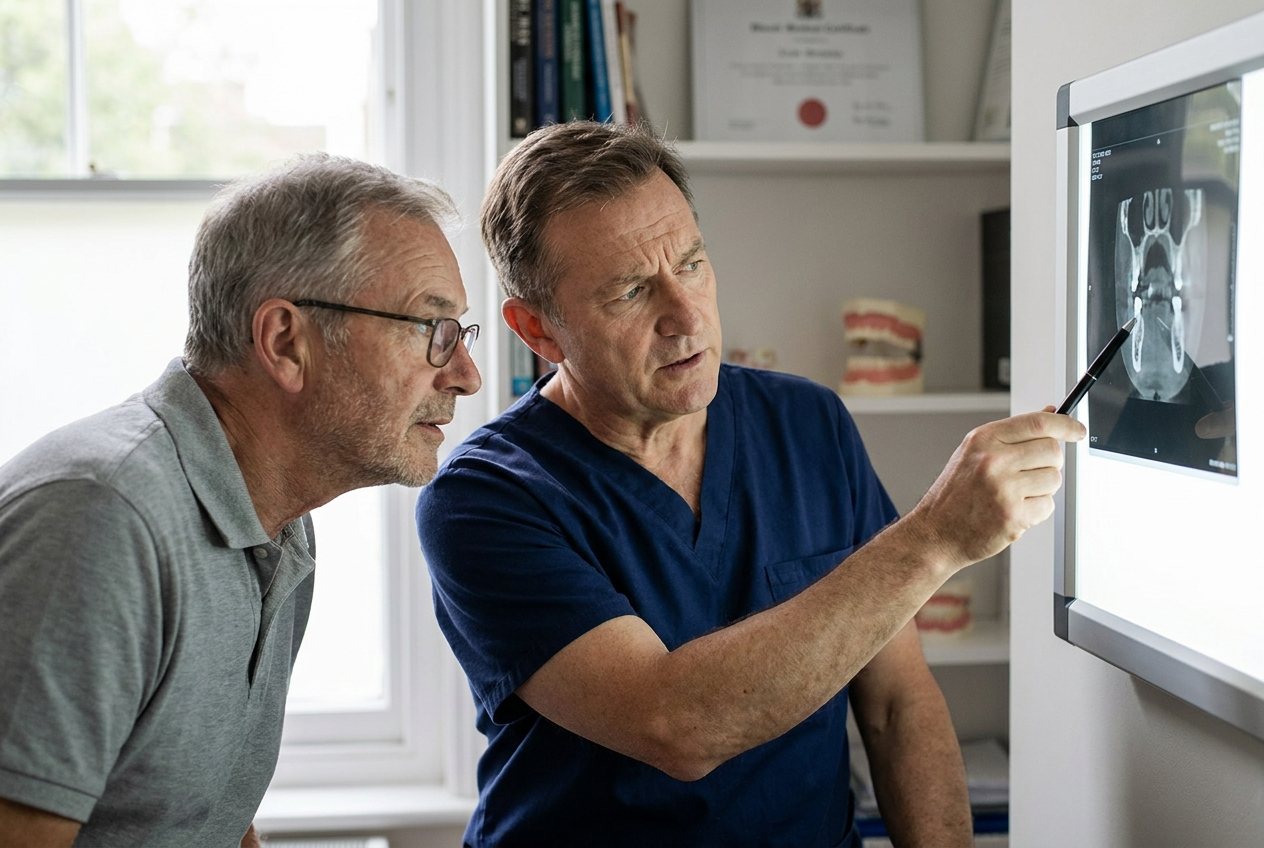
At ANEWU, every All-On-4 case is performed by Dr. Abtin Shahriari, and any remaining teeth in the arch are removed when the four implants are placed in a single outpatient visit. Once those teeth are gone, there is no going back to them in that arch. Planning happens before surgery day from a 3D scan, and the back two implants are usually angled to use the bone that is already there.
| What you gain | What you take on |
|---|---|
| Fixed teeth that stay in, with no removing them at night | Daily cleaning around and under the bridge, plus regular professional checkups |
| A route that can avoid bone grafting for some jaws | Possible repairs to the acrylic or ceramic teeth over the years |
| Provisional teeth on surgery day for qualifying cases, with the final bridge after healing | A healing period, with repair visits possible, before the final bridge |
| Survival of 93.91% of implants and 99.31% of bridges over 3 to 18 years in a 2022 meta-analysis of full-arch bridges | A small chance of losing an implant, or of gum disease around one |
Does food get under All-On-4 implants, and is the bridge hard to clean?
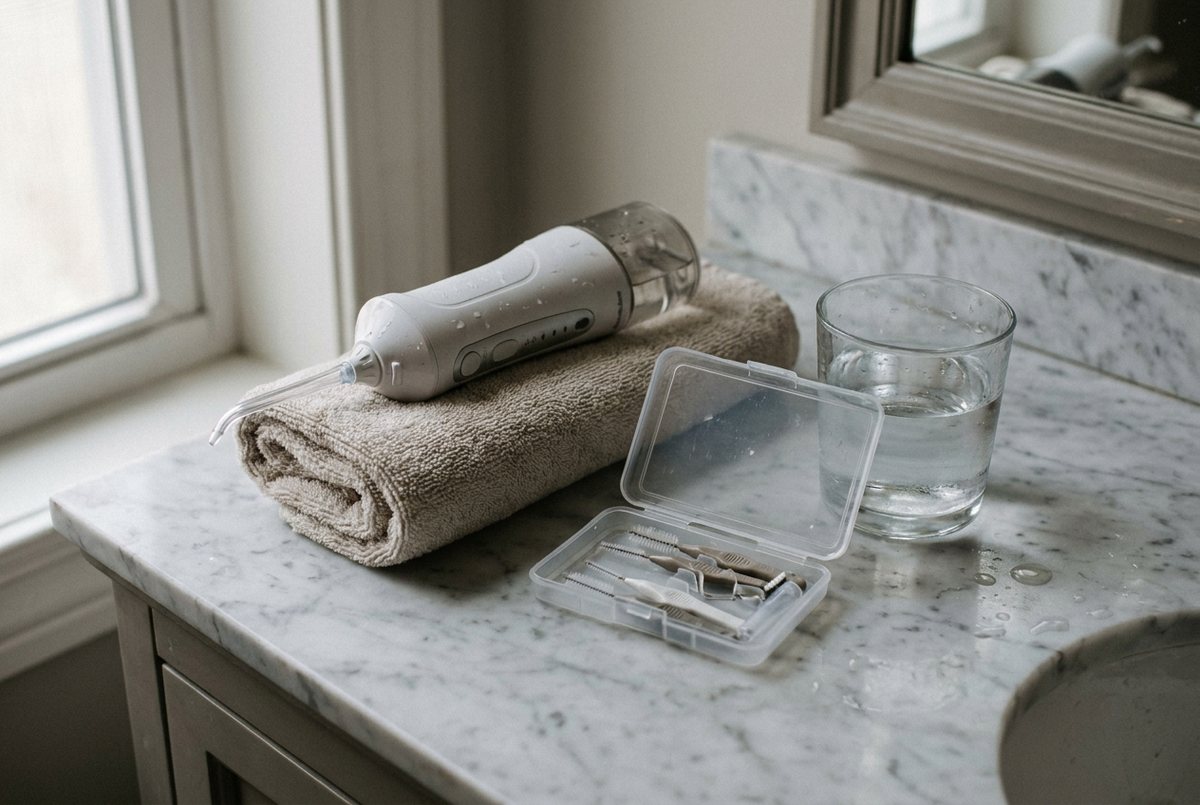
Yes, food can collect around and under a fixed bridge, so cleaning takes a daily routine. Prosthodontist guidance advises brushing at least twice a day plus floss, interdental cleaners and a water irrigator, with professional checkups every 2 to 6 months based on your risk. Plaque control is the main way to limit inflammation around each implant.
A 2019 review of 15 articles described food impaction as a common risk factor for the start of inflammation around implants. The FDA lists difficulty cleaning around an implant, and the poor hygiene that follows, among the risks of dental implants. Design helps. The American College of Prosthodontists says the bridge needs hygienic contours and self-cleansable sections between implants, and a 2017 consensus report from a conference hosted by an implant manufacturer advised a non-concave underside that rests above the gum.
Poor cleaning matters because of peri-implantitis, which the College describes as inflammation around an implant that comes with loss of the bone around it. In the 2026 umbrella review of complete-arch bridges followed for at least 5 years, peri-implantitis prevalence ranged from 4% to 18%. At ANEWU the bridge stays fixed and you clean it in place, and the team shows you the technique at your follow-up. If you doubt you will manage that, ask about a removable option such as mini implant dentures.
How often do the teeth on an All-On-4 bridge chip, wear or need repair?
Repairs to the bridge are a common downside. A 2026 umbrella review of seven systematic reviews, each with at least 5 years of follow-up, reported screw loosening in 5% to 15% of cases, veneer chipping in 15% to 35% of veneered zirconia bridges, and framework fractures in under 5%. Prosthetic survival ranged from 89.5% to 96.8% over 5 to 15 years.
A 2019 case series of 471 lower-arch patients followed for 10 to 18 years reported an incidence of mechanical complications of 36.7%, and found the prosthetic material was linked to how often they occurred. In a 2020 study of 74 arches followed for an average of 8.7 years, prosthetic survival at 5 years was 93.7% for zirconia bridges and 83.0% for metal-acrylic bridges. Chipping or fracture of a single tooth was the most common minor problem in both groups.
So ask which material your final bridge uses, how a chipped tooth would be repaired, and what follow-up visits include. If you clench or grind your teeth, say so, because bridge design should account for those habits. A 2017 systematic review of the technique described repairing the bridge, adjusting the bite and wearing a night guard as the fixes for fractured acrylic teeth, and most authors in it reported that these mechanical problems did not affect implant or bridge survival.
What happens between the provisional bridge and the final bridge?
For qualifying cases, ANEWU attaches a provisional (temporary) fixed bridge on surgery day, and the final bridge is made after the implants heal. The provisional set tended to need repair more often than the final one. In a 2019 retrospective series of 1,072 patients with upper-arch bridges, the incidence of mechanical complications was 58.8% for provisional bridges and 7.3% for final bridges.
The provisional bridge is there to let you eat and speak while the bone heals, not to test hard or chewy food. That 2017 consensus report said it should be rigid and strong enough not to fracture, and should stay in place for at least six months. In a 2017 systematic review, 14 studies fitted the definitive bridge after 4 to 6 months. Your surgeon confirms the timeline for your case.
Expect soft food at first. In that same review, patients were advised to avoid foods that need significant chewing effort so the bridge was not overloaded, and a loose screw was resolved by retightening it and controlling the bite. Our full arch recovery timeline covers the first weeks in detail.
How long do All-On-4 implants last, and what happens if one fails?
Most stay in place for many years. A 2022 meta-analysis of 24 studies and 2,637 patients with full-arch bridges on tilted and straight implants found 93.91% of implants and 99.31% of bridges survived over 3 to 18 years, though 274 implants failed. The FDA notes that a failed implant can mean another procedure, so ask your surgeon how it would be handled in your case.
The jaw matters. In a Japanese series of 561 cases followed for up to 17 years, implant-level survival was 97.4% in the upper arch and 98.9% in the lower arch, and 94.4% of upper-arch patients and 96.7% of lower-arch patients kept every implant. The upper-arch implant figure was significantly lower. Two 2019 series reported implant survival of 94.7% for upper arches (up to 13 years) and 93.0% for lower arches (up to 18 years). In the meta-analysis, marginal bone loss, the bone lost around the top of the implant, was significantly lower for straight implants than for angled ones (P < .0001), though the average change was moderate, exceeding 2 mm in only two studies.
These studies count bridge survival separately, and it is higher than implant survival: 99.31% against 93.91% in the meta-analysis, and 98.8% against 93.0% in the lower-arch series. The abstracts do not say how each lost implant was handled, so this article cannot give you a figure for that. ANEWU's All-On-6 page lists added redundancy if one implant ever needs attention as one reason a case may get six implants.
Who is not a good candidate for All-On-4?
All-On-4 fits poorly when the jaw lacks the bone for four implants, when health or smoking raises the risk of poor healing, or when you want teeth you can remove to clean. A 3D scan settles the bone question. At ANEWU, Dr. Abtin Shahriari confirms candidacy from that scan at a free consultation.
Bone is the first limit. That same 2017 consensus report says the technique needs enough bone to place four implants, between the sinuses in the upper jaw and between the nerve exits in the lower jaw, plus 12 mm of room for the bridge. It also says immediate loading calls for implants that reach an insertion torque above 35 Ncm, a measure of how firmly each implant sits in the bone. ANEWU says same-day provisional teeth, with the final bridge made after healing, are available for qualifying cases, not all of them. If bone is short, ANEWU describes bone grafting, zygomatic implants and pterygoid implants as the routes.
Health and habits come next. The FDA says your overall health affects whether you are a good candidate, that smoking may slow healing and lower long-term success, and that infection may be more likely with uncontrolled diabetes. In the 2019 upper-arch series, smoking was linked to a higher risk of implant failure (hazard ratio 1.94). The American College of Prosthodontists also lists gum disease history and limited vision or dexterity as factors that shape how often you are seen. Tell your surgeon about all of it.
Is All-On-4 worth it compared with dentures or other options?
For many people it is, but it depends on what you value. A 2026 systematic review of 11 studies on fixed upper-arch bridges, looking at outcomes by number of implants, found improved quality of life, mild postoperative symptoms and increased satisfaction. It also described the evidence linking those results to the number of implants as limited. If easy cleaning matters most, a removable option may fit better.
Treat those satisfaction findings as encouraging, not settled. In that review, randomized trials showed low to high risk of bias and prospective studies showed moderate to serious risk. A traditional denture, by comparison, is removable, often relies on adhesive, and sits on a jawbone that continues to shrink, according to ANEWU.
Cost is the other half of the decision. ANEWU accepts CareCredit and Proceed Finance and can arrange a monthly payment plan before your procedure, so review the financing options early. If you want your own answer, you can book a free consultation, where a 3D scan shows which route fits your jaw.
- A fixed bridge fits if you want teeth that stay in, will commit to daily cleaning and checkups, and your scan shows enough bone.
- Mini implant dentures fit if you want teeth you can take out to clean, or your bone is limited.
- Bone grafting or zygomatic implants are the routes to ask about if the scan shows too little bone for standard placement.
Sources and further reading
- Prosthetic complications of implant-supported complete arch prostheses: An umbrella review of systematic reviews The Journal of Prosthetic Dentistry, 2026
- Outcomes of Fixed Full-Arch Rehabilitations Supported by Tilted and Axially Placed Implants: A Systematic Review and Meta-Analysis The International Journal of Oral & Maxillofacial Implants, 2022
- The All-on-4 concept for full-arch rehabilitation of the edentulous maxillae: A longitudinal study with 5-13 years of follow-up Clinical Implant Dentistry and Related Research, 2019
- The All-on-4 treatment concept for the rehabilitation of the completely edentulous mandible: A longitudinal study with 10 to 18 years of follow-up Clinical Implant Dentistry and Related Research, 2019
- The All-on-four concept for fixed full-arch rehabilitation of the edentulous maxilla and mandible: a longitudinal study in Japanese patients with 3-17-year follow-up and analysis of risk factors for survival rate International Journal of Implant Dentistry, 2023
- The all-on-four treatment concept: Systematic review Journal of Clinical and Experimental Dentistry, 2017
- Consensus statements and clinical recommendations on treatment indications, surgical procedures, prosthetic protocols and complications following All-On-4 standard treatment (9th Mozo-Grau Ticare Conference) Journal of Clinical and Experimental Dentistry, 2017
- Patient- and Clinician-Reported Outcomes and Outcome Measures Evaluating Maxillary Full Arch Fixed Prostheses Supported by Different Numbers of Implants: A Systematic Review Clinical Oral Implants Research, 2026
- Long-term Clinical Outcomes and Cost-Effectiveness of Full-Arch Implant-Supported Zirconia-Based and Metal-Acrylic Fixed Dental Prostheses: A Retrospective Analysis The International Journal of Oral & Maxillofacial Implants, 2020
- Maintenance of Full-Arch Implant Restorations (position statement) American College of Prosthodontists, revised 2023
- Dental Implants: What You Should Know U.S. Food and Drug Administration, content current as of 10/29/2021
- Etiology and classification of food impaction around implants and implant-retained prosthesis Clinical Implant Dentistry and Related Research, 2019
This article is general information about dental and facial procedures, not a diagnosis or medical advice. Every jaw and every health history is different, so the right plan for you can only be set after an exam and imaging with a surgeon.