










Short answer
Yes, a missing front tooth can be replaced with an implant, and the front is where planning matters most. A 2014 systematic review in the International Journal of Oral and Maxillofacial Implants found gum recession over 1 mm at a median 26 percent of upper front and premolar implants placed on the day of extraction, so timing, gum thickness and the bone wall shape how natural it looks.
Can front teeth have implants?
Front teeth can have implants, and the steps are the same as for any implant, with two extra concerns: the gum line shows when you smile, and you need a temporary tooth while it heals. Cleveland Clinic notes that for implants near the front of the mouth a temporary tooth is made to wear until you heal.
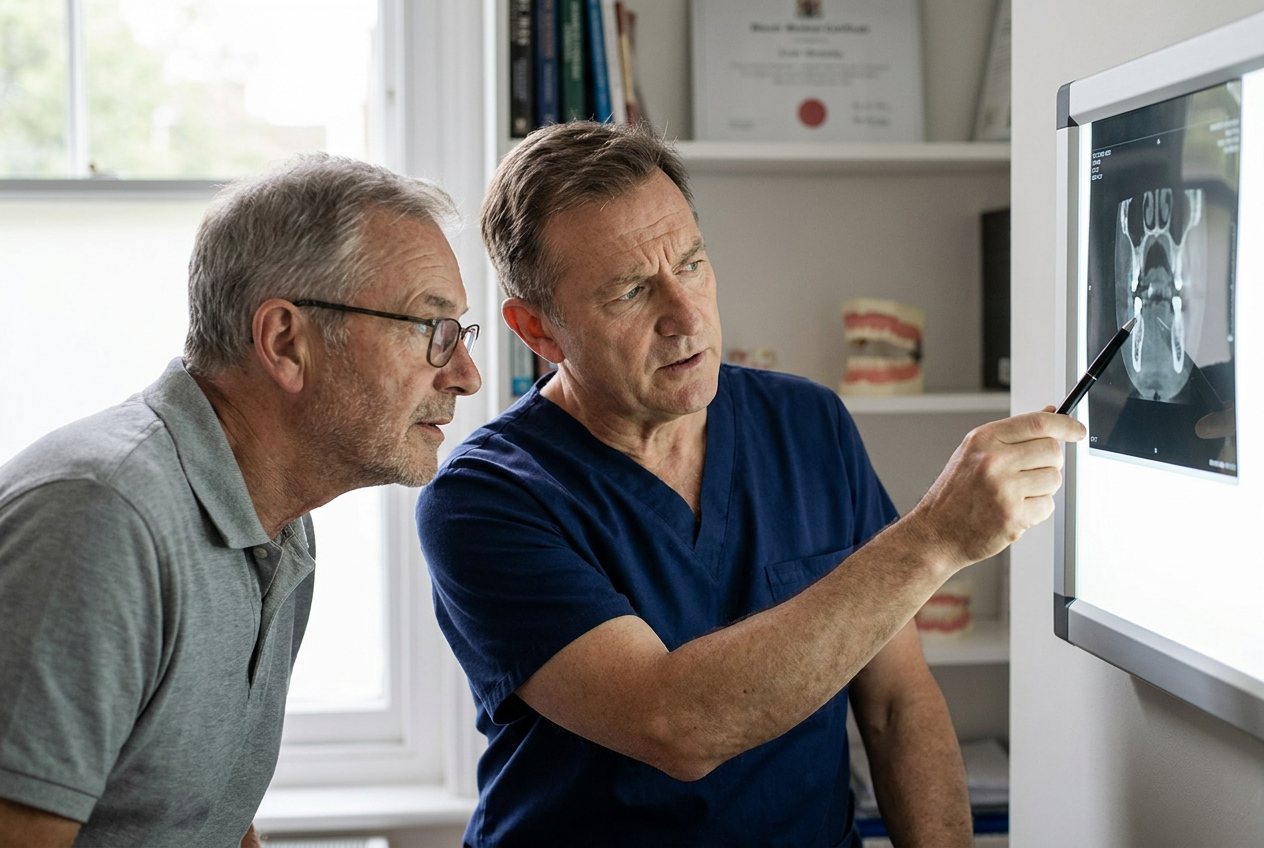
The esthetic zone is the part of the mouth that shows when you talk and smile, usually the upper front teeth. A 2017 review in Periodontology 2000 describes how attention in implant dentistry shifted toward esthetic outcomes in this zone after several studies showed a significant risk of gum recession with immediate implants, and it recommends choosing among the timing options from a preoperative analysis that includes a 3D cone beam CT scan.
That means more decisions than for a molar. Your surgeon looks at how thick your gum is, whether the thin plate of bone over the root is intact, and how much the gum shows when you smile, and then chooses the timing and the temporary tooth around those findings.
- 1. Consultation and 3D scan of the front of the jaw.
- 2. Extraction, with the implant placed the same day, or a socket graft and a wait.
- 3. A temporary tooth to cover the gap from day one.
- 4. Healing while bone fuses to the implant.
- 5. A provisional crown on the implant, often used to shape the gum.
- 6. The final crown, matched to the neighbouring teeth.
How can I cover my missing tooth while waiting for the implant?
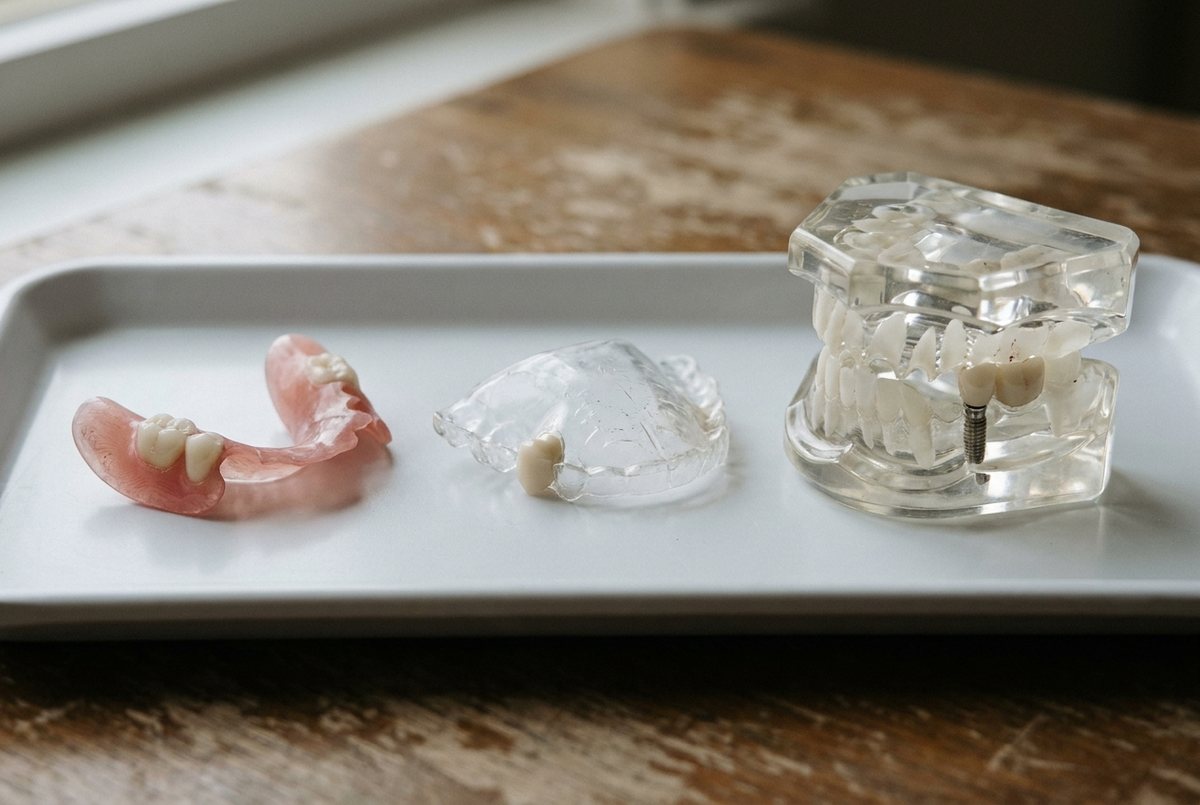
A missing front tooth is usually covered with one of four temporaries: a removable flipper, a clear retainer with a tooth, a temporary bridge bonded to the neighbouring teeth, or a provisional crown on the implant itself. A 2026 narrative review of temporary prostheses compares them by cost, comfort and how much each risks pressing on the healing site.
A flipper is a small removable plate that carries a replacement tooth. You can usually wear one while waiting for an implant, as long as it is trimmed so it does not rest on the incision or graft. The review notes that removable options can rub on the surgical site and compromise a graft if they press on it. Which temporary suits you is decided by your surgeon for your case.
Properly shaped provisionals also do a second job. The same review found that provisional restorations shaped the emergence profile, the way the tooth appears to rise out of the gum, and the soft tissue around the implant.
| Temporary option | Pros | Cons | Who it usually suits |
|---|---|---|---|
| Flipper (removable partial denture) | Quick and inexpensive; easy to adjust | Can rub or press on the site; comfort and looks vary; removed to clean | Cover before and after surgery, and longer gaps; not ideal with a strong gag reflex or a graft needing strict protection |
| Clear retainer with a tooth (Essix type) | Low cost, quick, little or no work on other teeth | Wears quickly, limited chewing, collects plaque, does not shape the gum | Short-term cover, tight bites with little room |
| Bonded temporary bridge | Fixed in place; better function and looks; can shape the gum | Higher cost; needs suitable neighbouring teeth | Front teeth with healthy neighbours; people who want to avoid a removable piece |
| Provisional crown on the implant | Fixed and comfortable; shapes the gum around the tooth | Higher cost; only when the implant is firm enough | Implants that meet stability criteria at surgery |
Can a front tooth implant be done the same day as the extraction?
A front tooth implant can sometimes go in the same day as the extraction, but it carries more risk of gum recession than waiting a few weeks. The 2014 systematic review found recession of more than 1 mm at 9 to 41 percent of immediate front implant sites, median 26 percent, after 1 to 3 years, against none in two studies of early placement.
Early placement here means Type 2, at 4 to 8 weeks once the gum has closed, or Type 3, at 12 to 16 weeks with partial bone healing, as a 2025 review in the Journal of Clinical Medicine sets out. The 2014 review noted that recent studies of immediate placement limited it to people with a thick gum and an intact socket wall to reduce the esthetic risk, which is the selection your surgeon is making when the scan is read. For a full arch replaced on the day, see our article on same-day dental implants.
The evidence has limits. The 2014 review included 50 records, 33 of them case series, and the designs were too varied to pool. If an implant does go in on the day, any tooth attached is provisional and is kept out of heavy biting; the final crown is made after healing.
Do front tooth implants look natural?
Front tooth implants can look natural, and the gum and bone around them decide it as much as the crown. A 2022 systematic review of 34 studies in Clinical Oral Implants Research found thin gum tissue, under 2 mm, was linked to 0.62 mm more recession, and thicker tissue to more favourable esthetic results, though the evidence quality was very low.
Gum phenotype is the thickness of your gum tissue, and the facial bone wall is the thin plate of bone on the lip side of a front tooth root. Both matter. In two studies cited by the 2014 review, the facial bone wall could not be seen on cone beam CT at 36 and 57 percent of grafted immediate implant sites, and those sites had more recession. In two studies of early placement with a contour graft, the wall was visible at more than 90 percent of sites.
Materials play a smaller part. A 2015 meta-analysis found zirconia abutments gave a better gum colour than titanium, with no clear difference in recession, and the 2026 review notes that titanium provisional abutments can show through thin tissue. The crown itself is shaped and shaded to match your other teeth.
Is there a minimum age for a front tooth implant?
Yes, in practice: an implant waits until the jaw has stopped growing. Cleveland Clinic gives the typical minimum age as 18, and AAOMS says implants in children are usually deferred until jaw growth is complete. A 2019 systematic review shows why: implants placed in growing jaws tended to end up out of line with the neighbouring teeth as the jaw developed.
That review, in the British Journal of Oral and Maxillofacial Surgery, covered 147 patients aged 3 to 18 who had implants while still growing. The main problems were upper implant teeth ending up higher than their neighbours, so they looked shorter, which is called infraocclusion, and rotation of lower implants, and the authors concluded implants in growing jaws should be considered only under special circumstances.
That matters because dental trauma was one of the most common reasons for missing teeth in the patients that review covered. The usual bridge to adulthood is a temporary: the 2026 review notes that tooth-supported temporaries suit front teeth in younger patients when the neighbouring teeth can carry them.
What disqualifies you from getting a front tooth implant?
Few conditions rule out a dental implant for good, but several mean waiting or treating something first. Cleveland Clinic lists active or untreated gum disease, unmanaged diabetes, some bone and autoimmune conditions, severe bone loss, poor oral hygiene and smoking or vaping among the reasons an implant may not suit you yet, and you must be done growing.
AAOMS puts it more broadly: if you can have routine dental treatment, you can generally have an implant, and smoking lowers the success rate without ruling implants out. For a front tooth, a few more points count, because the result shows. A thin gum and a missing bone wall do not disqualify you, but they can add a graft and months to the plan. A front tooth implant is not for everyone, though, and these are the people it may not suit, or not yet:
- Teens and young adults whose jaws are still growing.
- Anyone with active gum disease, until it is treated.
- People with unmanaged diabetes, until it is under control.
- Smokers who cannot stop around surgery and healing.
- People who need a fixed tooth within days and cannot accept months of healing, for whom a bridge may fit better.
How quickly can a tooth implant be done at ANEWU?
At ANEWU the pace is set by your scan. Your free consultation includes a 3D scan taken in the office, Dr. Abtin Shahriari reviews it and examines you, and no treatment is done that day. The plan then shows whether grafting has to come first or the implant can go ahead, which is what decides how many months your front tooth takes.
If the tooth is still in place, socket preservation can be done when it is removed, so the site is ready for an implant later. If the bone is too thin, grafting comes first, and a second 3D scan confirms the graft has hardened before the implant is placed. The 3D plan sets the implant's position from the final crown backwards, which matters most where the tooth shows. The surgeon who reads your scan, Dr. Abtin Shahriari, is also the one who places the implant, at the Buckhead, Cumming or Dawsonville office.
Cost is reviewed at the same visit once the scan is read; the number of implants, any grafting and the restoration chosen set the figure. When you are ready, you can book a free consultation online. Questions to ask your surgeon:
- Is the bone wall over my root intact, and is my gum thin or thick?
- Could the implant go in the day the tooth comes out, or should we wait?
- Which temporary tooth do you suggest, and will it press on the site?
- Will a provisional crown shape my gum before the final crown?
- Which abutment and crown materials do you plan, and why?
- How will you check that my jaw has finished growing?
How painful is a front tooth implant?
A front tooth implant is done with the area numbed, and soreness afterwards is usually short. In a 2021 study in Medicina of 40 implant patients, most recovery measures settled within about 4 days, but implants placed between the canines left people with eating difficulties for nearly a week, so plan soft foods for the first several days.
The direction of symptoms matters more than the amount. Discomfort that eases day by day is normal, and pain, swelling or bleeding that increases after the first day or two is the signal to call. Cleveland Clinic's bone graft guidance adds a fever of 101 degrees Fahrenheit (38.3 Celsius) or higher, pus and severe pain as reasons to contact your provider.
When to call right away: ANEWU's post-op instructions ask you to call the office immediately for uncontrolled bleeding, severe swelling, difficulty breathing or swallowing, or a reaction to a medication. The offices are open Monday to Saturday, 7am to 5pm, on (470) 567-6415. Our article on implant surgery pain covers recovery in more detail.
- Same-day call to the office: bleeding that will not stop, severe swelling, a medication reaction.
- Call your surgeon: fever of 101 F or higher, pus at the site, pain that worsens after day two.
- Emergency care: trouble breathing or swallowing, spreading swelling or a high fever means the ER or 911.
Sources and further reading
- Esthetic outcomes following immediate and early implant placement in the anterior maxilla: a systematic review International Journal of Oral and Maxillofacial Implants, 2014
- Implant placement post extraction in esthetic single tooth sites: when immediate, when early, when late? Periodontology 2000, 2017
- Optimizing Implant Placement Timing and Loading Protocols for Successful Functional and Esthetic Outcomes: A Narrative Literature Review Journal of Clinical Medicine, 2025
- Temporary prostheses following implant surgery: A narrative review Journal of Advanced Periodontology and Implant Dentistry, 2026
- The influence of thin as compared to thick peri-implant soft tissues on aesthetic outcomes: A systematic review and meta-analysis Clinical Oral Implants Research, 2022
- The effect of zirconia or titanium as abutment material on soft peri-implant tissues: a systematic review and meta-analysis Clinical Oral Implants Research, 2015
- Dental implants in growing patients: a systematic review British Journal of Oral and Maxillofacial Surgery, 2019
- Survival and Success of Dental Implants in Patients with Autoimmune Diseases: a Systematic Review Journal of Oral and Maxillofacial Research, 2024
- Patients' Perception of Recovery after Dental Implant Placement Medicina, 2021
- Dental Implants Cleveland Clinic, accessed 2026
- Dental Bone Graft Cleveland Clinic, accessed 2026
- Are You a Candidate for Dental Implants? American Association of Oral and Maxillofacial Surgeons
This article is general information about dental and facial procedures, not a diagnosis or medical advice. Every jaw and every health history is different, so the right plan for you can only be set after an exam and imaging with a surgeon.