










Short answer
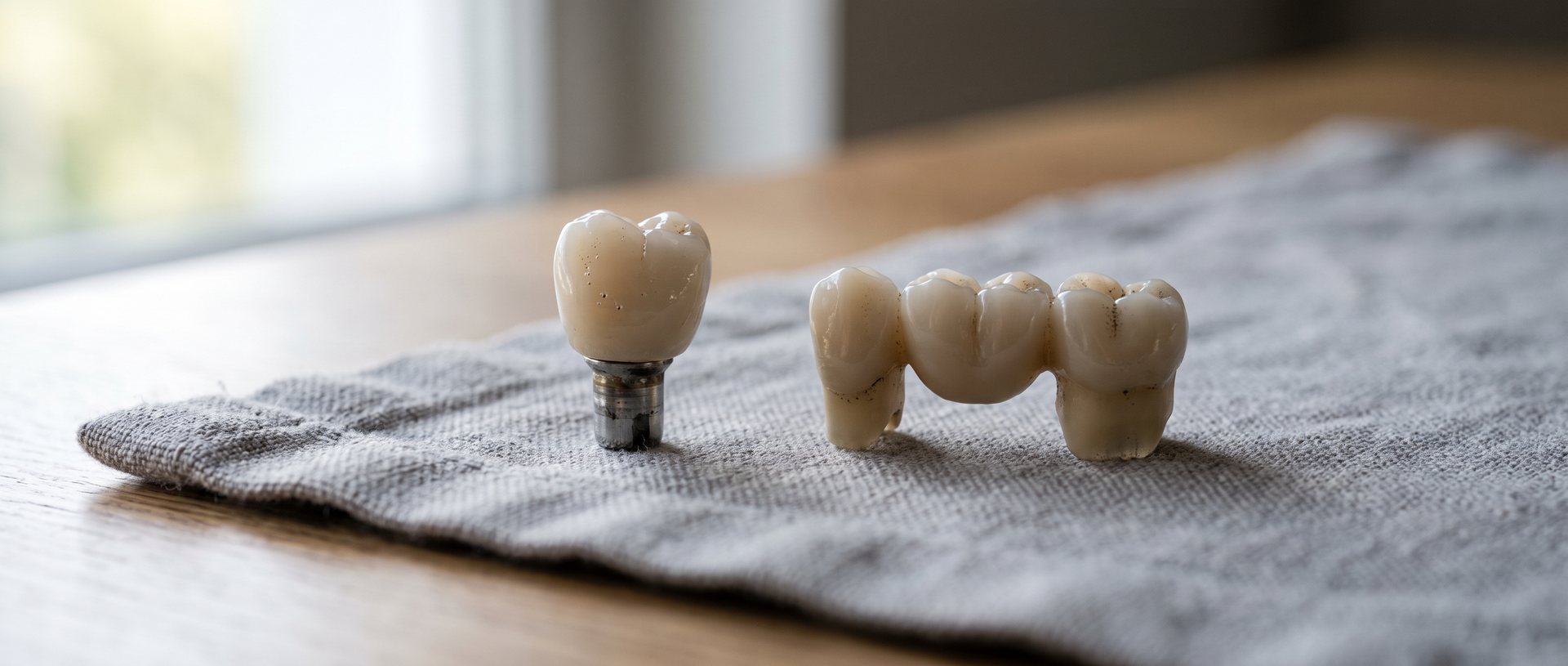
A dental implant and a bridge can both replace one missing tooth, and neither is right for everyone. An implant leaves the neighboring teeth alone but needs surgery and often months of healing. A bridge is quicker and needs no surgery, but it reshapes the teeth on each side of the gap. Restoration survival is similar in the research, so your teeth, bone, health and budget decide.
Dental implant vs bridge: how do they compare for one missing tooth?
For one missing tooth, both options work, and neither wins on every measure. A 2007 systematic review in Clinical Oral Implants Research found 5-year survival of 94.5% for implant-supported single crowns and 93.8% for conventional tooth-supported bridges, and about 89% for both at 10 years. Your neighboring teeth, bone, health, time and budget decide which one fits.
That 2007 review in Clinical Oral Implants Research pooled cohort studies with a mean follow-up of at least 5 years. Survival is not the same as trouble-free. Bridges mostly ran into decay and loss of pulp vitality, meaning the tooth's nerve dying. Implant-supported restorations had significantly more technical problems, such as chipped veneer material, loose screws and lost retention. These were cohort studies, not head-to-head trials, and the review is almost two decades old.
A 2012 systematic review of 46 studies looked at implant crowns alone. It estimated implant survival of 97.2% at 5 years and 95.2% at 10 years, and crown survival of 96.3% at 5 years and 89.4% at 10 years. Over 5 years, 8.8% of crowns had a loose screw, 4.1% lost retention and 3.5% chipped their veneering material. Cleveland Clinic is the source for the time and cost rows below; a 2012 economic review found initial costs similar but varying by payment system.
| Factor | Single implant and crown | Conventional bridge |
|---|---|---|
| Neighboring teeth | Left alone | Reshaped to hold crowns |
| Surgery | Yes, oral surgery | None |
| Time to finish | Often months, up to about 6 in all | Usually two visits over a couple of weeks |
| 10-year survival, 2007 review | 89.4% | 89.2% |
| Common problems | Loose screws, chipped veneer, infection around the implant | Decay and nerve damage in the anchor teeth |
| Upfront cost and insurance | Usually higher, less often covered | Usually lower, more often covered |
Why would a dentist not recommend a bridge?
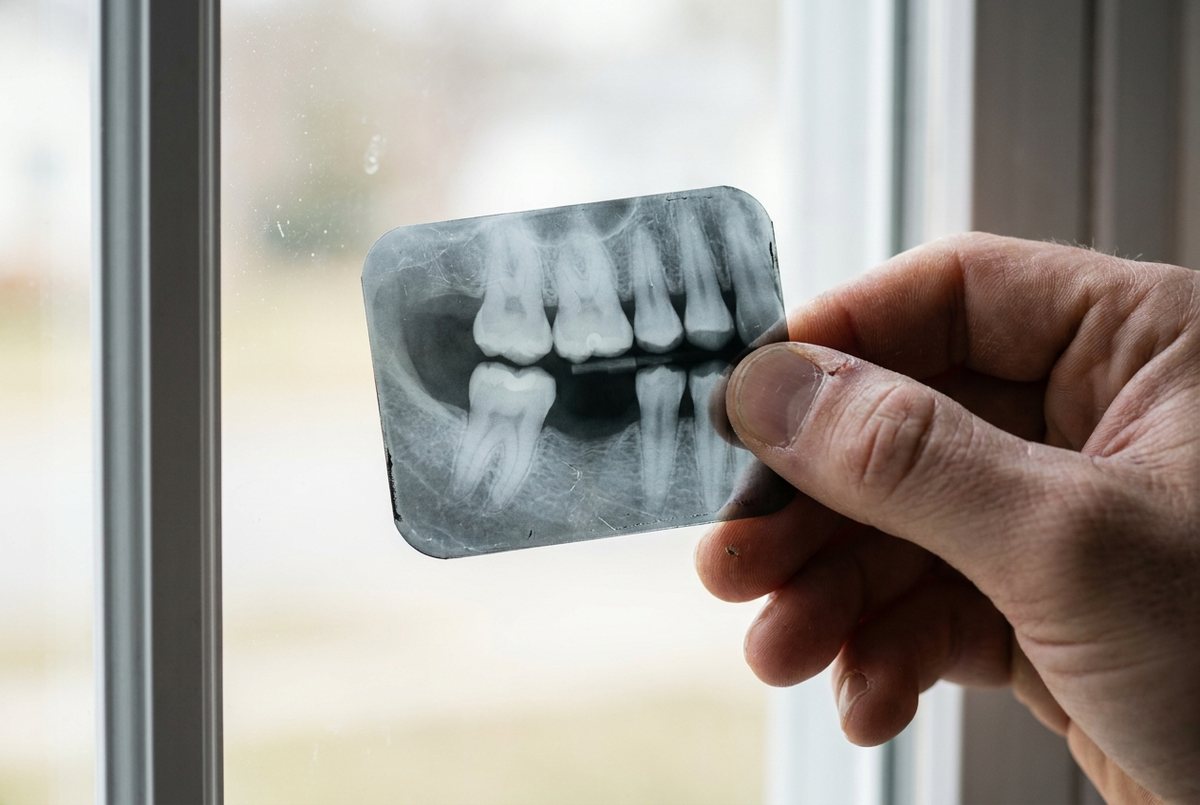
A dentist may steer away from a bridge when the teeth beside the gap are healthy, because a conventional bridge needs both of them reshaped to hold crowns. The Leeds Teaching Hospitals NHS Trust says as many as 10 to 15% of supporting teeth may eventually need root canal treatment. A conventional bridge is usually advised when those teeth are already crowned or heavily filled.
The Leeds patient page describes the work: the neighboring teeth are drilled down to pegs, a dental crown is fitted over each one, and the false tooth hangs between them. It calls a conventional bridge potentially destructive to the supporting teeth. It also reports that 80% of conventional bridges last 10 years or longer with relatively minor complications. That is patient information reviewed in July 2025, not a trial.
A 2022 retrospective study in the Journal of Dentistry followed 514 patients treated from 2008 to 2017 with an implant (103), a resin-bonded bridge (216) or a conventional bridge (195). Teeth with a living nerve beside the gap survived significantly less well after a conventional bridge than after an implant (p = 0.037), though complication-free rates did not differ significantly. Teeth beside resin-bonded bridges, which glue a small metal wing to one neighboring tooth with little or no drilling, did not differ significantly from those beside implants. The Leeds page says about 80% of adhesive bridges last 5 years or more, and the usual failure is the bond letting go.
Video transcript
A silent animation in four steps comparing two ways to replace one missing tooth. Step 1: one tooth is missing. Step 2: with an implant, a post replaces the root and a crown is placed on top. Step 3: with a conventional bridge, both neighbor teeth are reshaped to hold crowns. Step 4: neighbors, bone, health, time and budget decide which one fits. Neither option wins on every measure.
What happens to the jawbone under a bridge or an implant?
Bone shrinks fastest in the first months after a tooth is removed. A 2012 systematic review in Clinical Oral Implants Research reported, from human re-entry studies, horizontal bone loss of 29 to 63% and vertical bone loss of 11 to 22% at 6 months. No study cited here shows whether a bridge or an implant keeps more bone; the oral surgeons' association expects implants to help, but that is an expert view.
That review measured an average width reduction of 3.79 mm at 6 months, with rapid change in the first 3 to 6 months and gradual change after. It studied healing sockets with no replacement tooth, so the figures show why timing matters, not what a bridge or an implant does. ANEWU's financing page makes the same point: bone volume changes after teeth are lost, and that can change which treatment is possible later. A 3D scan shows how much bone is left.
Cleveland Clinic notes that a bridge fills in for the missing tooth without replacing the root. The American Association of Oral and Maxillofacial Surgeons says fixed bridges affect adjacent healthy teeth and that, because implants fuse with the jawbone, bone loss is generally not a problem. Yet bone loss around implants happens: the 2012 implant-crown review found 5.2% of implants with bone loss over 2 mm at 5 years. None of the studies cited here compared the bone under a bridge's false tooth with the bone beside an implant, so treat 'implants protect bone' as an expert expectation, not a measured difference.
What are the downsides of dental implants?
The main downsides are surgery, a longer timeline and long-term upkeep. A 2025 AO/AAP systematic review of 102 studies found that 21% of implant patients had peri-implantitis, a more serious infection around the implant, and 46% had peri-implant mucositis, inflammation around it. Cleveland Clinic says an implant and crown can take as long as six months.
The same review put the incidence of peri-implantitis at 22% of patients within 20 years of function and listed periodontitis, diabetes, smoking and alcohol use as risk indicators. Risk indicators are associations, not proven causes, and the review covered all implants, not only single crowns. Cleveland Clinic also lists surgical risks: infection, nerve damage, sinus damage or improper placement. Our post on the failure rate of dental implants goes deeper.
An implant may also not suit you. The American Dental Association says chronic illnesses such as diabetes or leukemia may interfere with healing, so patients with them may not be good candidates, and tobacco can slow healing. The American Association of Oral and Maxillofacial Surgeons is more optimistic: patients with most chronic diseases, including high blood pressure and diabetes, are usually successful candidates, and smoking lowers the success rate without ruling implants out.
Which is more painful, a bridge or an implant?
It varies from person to person, and none of the studies cited here compares the two directly. In a 2017 study of 339 patients, straightforward implant placement healed much like a simple tooth extraction, and pain scores stayed generally low, falling to nearly zero over two weeks. A bridge means reshaping the teeth on each side of the gap.
That study in Clinical Oral Implants Research followed patients in Hong Kong and Nanjing after five kinds of dental surgery. Surgical (transalveolar) extraction caused the most pain in the first 3 days. Implant placement combined with bone grafting caused the most swelling and bruising and the highest painkiller use. The study did not include bridge work, so it cannot rank the two options.
For a bridge, each anchor tooth is drilled down to a peg for a crown, as the Leeds page describes. ANEWU's crown page, which covers crowns and not bridges, says the tooth is numbed before it is reshaped and that some sensitivity in the days after is normal and typically fades. At ANEWU, sedation options are discussed before any surgery is scheduled. Our guide to dental implant surgery pain and recovery covers the days after an implant.
When would a dentist suggest a bridge instead of an implant?
A bridge may be suggested when the teeth beside the gap already have crowns or large fillings, when there is too little bone and you would rather skip grafting, when health conditions raise the risk of surgery, or when a quicker, non-surgical route fits your time or budget.
The first reason is the one the Leeds page names: a conventional bridge is usually advised when the supporting teeth are already crowned or have large fillings. One point to discuss with your dentist is that, if those teeth are already reshaped, the usual drawback of a bridge may weigh less; that is our reasoning, not a study finding. For healthy neighbors, a 2012 review of economic studies reached the opposite conclusion: keeping them unprepared makes the implant crown more economic.
Time and money come next. That review of 26 publications found the long-term financial comparison came out similar. Cleveland Clinic says the initial cost of a bridge is usually lower, it is more likely to be covered by insurance, and it needs no bone grafting.
- Neighboring teeth already crowned or heavily filled
- Too little bone, and you would rather avoid grafting
- Health conditions or tobacco use that slow healing
- A young patient whose jaw is still growing
- A need for the quickest or lowest upfront option
What about a removable partial denture?
A removable partial denture is a third option: a false tooth on a plate that you take out at night and for cleaning. A 2025 systematic review of 46 studies in the Journal of Prosthetic Dentistry found 5-year survival of 95.1% for cast-clasp partial dentures and few periodontal changes, though the teeth that held them had a higher extraction risk. The Leeds Teaching Hospitals NHS Trust says a denture is usually recommended when multiple teeth are missing.
That review covered 4,359 prostheses in 4,072 people, with a mean age of 60. Five-year survival was 95.1% for cast-clasp dentures and 91.7% for dentures held by telescopic crowns. Teeth that held the denture were more likely to be extracted by year 5 (odds ratio 1.99, 95% CI 1.32 to 3.01; the abstract does not say compared with what), and a gum inflammation score rose, while tooth mobility and probing depth did not change. Risk of bias was low to moderate.
Weigh the trade-offs plainly. A removable denture must come out for cleaning and at night, and the review found a higher extraction risk for the teeth that hold it. It needs no surgery, and the abstract reports no comparison with implants or bridges.
What does this look like at ANEWU?
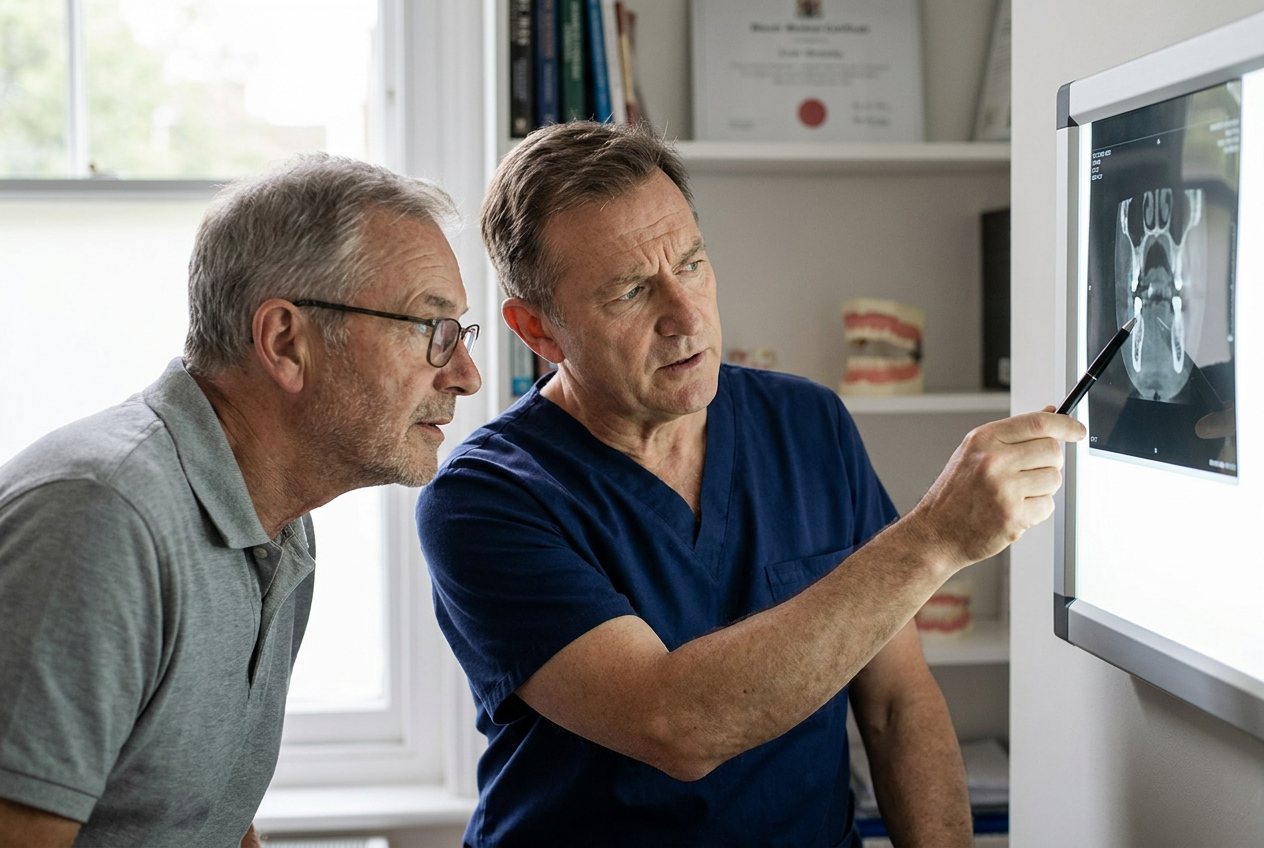
At ANEWU, you start with a free consultation that includes an in-office 3D scan. Dr. Abtin Shahriari, an oral surgeon specializing in implant dentistry, examines you and explains your options in plain language, including the alternatives worth considering. No treatment is performed that day, and the team reviews the cost of the recommended plan with you before you leave.
For a single missing tooth, ANEWU's site describes one implant and one crown placed in the gap, so the neighboring teeth are left alone. Every implant plan starts with the 3D scan, which shows bone volume, nerve position and sinus anatomy. Dr. Abtin plans and performs the surgery himself, so the surgeon who reads your scan is the one in the operatory. The first visit page walks through each step. ANEWU's service pages describe implant treatment, not conventional bridges or removable partial dentures, so ask what the office provides.
ANEWU does not publish implant prices, because the figure depends on how many implants are needed, whether bone grafting comes first and which restoration is used. ANEWU's pages note that dental insurance rarely covers implant treatment in full. ANEWU accepts CareCredit and Proceed Finance and can arrange a monthly payment plan before your procedure. Our guide to what dental implants cost in Georgia covers what a quote should include. To compare the options for your own tooth, book a free consultation. Questions to ask your surgeon, here or anywhere:
- Are my neighboring teeth healthy enough that leaving them alone matters?
- How much bone do I have, and would I need a graft first?
- What is the full timeline from today to the final crown?
- What does the quote include: the implant, the abutment, the crown and the imaging?
- Do my health conditions or habits, such as diabetes or smoking, change my risk?
- What upkeep and repairs should I expect over the next 10 years?
- If an implant is not right for me, which alternative would you choose, and why?
Sources and further reading
- Comparison of survival and complication rates of tooth-supported fixed dental prostheses (FDPs) and implant-supported FDPs and single crowns (SCs) Clinical Oral Implants Research, 2007
- Systematic review of the survival rate and the incidence of biological, technical, and aesthetic complications of single crowns on implants reported in longitudinal studies with a mean follow-up of 5 years Clinical Oral Implants Research, 2012
- A retrospective comparison of the survival of vital teeth adjacent to single, bounded edentulous spaces rehabilitated using implant-supported, resin-bonded, and conventional fixed dental prostheses Journal of Dentistry, 2022
- A systematic review of post-extractional alveolar hard and soft tissue dimensional changes in humans Clinical Oral Implants Research, 2012
- Comparison of patient-centered outcomes after routine implant placement, teeth extraction, and periodontal surgical procedures Clinical Oral Implants Research, 2017
- Implants versus short-span fixed bridges: survival, complications, patients' benefits. A systematic review on economic aspects Clinical Oral Implants Research, 2012
- Prevalence, incidence, systemic, behavioral, and patient-related risk factors and indicators for peri-implant diseases: An AO/AAP systematic review and meta-analysis Journal of Periodontology, 2025
- Long-term assessment of the periodontal health of removable partial denture wearers: A systematic review and meta-analysis Journal of Prosthetic Dentistry, 2025
- Bridges Leeds Teaching Hospitals NHS Trust, patient information page, last reviewed July 2025
- Are You a Candidate for Dental Implants? American Association of Oral and Maxillofacial Surgeons, patient information page, accessed October 2026
- Implants American Dental Association (MouthHealthy), patient information page, accessed October 2026
- Dental Bridge vs Implant: What's the Difference? Cleveland Clinic Health Essentials, 2023
This article is general information about dental and facial procedures, not a diagnosis or medical advice. Every jaw and every health history is different, so the right plan for you can only be set after an exam and imaging with a surgeon.