






Short answer
Same-day dental implants means a full arch of implants is placed and you leave surgery wearing provisional (temporary) fixed teeth. The final teeth are made months later, after the jawbone has healed around the implants. Whether you qualify depends on your bone, your bite and how firmly each implant seats, which a 3D scan and the surgery itself confirm.
Can dental implants be done in one day?
The implants can be placed in one day, and for qualifying full-arch cases you can leave with provisional (temporary) fixed teeth attached to them. Those teeth are not the final set. The final teeth are made after the implants have healed into the jawbone, which takes months, and they are fitted to the same implants.
Researchers call this immediate loading. A 2013 Cochrane review defined it as loading within 1 week, compared with after 2 months for conventional loading, and noted that implants are conventionally kept load-free for 3 to 8 months. The American Association of Oral and Maxillofacial Surgeons says there is no shortcut around osseointegration, the bonding of bone to the implant, which usually takes several months. A same-day plan does not speed up that bonding. It changes what you wear while it happens, provisional teeth instead of none.
At ANEWU this is called Same-Day Smiles. The provisional bridge is screwed onto the implants, so it does not come out at night and does not rely on adhesive. It lets you smile, speak and manage a soft diet while you heal, and the final teeth still follow after healing. Same-day teeth are a timing option added to a full-arch plan, not a separate procedure, and not every case qualifies.
How do they do dental implants in one day?
Surgery day follows a plan made beforehand from a 3D scan. The implants are placed in one outpatient surgery, stability is measured as each one goes in, and if the readings allow it a provisional fixed bridge is attached before you go home. The final bridge follows after healing.
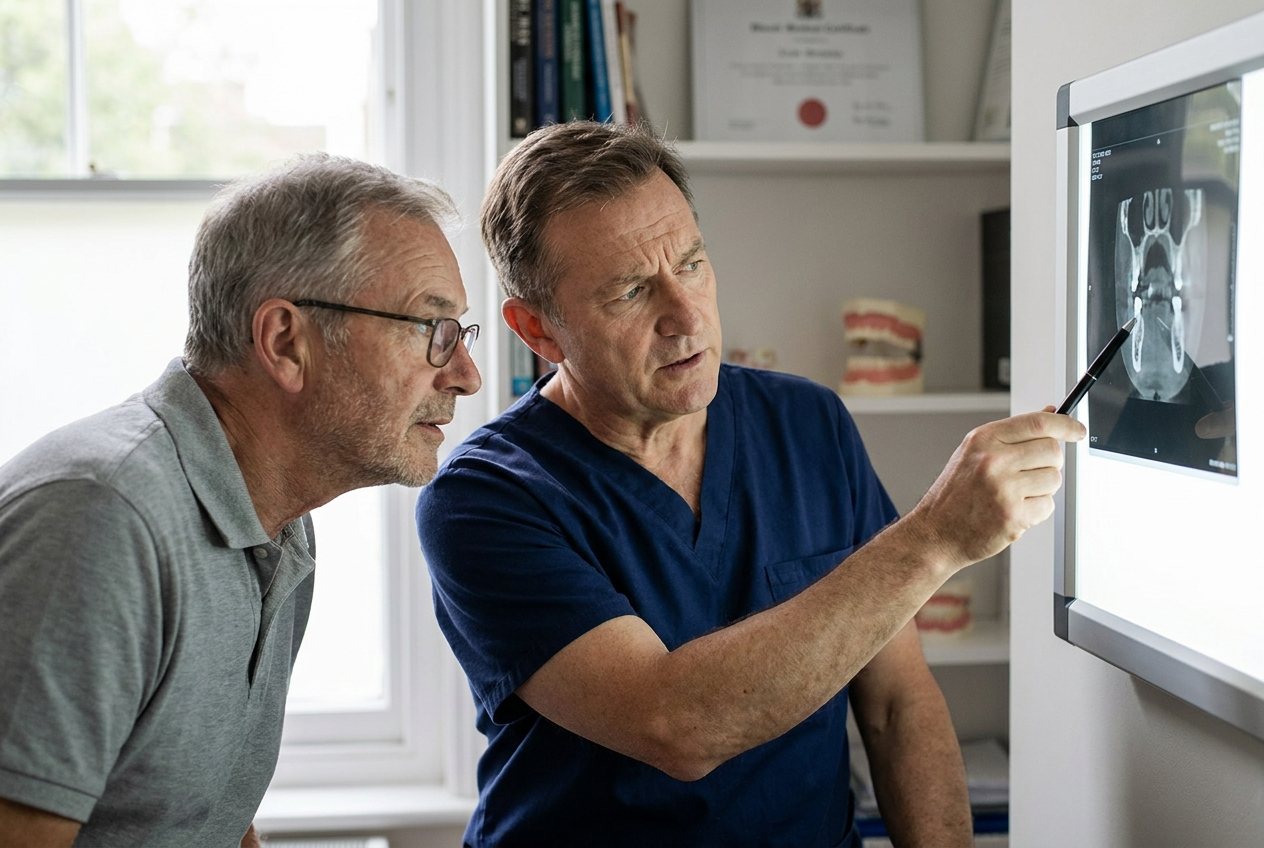
The scan comes first because a flat x-ray cannot show bone width, nerve position or the sinus floor, and the plan depends on all three. Computer-guided surgery then carries the planned position, angle and depth of each implant into the procedure. The same scan decides which design fits, such as All-On-4, and whether adding the same-day step is safe.
Stability is measured because immediate loading depends on it. A 2014 meta-analysis of 62 studies found that for immediate loading most studies recommended a minimal insertion torque of 30 Ncm (Newton-centimeters), a measure of how firmly an implant is seated. A 2017 systematic review of All-on-four studies reported final torque of 30 to 50 Ncm to allow immediate rehabilitation. If an implant seats too loosely, waiting to attach teeth is a change in timing, not a refusal.
- Before: a free consultation with an in-office 3D scan, then a treatment plan that maps each implant and says whether the same-day step is part of it.
- Surgery: any remaining teeth in the arch are removed and the implants are placed in a single outpatient visit.
- Stability check: the surgeon measures how firmly each implant seats, and that reading clears the provisional bridge.
- Same day: for qualifying cases the provisional bridge is attached, and you go home with a written aftercare plan.
- Later: after healing, the final restoration is made in the ANEWU on site lab and fitted to the same implants.
Are same day dental implants any good?
In the research, implants that receive provisional teeth right away survive at rates close to implants that wait. A 2019 systematic review of 34 prospective studies found a mean weighted implant survival of 97.4%, with a mean follow-up of about six years. Results are not identical everywhere: that review and a 2023 clinic cohort found lower-jaw implants did better than upper-jaw ones, while a 2014 meta-analysis found no jaw difference.
That 2019 review analyzed 5,349 immediately loaded implants in 1,738 fully and partially edentulous patients, across single crowns, partial bridges and full prostheses, with a mean follow-up of 72.4 months. Survival means the implant was still in place, not that nothing ever needed attention. Implants in the lower jaw had significantly higher cumulative survival than those in the upper jaw (98.4% against 97.0% at five years). A 2023 cohort of 561 All-on-four cases from one private clinic in Tokyo, followed for 3 to 17 years, showed the same pattern: 97.4% implant-level survival in the upper jaw and 98.9% in the lower.
Two caveats matter. The evidence is not uniform: of the 26 trials in the Cochrane review, 3 were at low risk of bias and 12 at high risk, and its authors asked for more well-designed trials. The 2014 review concluded that results are similar when cases are selected carefully and rough-surface implants are used, and warned of many confounding factors. The 2017 All-on-four review found its evidence limited by thin methodological reporting, inadequate follow-up and patient attrition.
| Study | What it covered | What it found |
|---|---|---|
| Cochrane review, 2013 | 26 randomized trials, 1,217 participants, 2,120 implants | No evidence of a difference in implant or prosthesis failure in year one between immediate and conventional loading (15 of the trials); mean implant failure across all 26 trials 2.5%, with follow-up of 4 months to 1 year |
| Meta-analysis, 2014 | 62 studies, 2,695 patients with fixed full-arch teeth | Similar survival across immediate, early and conventional loading; estimated 1-year implant survival above 99% |
| Systematic review, 2019 | 34 prospective studies, 5,349 implants, 72.4 months mean follow-up | Mean weighted implant survival 97.4%; lower jaw higher than upper jaw |
| Cohort study, 2023 | 561 All-on-four cases at one Tokyo clinic, 2,364 implants, 3 to 17 years | Implant-level survival 97.4% in the upper jaw, 98.9% in the lower jaw |
Who qualifies for same-day dental implants?
You are more likely to qualify if you have lost, or are about to lose, all of the teeth in one arch, have enough bone to hold implants firmly on surgery day, and have a bite that will not overload a new bridge while it heals. Your 3D scan and the stability reading during surgery settle it.
Not qualifying for the same-day step does not mean not qualifying for implants. If the implants will not seat firmly enough to carry a bridge right away, you would follow a staged timeline that ends in the same kind of fixed result. If bone is thin, bone grafting can rebuild the ridge first, and zygomatic implants anchor in the cheekbone when the upper back jaw has collapsed. Our guide to dental implants with bone loss explains those routes. Dr. Abtin Shahriari, an oral surgeon specializing in implant dentistry, reviews your scan with you at the free consultation.
Your health history counts too. In a 2023 study of All-on-four patients at one Tokyo clinic, implant-level survival was 97.9% in smokers (10 or more cigarettes a day) and 99.2% in non-smokers, a gap of 1.3 percentage points that was significant in a simple comparison but not after the authors adjusted for other factors. A 2022 systematic review that included 40 clinical studies found that poorly controlled diabetes brings more peri-implantitis (inflammation and bone loss around the implant) and higher long-term implant loss, while under controlled conditions success rates are similar. Tell your surgeon about both.
Can I get teeth pulled and implants the same day?
Yes, in suitable cases. Implants can go into fresh extraction sockets, and in a full-arch case any remaining teeth in the arch are removed and the implants placed in one outpatient visit. Whether that is wise depends on infection, how firmly the implants seat, and your bone and health, so some cases wait weeks or months. Any teeth attached the same day are provisional, and the final set comes after healing.
A 2019 European consensus report listed six considerations: presence of infection, inability to achieve primary stability in the restoratively driven position, a damaged tooth socket, your periodontal phenotype (gum and bone type), aesthetic demands and systemic conditions. It also noted that the evidence mostly covers single-tooth replacement, so applying it to multiple extractions requires careful consideration.
A 2025 narrative review sorted placement timing into four groups, shown below. It reported survival of 93.8 to 100 percent for immediate placement, 95 to 100 percent for early placement and 92 to 100 percent for delayed placement. Those ranges overlap. The review concluded that timing should be individualized, and that immediate placement needs careful patient selection and surgical expertise.
| Timing | When the implant goes in | Healing before the implant |
|---|---|---|
| Immediate | The day the tooth is removed | None |
| Early, soft tissue healed | 4 to 8 weeks after extraction | Gum tissue |
| Early, partial bone healing | 12 to 16 weeks after extraction | Gum tissue and part of the bone |
| Delayed | More than 4 months after extraction | Soft tissue and bone |
What do you wear while the implants heal?
With a same-day plan you wear a provisional fixed bridge, attached during surgery for qualifying cases, until the final teeth are fitted after healing. In a staged plan the wait is longer, and you may wear a removable temporary appliance, if any, until the implants have healed enough for fixed teeth.
The provisional bridge is built to be replaced, and it needs care. In the 2017 All-on-four review, most reports used acrylic resin for the provisional prosthesis, and the most frequent prosthetic complication was fracture of the acrylic prostheses, seen in 9 clinical studies. In those reports, repair, bite adjustment and a night guard resolved them. Follow the written instructions from your surgeon on diet and cleaning.
Discomfort is front-loaded: it is heaviest in the first few days and eases from there, while the long stretch that follows is mostly patience. No additional surgery is typically needed for the final teeth. Our full arch implant recovery guide covers the first weeks in more detail.
- Surgery day: implants placed and, for qualifying cases, the provisional bridge attached.
- First few days: swelling and soreness peak, then settle. Expect a liquid to very soft diet.
- Weeks one to two: swelling falls away and most routines resume. A follow-up visit checks the bridge.
- Healing months: the implants bond with the jawbone while you wear the provisional teeth.
- Final restoration: once healing is confirmed, the provisional bridge comes off and the final teeth are fitted to the same implants.
Can you choose sedation for implant surgery?
Ask early, because the answer depends on your health history and the surgery planned. The American Association of Oral and Maxillofacial Surgeons says its specialists are prepared to give local anesthesia and all forms of sedation, including general anesthesia. At ANEWU, sedation options are discussed before any surgery is scheduled.
That describes the specialty in general, not a menu at any one office. The American Association of Oral and Maxillofacial Surgeons adds that your surgeon will review the anesthetic and how you are likely to feel, and that sharing your medical and anesthesia history, including any family problems with anesthesia, is vitally important. No treatment is done at the consultation, so it is the right place to raise nerves. Tell the team at check in and they can pace the appointment around it. If you are sedated, arrange a ride home after surgery.
What affects the cost of same-day implants?
Cost follows the number of implants your case needs, whether bone grafting comes first and which materials the final teeth use. Dental insurance typically does not cover implant treatment. ANEWU accepts CareCredit and Proceed Finance and can arrange a monthly payment plan before your procedure.
A same-day plan involves two sets of teeth, the provisional bridge and the final restoration, so ask any practice to put in writing what a quote includes. At ANEWU, 3D imaging and surgical planning are part of implant treatment rather than a separate charge. We do not publish a price here, because the implant count and the need for grafting come from your scan.
Some dental plans contribute toward part of a case, more often an extraction or the restoration than the implants. Our guide to what dental implants cost in Georgia and our financing options page set out the payment routes. To find out whether same-day teeth fit your case, book a free consultation and bring your questions.
Sources and further reading
- Interventions for replacing missing teeth: different times for loading dental implants Cochrane Database of Systematic Reviews, 2013
- Implant loading protocols for edentulous patients with fixed prostheses: a systematic review and meta-analysis International Journal of Oral & Maxillofacial Implants, 2014
- A Systematic Review of Survival Rates of Osseointegrated Implants in Fully and Partially Edentulous Patients Following Immediate Loading Journal of Clinical Medicine, 2019
- The All-on-four concept for fixed full-arch rehabilitation of the edentulous maxilla and mandible: a longitudinal study in Japanese patients with 3-17-year follow-up and analysis of risk factors for survival rate International Journal of Implant Dentistry, 2023
- The all-on-four treatment concept: Systematic review Journal of Clinical and Experimental Dentistry, 2017
- Management of the extraction socket and timing of implant placement: Consensus report and clinical recommendations of group 3 of the XV European Workshop in Periodontology Journal of Clinical Periodontology, 2019
- Optimizing Implant Placement Timing and Loading Protocols for Successful Functional and Esthetic Outcomes: A Narrative Literature Review Journal of Clinical Medicine, 2025
- Systematic review on diabetes mellitus and dental implants: an update International Journal of Implant Dentistry, 2022
- Dental Implant Surgery American Association of Oral and Maxillofacial Surgeons, patient information page, accessed October 2026
- Anesthesia for Oral and Maxillofacial Surgery American Association of Oral and Maxillofacial Surgeons, patient information page, accessed October 2026
This article is general information about dental and facial procedures, not a diagnosis or medical advice. Every jaw and every health history is different, so the right plan for you can only be set after an exam and imaging with a surgeon.