












Short answer
An implant bridge, or implant-supported bridge, is a fixed row of joined replacement teeth held by dental implants instead of natural teeth, so it usually needs fewer implants than missing teeth, such as two implants for three teeth. A 2012 systematic review of 32 studies in Clinical Oral Implants Research estimated that 93.9% of metal-ceramic implant bridges were still in use at 10 years.
How does an implant bridge work?
An implant bridge works by joining replacement teeth into one fixed piece that is screwed or cemented onto two or more dental implants. The implants act as roots, and the teeth between them rest over the gum. Cleveland Clinic defines an implant bridge as two or more implants supporting a bridge that replaces three or more teeth.
Three parts do the work. The implant is a threaded post in the jawbone. The abutment is the connector between an implant and the bridge; dentists use the same word for a natural tooth that holds up a regular bridge. A pontic is a false tooth with no root or post under it. So a bridge is not an implant: the implants are the posts, and the bridge is the row of teeth they carry.
Cleveland Clinic puts the time for the jawbone to fuse with implants at three to nine months, while the American Academy of Periodontology describes two to six months before the abutments go on, then a couple of weeks of gum healing before the final bridge.
How many implants are needed for 3 missing teeth?
Three missing teeth in a row can be replaced with two implants carrying a three-tooth bridge, with a false tooth in the middle, or with three implants. A 2025 study in the International Journal of Prosthodontics randomly assigned 63 patients to one design or the other for back teeth and found similar implant survival, bone levels and bridge failures over 6 to 10 years.
The table applies the same logic to other spans. No study fixes an exact ratio of implants to teeth: a 2012 systematic review in Clinical Oral Implants Research looked for one and found that none of its nine studies reported it. That review did estimate 98.9% survival at 5 years and 97.8% at 10 years for partial bridges on two to four implants. Cleveland Clinic notes that longer bridges usually need more support, so the count rises with the span, your bite and the bone at each site.
| Teeth missing in a row | Implant counts used | When a cantilever comes up | When one implant per tooth may fit better |
|---|---|---|---|
| 2 | 1 or 2 | One implant carrying two teeth can work at the front (2017 review) | At the back, where that review called the two-tooth cantilever unwise |
| 3 | 2 (false tooth in the middle) or 3 | Only if one end has no site for an implant | A small 2025 trial and a 2023 review found no clear winner, so bone and bite decide |
| 4 | 2 to 4 | If the last position lacks bone, with more repairs expected (2024 review) | Joined crowns on one implant each did as well as bridges with false teeth over 3 years (2023 review) |
| 5 to 6 | More as the span grows; reviewed studies used up to 4 | A short end extension is sometimes planned, with more repairs expected | Possible, though each extra implant adds a surgical site and cost |
Is it better to do 2 implants and a 3-unit bridge or 3 implants?
Neither is clearly better in the research, so your bone and bite usually decide. A systematic review prepared for the 2023 ITI Consensus Conference found 3-year survival of 98.3% for metal-ceramic back-tooth bridges with a false tooth and 99.1% for joined crowns on one implant per tooth, with no significant difference. A removable partial denture avoids surgery but comes out every day.
Two implants mean one fewer surgical site, and the false tooth's position does not need enough bone to hold an implant. Three implants give every tooth its own support. The evidence has limits: the 2023 review gives short-term, 3-year estimates, and the 2025 trial was small. A removable partial denture rests on the gums and clasps to nearby teeth; the American Academy of Periodontology notes it should be taken out and cleaned after eating and soaked overnight.
| Factor | 2 implants, 3-tooth bridge | 3 implants | Removable partial denture |
|---|---|---|---|
| Surgery | Two implant sites | Three implant sites | None |
| Bone needed | At the two ends | At all three sites | Not for implants |
| Evidence | 98.3% at 3 years, bridges with a false tooth (2023 review) | 99.1% at 3 years, joined crowns | Not compared in these reviews |
| Daily care | Clean under the false tooth | Clean around each implant | Remove, clean after meals, soak overnight |
| Fixed or removable | Fixed | Fixed | Removable |
What are the downsides of using a cantilever bridge?
The main downside of a cantilever implant bridge, where a false tooth extends past the last implant with nothing beneath it, is more mechanical trouble. A 2024 systematic review in the International Journal of Implant Dentistry, prepared for a Japanese Society of Oral Implantology guideline, found mechanical complications significantly more often with cantilevers, while implant survival, bone loss and patient satisfaction did not differ significantly.
The same review explains why cantilevers are used at all. When bone at the end of a gap is thin, or a nerve or neighbouring tooth is in the way, a cantilever can avoid a bone graft, shorten treatment and reduce cost. The trade-off is repairs: all four studies in the review that tracked mechanical problems found more of them with cantilevers, and loosened screws were the most common problem in a series of 29 front-tooth cases that the review discusses. The review was small, with nine studies.
For two missing teeth, a 2017 systematic review in the Journal of Oral Rehabilitation found implant survival of 96.6% to 100% when one implant carried a two-tooth cantilever. Its authors judged that design a reasonable alternative to two implants at the front of the mouth but unwise at the back, where technical problems were more frequent.
Are implant bridges strong?
Implant bridges are strong enough to stay in use for years in most studies, but many need repairs along the way. A 2012 systematic review of 32 studies in Clinical Oral Implants Research estimated that 96.4% of metal-ceramic implant bridges survived 5 years and 93.9% survived 10 years, yet only 66.4% of patients had no complication of any kind over 5 years.
The commonest problems in that review over 5 years were chipped or fractured veneering porcelain (13.5%), peri-implantitis and soft tissue problems (8.5%), a lost filling over the screw access hole (5.4%), loose abutments or screws (5.3%) and cemented bridges coming loose (4.7%). These figures come from cohort studies and case series, not randomized trials. With older gold-acrylic bridges counted too, 10-year survival fell to 80.1%, so material matters. The 2023 ITI consensus recommended monolithic zirconia for back-tooth implant bridges to reduce technical complications. Monolithic zirconia is one solid block of zirconia with no layered porcelain coat to chip.
Can an implant bridge be removed, and how do you clean under it?
You cannot take a fixed implant bridge out at home, but a dentist can remove one, most easily when it is screw-retained rather than cemented. A 2012 systematic review of 59 studies in Clinical Oral Implants Research found screw-retained restorations easier to retrieve, so problems can be treated more easily, and similar 5-year survival for screwed and cemented partial bridges.
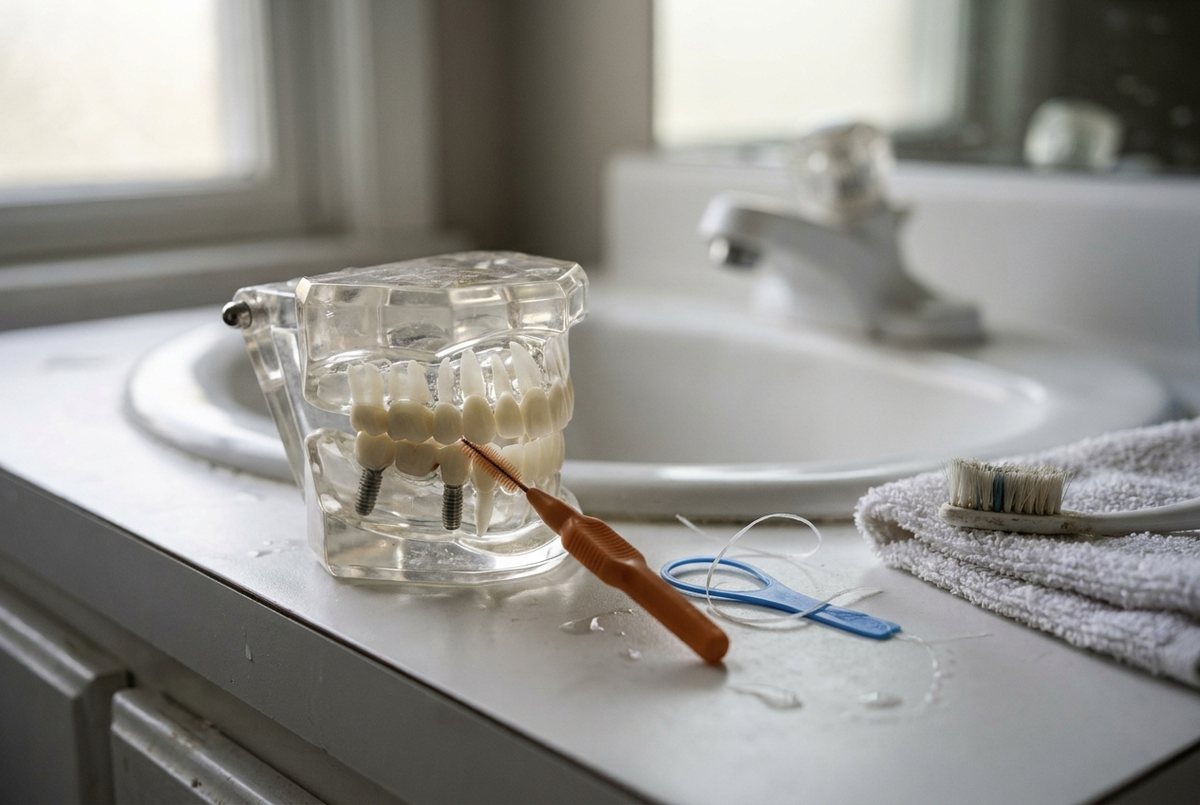
Because the bridge stays in, cleaning under it is a daily job. Cleveland Clinic advises cleaning underneath a bridge every day with floss threaders or small interproximal brushes, which slide under each false tooth where a toothbrush cannot reach. Our guide on how to clean around implants walks through the tools in more detail.
- Brush the bridge and the gum line where each implant meets the gum.
- Pass floss with a threader, or a small interproximal brush, under every false tooth.
- Keep the check-ups your surgeon sets, so inflammation is caught early.
Who is a candidate for an implant bridge?
A good candidate for an implant bridge has several missing teeth in a row, has finished growing, has healthy gums and enough jawbone at the implant sites, and can clean under a fixed bridge. Cleveland Clinic lists active gum disease, unmanaged diabetes, severe bone loss and poor oral hygiene among reasons implants may not suit, and says smoking or vaping can disrupt healing.
An implant bridge is not for you if you want to avoid surgery, if months between surgery and final teeth would not work for you, or if your health makes oral surgery unwise right now. Thin bone does not automatically rule it out: a graft can rebuild a site first, as our guide to bone grafts for dental implants explains, though it adds healing time.
- Questions to ask your surgeon: how many implants does my span need, and why that number?
- Where will the false teeth sit, and is the bone at the implant sites enough without a graft?
- Is a cantilever part of the plan, and how long is it?
- Will the bridge be screw-retained or cemented, and how would it be repaired?
- What material is the bridge, and is it monolithic or layered?
- What will I wear in the gap while the implants heal?
- How do I clean under it, and how often should it be checked?
What happens at an implant bridge consultation at ANEWU?
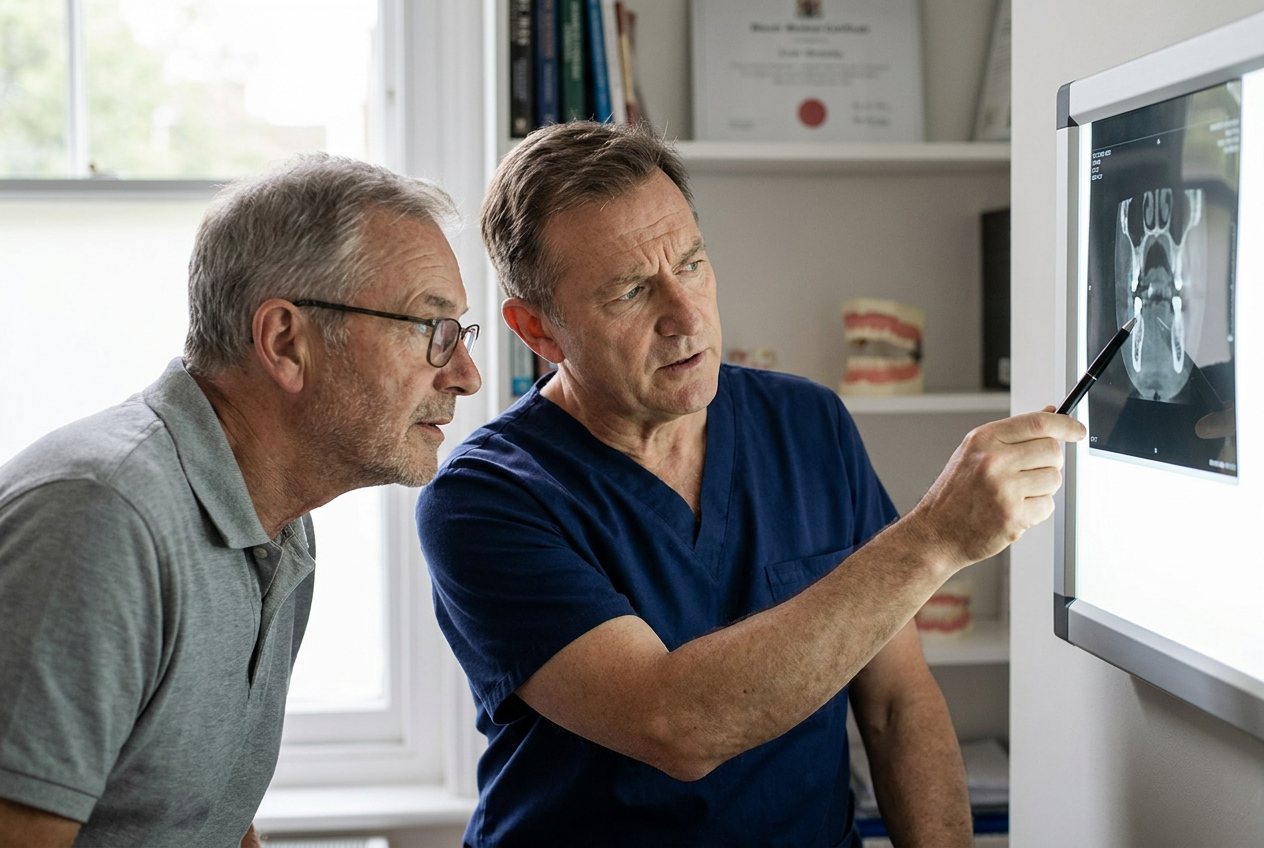
At ANEWU, your first visit about an implant bridge is a free consultation that includes an in-office 3D scan, and no treatment is done that day. Dr. Abtin Shahriari, the oral surgeon who plans and places every implant at ANEWU, reviews the scan with you and explains which options your bone supports. The cost of the plan is reviewed at the same visit.
Here is the order of your first visit, with branches that depend on what the scan shows. You are welcome to bring someone with you, and nothing is scheduled until you decide. Implant surgery is done at the Buckhead, Cumming and Dawsonville offices. When you want to see what your own jaw can carry, you can book a free consultation.
- Step 1: the front desk reviews your medical and dental history and medicines. Bring old x-rays; they show how long the teeth have been missing.
- Step 2: a cone beam 3D scan in the office maps bone height and width, the lower jaw nerve and the sinus floor.
- Step 3: Dr. Abtin Shahriari reviews the scan with you on screen and explains which plans your bone supports.
- If the scan shows thin bone at a site, grafting comes first, and a second 3D scan confirms healing before implants are booked.
- If the bone is ready, implant position and angle are planned on the scan around your final bridge.
- Step 4: the cost is reviewed before you leave. ANEWU accepts CareCredit and Proceed Finance and can set up a monthly plan before your procedure.
When should you call right away after implant bridge surgery?
Call the office right away if an implant or bridge feels loose, or if you notice pus, swollen or bleeding gums, fever or swollen neck glands, which Cleveland Clinic lists as reasons to call. Go to an emergency room or call 911 for trouble breathing, speaking or swallowing, or a lot of swelling in your mouth, the emergency signs in NHS guidance for dental infections.
Some soreness and swelling are normal at first, and Cleveland Clinic says most people feel like themselves within a week or so. Pain or swelling that grows after that, instead of fading, is worth a call. Follow the written instructions from your surgeon for medicines and aftercare.
- A loose implant or a loose bridge
- Pus or a bad taste around an implant, or swollen or bleeding gums
- Fever, or swollen glands in your neck along with any of the above
- Pain or swelling that is getting worse after the first week
- Emergency room or 911: trouble breathing, speaking or swallowing, a lot of swelling in the mouth, a swollen eye, trouble opening your mouth, or a high fever with spreading swelling
Sources and further reading
- Dental Implants Cleveland Clinic, last updated 2026
- Dental Bridges Cleveland Clinic, last updated 2023
- Multiple Tooth Dental Implants American Academy of Periodontology
- What is the optimal number of implants for fixed reconstructions: a systematic review Clinical Oral Implants Research, 2012
- Systematic review evaluating the influence of the prosthetic material and prosthetic design on the clinical outcomes of implant-supported multi-unit fixed dental prosthesis in the posterior area Clinical Oral Implants Research, 2023 (7th ITI Consensus Conference)
- Group 2 ITI Consensus Report: Technological developments in implant prosthetics Clinical Oral Implants Research, 2023
- Immediate Loading of Three-Unit Posterior Fixed Dental Prostheses on Three vs Two Implants: Comparison and Evaluation with up to 10-Year Follow-up International Journal of Prosthodontics, 2025
- Implant-supported fixed prostheses with cantilever: a systematic review and meta-analysis International Journal of Implant Dentistry, 2024
- How to treat two adjacent missing teeth with dental implants: a systematic review on single implant-supported two-unit cantilever FDPs Journal of Oral Rehabilitation, 2017
- A systematic review of the survival and complication rates of implant-supported fixed dental prostheses (FDPs) after a mean observation period of at least 5 years Clinical Oral Implants Research, 2012
- Cemented and screw-retained implant reconstructions: a systematic review of the survival and complication rates Clinical Oral Implants Research, 2012
- Dental abscess NHS, reviewed March 2026
This article is general information about dental and facial procedures, not a diagnosis or medical advice. Every jaw and every health history is different, so the right plan for you can only be set after an exam and imaging with a surgeon.