










Short answer
Signs worth a consultation are loose teeth from advanced gum disease, decay or infection that keeps returning after repairs, a denture that no longer fits or causes sores, and trouble chewing. None of these alone is a diagnosis. Implants are usually considered when most teeth in a jaw cannot be saved, and a surgeon decides that from an exam and a 3D scan.
What are the signs you may need full-mouth dental implants?
The signs that point toward a full-arch discussion are loose teeth, advanced gum disease, decay or infection that returns after repairs, a denture that slips or causes sores, and trouble chewing. They matter most when they affect most of the teeth in one jaw, not one or two teeth. Only an exam and a 3D scan can show whether those teeth can be saved.
Each sign suggests that your teeth, or the denture replacing them, can no longer do their job. The CDC lists loose or sensitive teeth among the signs of gum disease and says periodontitis and cavities are the two main causes of tooth loss. A sign is a reason to book an exam, not a reason to book surgery.
Use this list as a conversation starter, not a diagnosis. The 'two or more' cutoff is our own rule of thumb, not a threshold from any study or guideline. If two or more apply to most of the teeth in one jaw, it is reasonable to book a consultation and ask whether full-arch restoration fits your mouth. If only one applies, smaller fixes are often worth trying first.
- Several teeth in one jaw feel loose, or your bite has shifted
- Your gums bleed or pull back, or you have been treated for gum disease more than once
- Fillings, crowns or root canals keep failing across many teeth
- Your denture slips, clicks or leaves sore spots even after adjustments
- You avoid foods because chewing is hard or painful
- A dentist has told you that most teeth in one jaw have a poor prognosis
How common is losing most or all of your teeth?
Complete tooth loss is less common than it once was, but it still affects about 1 in 8 older adults. In a CDC National Center for Health Statistics report using 2015 to 2018 NHANES data, 12.9% of US adults aged 65 and over had lost all their natural teeth, rising from 8.9% at ages 65 to 69 to 17.8% at 75 and over.
The gaps were wide. Among older adults with less than a high school education, 31.9% had lost all their teeth, compared with 9.5% of those with at least a high school education. NHANES is a national survey of the civilian noninstitutionalized population, so these figures describe groups. They cannot tell you what is likely for your own mouth.
Gum disease is a major reason teeth are lost. A 2018 national analysis of NHANES 2009 to 2014 data, published in the Journal of the American Dental Association, estimated that 42% of dentate US adults aged 30 and older had periodontitis and 7.8% had severe periodontitis, with the severe form most prevalent among adults 65 and older, smokers and some racial and ethnic groups. All of them still had teeth, and treatment can often keep them.

Do loose teeth, gum disease or repeated decay mean your teeth cannot be saved?
Not by themselves. Loose teeth, deep gum pockets and repeated decay are warning signs, but treatment often keeps teeth affected by gum disease. A 2024 meta-analysis of 41 studies in the Journal of Clinical Periodontology found that 82% of periodontally treated molars were still present after a mean follow-up of 14.7 years.
The same 2024 meta-analysis named what raised the risk of losing a molar: higher tooth mobility (looseness), deep gum pockets, bone loss between the roots of a molar, a tooth whose nerve has died, smoking, grinding, diabetes and lack of compliance with maintenance visits. When several of these stack up across most teeth in a jaw, a full arch can become a realistic discussion, though the study looked only at molars. The 82% also means about 18% of molars were lost. Patients lost 0.05 molars per year on average, but they were in regular periodontal maintenance, so the figure does not apply if care lapses.
Decay and infection follow the same logic. One failed filling or one infected tooth is a question about that tooth, not your whole jaw. The pattern worth raising with a dentist is decay or infection that keeps coming back across many teeth despite repairs. No study cited here says when repeated repairs should give way to replacement.
Can a denture that no longer fits be a sign?
Yes. A full denture that slips, clicks or no longer fits the way it did is one of the signs ANEWU lists for considering a fixed full arch. Mouth inflammation under dentures is also common: a 2024 systematic review in the Journal of Fungi cites a worldwide prevalence of denture stomatitis of 20% to 67% among removable denture wearers and says it is often associated with ill-fitting dentures or Candida infection.
Fit changes because the jawbone changes. ANEWU's full-arch page notes that the bone under a denture continues to shrink over time, and a denture is relined as the ridge changes shape. If your sore spots are recent, a relined or remade denture is a sensible first step. If adjustments no longer hold, or the denture limits what you eat, a fixed or snap-on implant arch is worth discussing. See our comparison of implants and dentures.
Chewing is the other sign. A 2021 systematic review and meta-analysis of 14 studies in Clinical Nutrition (660 patients with full or partial tooth loss, mean age 66.8) found that people with implant overdentures chewed better than people with conventional complete dentures, and the authors concluded that fixed implant-supported prostheses also improved chewing over removable ones. Blood nutrient levels stayed mostly stable, though serum folate was lower in the overdenture group, so better chewing does not automatically mean a measurable change in nutrition.
What are the signs you may not need a full arch?
You may not need a full arch if most of your teeth are firm, your gums respond to treatment, and the damage is limited to a few teeth that can be repaired. The American Academy of Periodontology says treating and maintaining a natural tooth is 'preferable whenever possible', with implants an effective alternative for teeth that cannot be saved.
A 2013 systematic review in the Journal of the American Dental Association looked at 19 studies with at least 15 years of follow-up. Long-term tooth loss ranged from 3.6% to 13.4% in the tooth studies and implant loss from 0% to 33% in the implant studies. The authors concluded that implant survival does not exceed that of compromised but adequately treated and maintained teeth. The studies differed too much to pool, so treat those ranges as broad. The review is also more than a decade old.
None of this makes implants a poor choice when teeth truly cannot be saved. The order matters: treat what can be treated, replace what cannot. The same academy, a professional society of gum specialists, advises people at risk of tooth loss to seek guidance from a dental professional skilled in preserving natural teeth, such as a periodontist, so a second opinion is reasonable. At ANEWU, the first visit explains your options, including the alternatives worth considering.
- Only a few teeth are failing and the rest are firm
- Gum disease is responding to cleanings and home care
- A cracked or decayed tooth still has enough structure to repair
- Your denture problem is one that relining or remaking could fix
- A dentist or periodontist expects your teeth to stay stable with treatment
Should I get all my teeth pulled and get implants?
Only if your teeth cannot be saved or keeping them would cause more harm than replacing them. If most teeth in a jaw are loose, infected or too damaged to repair, removing them and replacing the arch with implants becomes a reasonable plan. If the teeth can be treated, the American Academy of Periodontology's 2024 statement and a 2013 review both lean toward keeping them, because extraction cannot be undone.
The 2013 Journal of the American Dental Association review noted that a tooth can be extracted and replaced at any time, but extraction is definitive and irreversible. It added that implants may need extra surgical procedures with their own risks. In 2024 the American Academy of Periodontology said patients should be informed of the full range of treatment options, with their risks and benefits, before considering extraction.
If removal is the right plan, ask how the implants and teeth will be staged. Same-day teeth are provisional, and the final set follows after healing; our guide explains how same-day teeth work. If your jaw has lost a lot of bone, read about implants with bone loss before assuming you are out of options.
| Situation | What is usually discussed |
|---|---|
| A few loose or decayed teeth, the rest firm | Treating those teeth first, and replacing any that cannot be saved one at a time |
| Gum disease that responds to cleanings and home care | Periodontal treatment and regular maintenance visits |
| Most teeth in one jaw loose, infected or beyond repair | Removing them and replacing the arch, often with a fixed bridge on four to six implants |
| A full denture that slips or causes sores | Relining or remaking the denture, or a fixed or snap-on implant arch |
| Little bone left in the jaw | Bone grafting first, or zygomatic or pterygoid implants, decided from a 3D scan |
What are the downsides of full-mouth dental implants, and who should wait?
The downsides to weigh are surgery and recovery, the chance of complications, cost, and a commitment to daily cleaning and regular check-ups. In a 2025 AO/AAP meta-analysis of dental implants in general, 21% of patients had peri-implantitis, a more serious infection around the implant. Smoking and periodontitis were identified as risk indicators.
A 2026 systematic review and meta-analysis of 55 studies in the International Journal of Oral and Maxillofacial Surgery reported pooled implant survival of 98.14% for All-On-4 and 97.50% for All-On-6 at five years or more. Pooled mechanical complication rates were 5.91% and 6.64%, and biological complication rates were 6.54% and 7.41% (the abstract does not give the period). The authors cautioned that the studies varied widely, so read these figures as a rough guide, not a promise. Our failure-rate guide has more.
Who should wait or choose differently? A 2019 review in Dental Clinics of North America found few absolute contraindications. Relative ones include cognitive decline and a patient status of ASA IV or higher (a high-risk medical category). The risk of implant failure also rises with a history of periodontal disease, bruxism (teeth grinding), smoking and radiation therapy. These do not automatically rule implants out. The American Academy of Periodontology adds that implants do not get tooth decay but are susceptible to gum and bone loss. Questions to ask your surgeon:
- Can my teeth be saved, and what would saving them involve?
- How many implants do you recommend for my bone, and why?
- Will I wear provisional teeth while I heal, and what will they limit?
- What complications should I watch for, and who do I call?
- What does the full plan cost, including any grafting, and what is covered?
- What cleaning and check-ups will I need, and how often?
What does this look like at ANEWU?
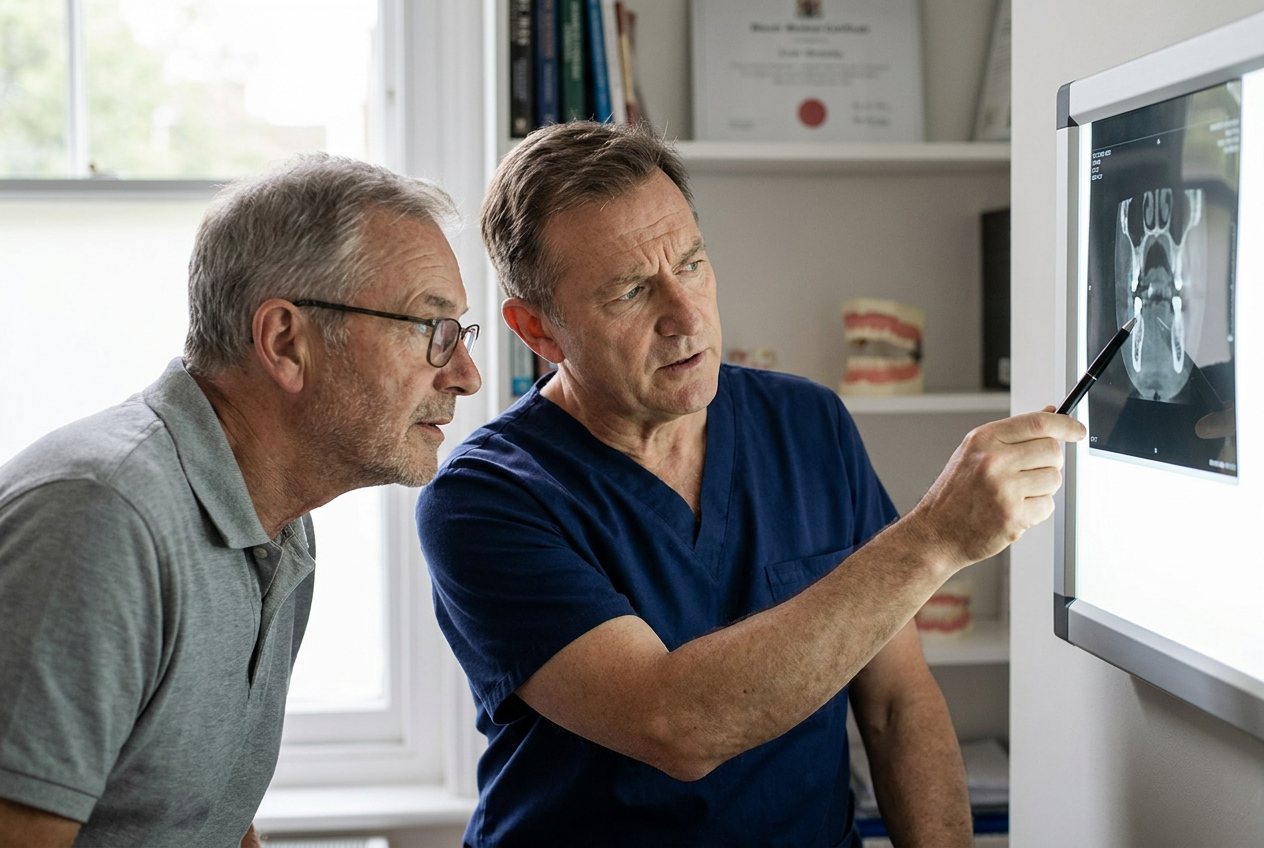
At ANEWU, a first visit is a free consultation with a 3D scan, and no treatment is performed that day. An oral surgeon examines you, reviews the scan and explains your options, including anything that must happen first, such as bone grafting. Dr. Abtin Shahriari, an oral surgeon specializing in implant dentistry, performs the implant exam.
The visit has three parts: the front desk reviews your medical and dental history, a 3D scan maps your jaw in the office, then the surgeon explains what your anatomy supports. Bring your medication list, insurance card and any x-rays from another office. There is no pressure to decide the same day.
If a full arch is the right plan, ANEWU offers a fixed bridge on four implants (All-On-4), six implants (All-On-6) or a number set by your scan (All-On-X). For qualifying cases a temporary fixed bridge can be attached on the day of surgery. It is provisional, and the final bridge is made in the on-site lab after healing. Cost is reviewed after the exam and scan, and CareCredit, Proceed Finance and monthly payment plans are available. When you are ready to see where you stand, you can book a free consultation.
Sources and further reading
- Prevalence of Tooth Loss Among Older Adults: United States, 2015-2018 (NCHS Data Brief No. 368) CDC National Center for Health Statistics, 2020
- Periodontal (Gum) Disease Centers for Disease Control and Prevention, Oral Health (page accessed October 2026)
- Periodontitis in US Adults: National Health and Nutrition Examination Survey 2009-2014 Journal of the American Dental Association, 2018
- Tooth preservation or implant placement: a systematic review of long-term tooth and implant survival rates Journal of the American Dental Association, 2013
- Statement from the American Academy of Periodontology (AAP) on the Importance of Preserving Natural Teeth American Academy of Periodontology, November 2024
- The survival of periodontally treated molars in long-term maintenance: A systematic review and meta-analysis Journal of Clinical Periodontology, 2024
- Do implant-supported prostheses affect bioavailability of nutrients of complete and partially edentulous patients? A systematic review with meta-analysis Clinical Nutrition, 2021
- A Systematic Review of Denture Stomatitis: Predisposing Factors, Clinical Features, Etiology, and Global Candida spp. Distribution Journal of Fungi, 2024
- Prevalence, incidence, systemic, behavioral, and patient-related risk factors and indicators for peri-implant diseases: An AO/AAP systematic review and meta-analysis Journal of Periodontology, 2025
- All-on-4 and All-on-6 implant-supported fixed prostheses for the edentulous jaw: a systematic review and meta-analysis International Journal of Oral and Maxillofacial Surgery, 2026
- Dental implant loss in older versus younger patients: a systematic review and meta-analysis of prospective studies Journal of Oral Rehabilitation, 2017
- Are There Contraindications for Placing Dental Implants? Dental Clinics of North America, 2019
This article is general information about dental and facial procedures, not a diagnosis or medical advice. Every jaw and every health history is different, so the right plan for you can only be set after an exam and imaging with a surgeon.