












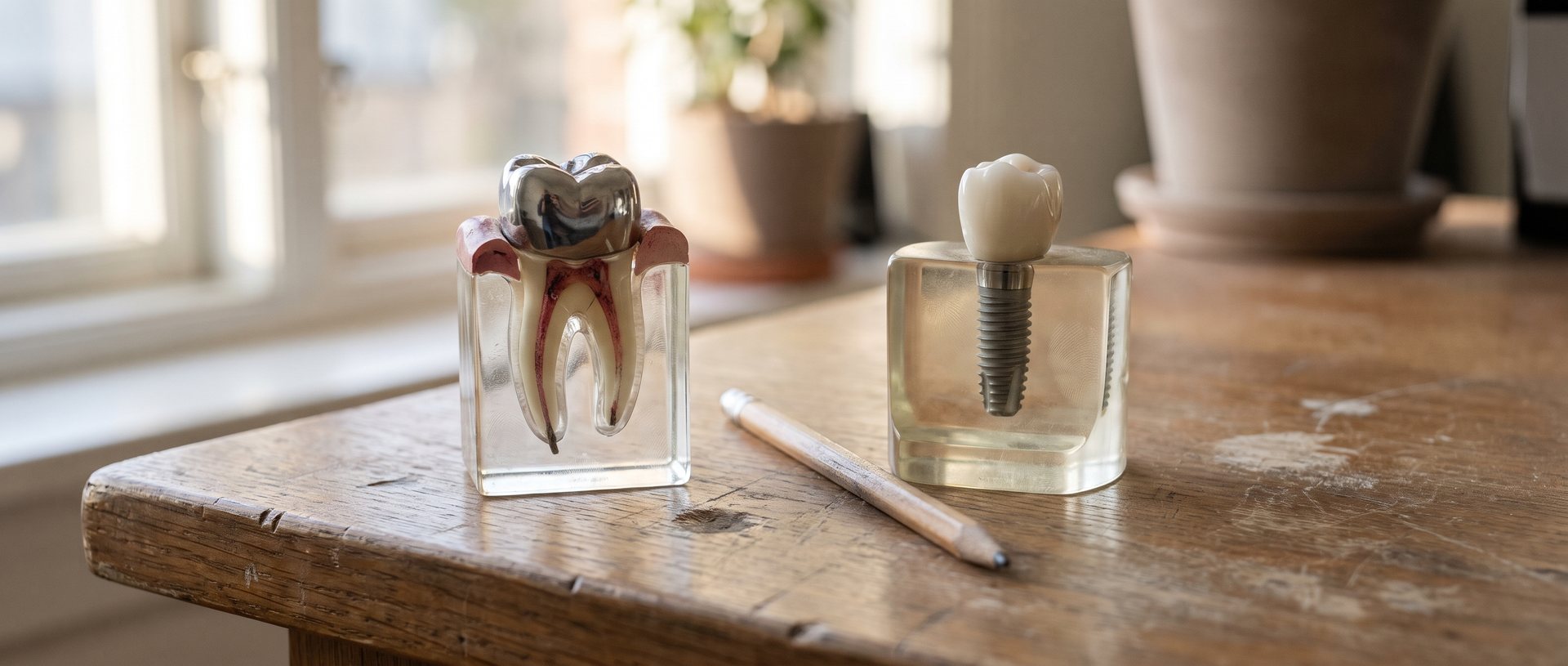
Short answer
Root canal treatment and a dental implant last about equally well in the research, so the condition of your tooth decides. A 2025 systematic review of 12 studies in Acta Odontologica Scandinavica found failure rates of 0.7% to 12.0% with no significant difference between them, though implants needed more follow-up treatment. Keep a tooth that can be restored; replace one that cannot.
What is better, an implant or a root canal?
Neither an implant nor a root canal is better for everyone; the state of the tooth decides. Root canal treatment removes infected pulp from inside a tooth and seals it so you keep the tooth. A 2025 systematic review in the Journal of Prosthetic Dentistry concluded it is unclear which lasts longer, so whether your tooth can be restored is the deciding question.
The table sorts common situations. It reflects what reviews and patient guidance report, not a verdict on your tooth, which needs an exam and x-rays. The 2010 review behind several rows called its evidence on these factors weak. Root canal treatment is general dental care from your dentist or an endodontist, a dentist who specializes in the inside of teeth. An implant replaces the tooth after it is removed.
| State of the tooth | Usually points to | Why |
|---|---|---|
| Infected pulp, enough sound tooth left for a crown | Root canal and crown | Teeth crowned after root canal survived better (2010 review) |
| Crack into the pulp that stays above the gum | Root canal and crown, if it can be sealed | AAE: these cracks can be treated with a root canal |
| Crack below the gum line, or a vertical root fracture | Extraction, then an implant or bridge | AAE: below-gum cracks cannot be saved; root fractures may mean extraction |
| Failed root canal that can be reached again | Retreatment or apical surgery first | Retreated teeth had 95.3% 4-year survival (2011 study) |
| Too little tooth left to rebuild | Extraction and replacement | Cleveland Clinic: severe damage can mean removal and an implant or bridge |
| Little bone support around the tooth, or active gum disease | Weighs against keeping it; gums need treatment before an implant | AAE: poor bone support can make a tooth unsavable; untreated gum disease can rule out implants (Cleveland Clinic) |
| Back molar, or a tooth anchoring a bridge | Can be saved, with a less certain outlook | Molars and bridge anchors survived less well (2010 review) |
Which lasts longer, a root canal or an implant?
Root-canal-treated teeth and single implants last about as long in comparison studies, and the evidence is not strong enough to name a winner. A 2025 systematic review of 12 studies in Acta Odontologica Scandinavica found failure rates of 0.7% to 12.0% with no significant difference, while implants needed more follow-up treatment and had more complications.
Follow-up time matters. A 2010 systematic review in the International Endodontic Journal pooled tooth survival after root canal treatment at 86% at 2 to 3 years, 93% at 4 to 5 years and 87% at 8 to 10 years. Most of its 14 studies were retrospective, and their designs differed enough to make direct comparison hard.
The 2025 Journal of Prosthetic Dentistry review of eight observational studies shows why the answer is unsettled. Three studies found no survival difference in the first 3 years, then a decline for treated teeth; three others found lower survival and more complications for implants. None were randomized trials. An implant can fail too, and our post on the dental implant failure rate explains why.

What if my root canal failed?
A failed root canal can often be treated again before the tooth is replaced. Root canal retreatment means reopening the tooth, removing the old filling and cleaning the canals again. A 2011 prospective study in the International Endodontic Journal found 4-year tooth survival of 95.3% after retreatment, similar to 95.4% after first-time treatment. Extraction and an implant are the fallback.
Apical surgery, also called an apicoectomy, is the other way to save the tooth: the root tip is removed through a small opening in the gum and the end of the canal is sealed. A 2023 systematic review in the International Endodontic Journal compared it with non-surgical treatment in five studies of 529 teeth and found no clear winner. Healing looked slightly better after surgery, tooth survival was higher after non-surgical care, and four of the five studies had a high risk of bias.
A redo makes less sense when the tooth is cracked into the root, has too little structure left for a crown, or has lost bone support. Cleveland Clinic notes the tooth may then be removed and replaced with an implant or bridge. The 2011 study followed teeth treated by dentists in specialist endodontic training, so results elsewhere may differ. Ask what caused the first failure, because the cause shapes the odds of a second attempt.
What hurts more, a dental implant or root canal?
Neither clearly hurts more. A 2025 systematic review of 12 studies in Acta Odontologica Scandinavica found patient-reported pain, satisfaction and quality of life comparable after root canal treatment and implants. Cleveland Clinic says a root canal under modern anesthesia is usually no more painful than a filling, and that most people recover in under a week.
The implant route has more steps: the tooth comes out, the site may need a graft, and the implant is placed, sometimes at a later visit. Cleveland Clinic says you should not feel pain during implant placement and should feel like yourself within a week or so. Throbbing pain that worsens after a root canal is a reason to call. Our post on dental implant surgery pain and recovery covers the implant side.
Root canal or extraction: what happens if you leave the gap?
Pulling a tooth without replacing it is the quickest option, but the gap changes over time. A 2012 systematic review in Clinical Oral Implants Research found horizontal bone loss of 29% to 63% and vertical loss of 11% to 22% in the 6 months after an extraction, with the fastest change in the first 3 to 6 months.
If you replace the tooth, the choices are a dental implant or a bridge, which our dental implant vs bridge guide compares. How soon an implant can follow an extraction depends on healing and bone. Bone loss after an extraction can narrow later options, so if you plan to leave a gap, ask what it would mean for an implant there in a few years.
| Factor | Root canal and crown | Extraction and implant | Extraction, no replacement |
|---|---|---|---|
| Visits | Treatment, then two crown visits | Extraction, any graft, implant surgery, crown | One extraction visit |
| Time to a finished tooth | A few visits | Often months; bone fuses to an implant over 3 to 9 months | None; the gap stays |
| What remains | Your own root and the bone around it | Bone around the implant | Bone shrinks where the root was |
| Cost drivers | The crown, and any retreatment later | Extraction, graft, implant parts, crown, dental benefits | No replacement cost now; replacement later if wanted |
Why do dentists recommend root canals?
Dentists recommend root canals because a treated, crowned tooth can last many years, keeps your own root and avoids surgery. A 2010 systematic review found 87% of treated teeth still in place at 8 to 10 years, and the American Association of Endodontists notes that most teeth can be treated with a root canal, but not all.
Keeping the tooth makes the most sense when enough sound tooth remains for a crown, any crack stays above the gum line, the gum and bone around it are healthy, or a past root canal can be retreated. It also suits you if surgery is a poor fit right now: Cleveland Clinic lists unmanaged diabetes and untreated gum disease among reasons implants may not suit. When several of those go the other way, ask whether replacement would be more predictable.
- Questions to ask your dentist, endodontist or surgeon: can this tooth hold a crown, and how much sound tooth will be left?
- Is there a crack, and does it reach below the gum line or into the root?
- How healthy are the gum and bone around this tooth?
- If this is a redo, what caused the first root canal to fail, and is apical surgery an option?
- If the tooth comes out, what goes in the gap, and when?
- How many visits, and how long until the final tooth, for each option?
- What will each option cost in total, including the crown?
What happens if you see ANEWU about a tooth that may need replacing?
Root canal treatment itself is done by your dentist or an endodontist. If a tooth may need to come out, your first ANEWU visit is a free consultation with an in-office 3D scan, and Dr. Abtin Shahriari, the oral surgeon who places every implant at ANEWU, examines you and explains the options your bone supports, including alternatives worth considering.
No treatment is done at the consultation, and you can bring someone with you. If you would like a surgeon's view on whether a damaged tooth should be replaced, you can book a free consultation.
- Step 1: bring a list of your medications and any recent x-rays from another office. The front desk reviews your medical and dental history.
- Step 2: a 3D scan in the office shows the bone around the tooth, the nerve and the sinus, and where an implant could sit.
- Step 3: Dr. Abtin Shahriari reviews the scan with you on screen and explains the options in plain language.
- If the tooth can be kept and your dentist plans a root canal, a crown usually follows; ANEWU's cosmetic dentistry team plans and fits crowns, including for teeth that need protection after a root canal.
- If the tooth must come out, the plan covers whether the socket should be grafted when it is removed, so the ridge holds its shape for a future implant.
- Step 4: cost is reviewed before you leave, with CareCredit, Proceed Finance and monthly plans explained. Nothing is booked until you decide.
How do I know if I need a root canal, and when is it urgent?
You may need a root canal if a tooth hurts when you chew, stays sensitive to hot or cold, darkens, or has a pimple-like bump on the gum beside it; Cleveland Clinic lists these as signs of infected pulp. Only an exam and x-ray can confirm it. Swelling with pain needs prompt care, and some signs need an emergency room.
Cleveland Clinic notes that tooth infections do not heal on their own, so a lingering toothache is worth an appointment even if it eases. NHS guidance lists a swollen face or jaw and a high temperature as signs of a dental abscess that need an urgent dental visit. Follow the written instructions from your dentist or surgeon for any medicine.
- Book soon: pain when chewing, lingering sensitivity to hot or cold, a darkening tooth, tender gums
- Call today: facial or jaw swelling, a gum boil that oozes pus, a high temperature, a loose tooth
- After a root canal: call if pain throbs, worsens or lasts beyond about a week
- Emergency room or 911: trouble breathing, speaking or swallowing, a lot of swelling in the mouth, a swollen eye, trouble opening your mouth, or a high fever with spreading swelling
Sources and further reading
- Comparative outcomes of endodontically treated teeth versus dental implant-supported prostheses: a systematic review Acta Odontologica Scandinavica, 2025
- Survival, complications, and patient-reported outcomes of endodontically treated teeth versus dental implant-supported prostheses: A systematic review Journal of Prosthetic Dentistry, 2025
- Tooth survival following non-surgical root canal treatment: a systematic review of the literature International Endodontic Journal, 2010
- A prospective study of the factors affecting outcomes of non-surgical root canal treatment: part 2: tooth survival International Endodontic Journal, 2011
- Non-surgical root canal treatment and retreatment versus apical surgery in treating apical periodontitis: A systematic review International Endodontic Journal, 2023
- A systematic review of post-extractional alveolar hard and soft tissue dimensional changes in humans Clinical Oral Implants Research, 2012
- Association between cardiovascular diseases and apical periodontitis: An umbrella review Journal of Dentistry, 2025
- Root Canal Cleveland Clinic, last updated 2026
- Dental Implants Cleveland Clinic, last updated 2026
- Root Canal vs. Dental Implant: Which Is Right for You? American Association of Endodontists
- Dental abscess NHS, reviewed March 2026
- Cracked Teeth American Association of Endodontists
This article is general information about dental and facial procedures, not a diagnosis or medical advice. Every jaw and every health history is different, so the right plan for you can only be set after an exam and imaging with a surgeon.