









Short answer
An oral and maxillofacial surgeon completes dental school plus a hospital-based surgical residency of four to six years that includes anesthesia training. A general dentist completes dental school, and any added implant training varies from dentist to dentist. A dentist with implant training can place straightforward cases, while complex cases such as bone loss, full arch treatment or sedation may go to a surgeon.
What is the difference between a dentist and an oral surgeon?
The main difference is training after dental school. A general dentist completes four years of dental school. An oral and maxillofacial surgeon completes dental school and then a hospital-based surgical residency, which the American Association of Oral and Maxillofacial Surgeons (AAOMS) puts at four to six years, with anesthesia training included.
The ADA's MouthHealthy site says becoming a general dentist generally takes three or more years of undergraduate education plus four years of dental school, and that a DDS and a DMD are the same degree. The National Commission on Recognition of Dental Specialties and Certifying Boards recognizes 12 dental specialties, and oral and maxillofacial surgery is one of them. Implant dentistry is not on that list, so an 'implant dentist' title describes a dentist's focus rather than a recognized specialty.
AAOMS says oral and maxillofacial surgery residents train alongside medical residents in fields that include internal medicine, general surgery and anesthesiology, and that they evaluate patients for anesthesia, deliver the anesthetic and monitor recovery. Dr. Abtin Shahriari's page on ANEWU's site describes his specialty training as including the University of Pennsylvania and Emory University, and says that surgical residency is why he takes on cases other offices send out, such as implants in thin or rebuilt bone and full arch reconstruction.
| Compared | General dentist | Oral and maxillofacial surgeon |
|---|---|---|
| Training | Four years of dental school | Dental school, then a four to six year hospital-based surgical residency |
| ADA-recognized specialty | No, general dentistry is not one of the 12 | Yes, one of the 12 |
| Anesthesia in training | Varies with added training | Part of residency |
Can a general dentist place dental implants?
Yes, a dentist with the right training can. The American College of Prosthodontists says a restorative dentist trained to place and restore implants may be an appropriate provider, and that this varies with each dentist's training and experience. A dentist should refer any implant procedure they are not experienced and trained to do.
Implant training differs from one dentist to the next. A 2019 survey of U.S. dental schools in the Journal of Dental Education heard back from 33 of 64 predoctoral periodontics directors, so its figures are self-reported and partial. Among those schools, 45.5% allowed students to place dental implants, but only 15.2% of the class actually did. That gap is one reason to ask any dentist about implant training instead of assuming it from the degree.
The same position statement, first affirmed in 2014 with revisions affirmed in 2019, describes implant placement as a procedure rather than a specialty. It notes that specialists also vary in their implant experience and should not perform procedures they are not experienced and trained to do, and it says placement without careful diagnosis and treatment planning should be avoided. So a referral from your dentist fits that guidance and is not a red flag.
Does the title or the experience matter more for implant outcomes?
Experience may matter more than the title, but the evidence is limited. A 2017 systematic review and meta-analysis found no significant difference in implant failure when experienced meant specialist, but significantly higher failure for less experienced surgeons when experienced meant having placed more than 50 implants. Use it to guide your questions, not to rank providers.
The review, in the International Journal of Prosthodontics, included 8 studies in its qualitative analysis and 6 in its quantitative synthesis. In four retrospective studies that defined experience as specialist status, the odds ratio for implant failure was 1.24 (95% CI 0.62 to 2.48, P = .54), which is not a significant difference, though the wide interval means a real difference between specialists and other dentists cannot be ruled out. In two studies that defined experience as more than 50 implants placed, the odds ratio was 2.18 (95% CI 1.40 to 3.39, P = .0005), so implants placed by the less experienced group had about twice the odds of failing.
Two caveats apply. The authors asked for more standardized prospective studies. And a 2025 Journal of Dentistry cohort of 1,049 implants placed in a postgraduate teaching setting found that implants placed by early-career students failed more often (5.6%) than those placed by advanced students (3.7%), but that difference was statistically significant only in the simpler univariate analysis. In the multivariate analysis, a history of periodontitis and smoking were the only independent predictors, with hazard ratios of 2.0 and 1.9.
Why would my dentist refer me to a maxillofacial surgeon?
Usually because part of your case goes beyond what the dentist routinely does. The American College of Prosthodontists gives complicated surgical procedures and serious medical conditions as examples that go to an oral and maxillofacial surgeon. Bone that needs grafting, severe upper jaw bone loss, a full arch and sedation are situations where referral can come up.
No single rule decides who places what. The same statement says both the surgical and the restorative parts of implant care can each range from straightforward to complex, so where a given dentist draws the line depends on that dentist's training. The table shows common referral situations and the reason behind each, drawing on a 2021 overview of zygomatic implant reviews and a 2026 analysis of grafted implants.
Not every referral means a complicated case. Sometimes the plan is simple but the dentist does not place implants, and the College says that surgical step should go to a dentist who is competent in placement. ANEWU's Dr. Abtin page says the practice accepts referrals from dental offices across Georgia, with Dr. Abtin handling the surgical portion and the team sending the treatment plan and progress back to the referring practice.
| Situation | Why a surgeon is often involved |
|---|---|
| Thin or short bone | Bone may need grafting before or with the implant. A 2026 analysis of one Israeli dental network's records reported 97.83% clinical success for 45,715 grafted implants, counted as no recorded failure over follow-up that varied. |
| Severe upper jaw bone loss | Zygomatic implants anchor in the cheekbone, and a 2021 overview said they should be directed by appropriately trained clinicians with noticeable surgical experience. |
| Replacing a whole arch | The College says the more complex or extensive the care, the more critical the provider's experience. |
| Sedation | AAOMS says surgery residents train to evaluate, deliver and monitor anesthesia. |
| Serious medical condition | The College names this as an example of referral to a surgeon. |
| Significant gum disease | A periodontist may be the better referral, the College says. |
Who can provide sedation for implant surgery?
AAOMS says oral and maxillofacial surgeons are trained in all aspects of anesthesia administration. Sedation options differ from office to office, so ask what level is planned, who gives it and what training that person has. If anxiety is what has kept you from replacing a tooth, say so at your first visit.
AAOMS states that during four to six years of hospital-based surgical residency, residents evaluate patients for anesthesia, deliver the anesthetic and monitor patients afterward. That is a training fact, not a promise about any one office, which is why the question to ask is specific: what level of sedation, given by whom, and with what monitoring.
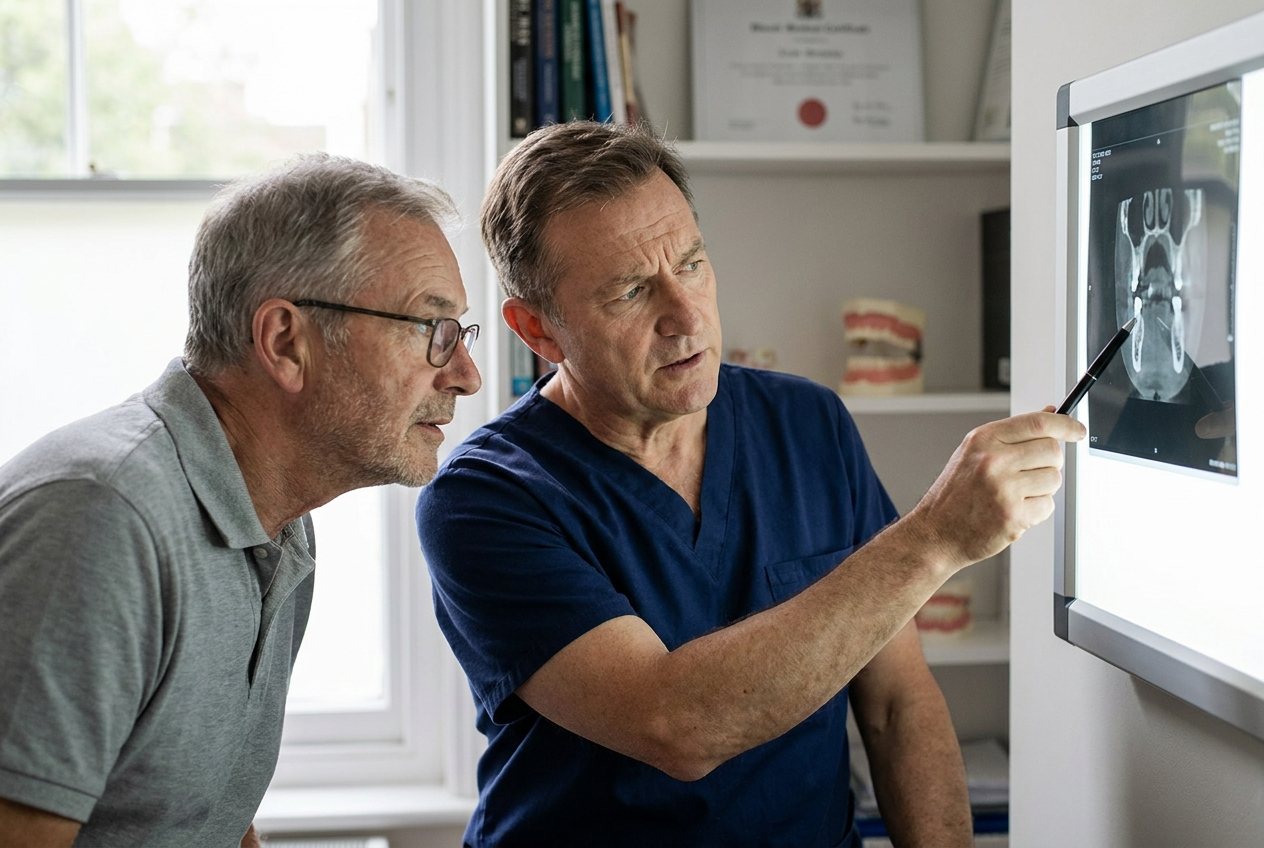
ANEWU's first-visit page says a first visit is an exam, a conversation and a 3D scan, with nothing drilled, extracted or placed that day, and that anesthesia and sedation options are discussed before any surgery is scheduled. It also says that if dental appointments make you anxious, you can tell the team at check in, which changes how the appointment is paced.
What should you ask any provider before implant surgery?
Ask how often they do your exact procedure, what training they have in it, how it will be planned, who gives sedation, who makes the final teeth and what follow-up looks like in the first year. The American College of Prosthodontists suggests asking how often a dentist does the procedure and what training they have had.
Planning is worth asking about because it can be measured. A 2021 systematic review and meta-analysis in BDJ Open compared guided and free-hand placement. Across four studies in its meta-analysis, implant failure was 2.25% with guided surgery and 6.42% with free-hand placement, though both approaches had high survival rates. ANEWU's services page says implant position and angle are mapped before surgery day using 3D imaging and guided surgery.
Follow-up matters because trouble tends to show up early. A 2026 retrospective analysis of 158,824 implants in a nationwide dental service in Israel recorded 3,507 failures, and 70% of them occurred within the first year. Ask when you will be seen during that year, who to call if something feels wrong, and what the office does if an implant does not integrate.
- How many of this exact procedure do you do each year, and how recently?
- What training do you have in it, and how long was it?
- How will my implants be planned, from a 3D scan and with a surgical guide?
- What level of sedation will I have, who gives it, and what is their training?
- Who makes my final teeth, and will that person see my plan before surgery?
- What is the follow-up schedule in the first year, and what happens if an implant does not heal?
How do you choose an implant surgeon in Atlanta?
Compare providers on training, caseload, planning and follow-up rather than on titles or rankings. For any Atlanta surgeon, check who performs the surgery, how cases are planned and who builds the teeth. Then ask the questions above at a consultation, ideally one that includes imaging of your own jaw.
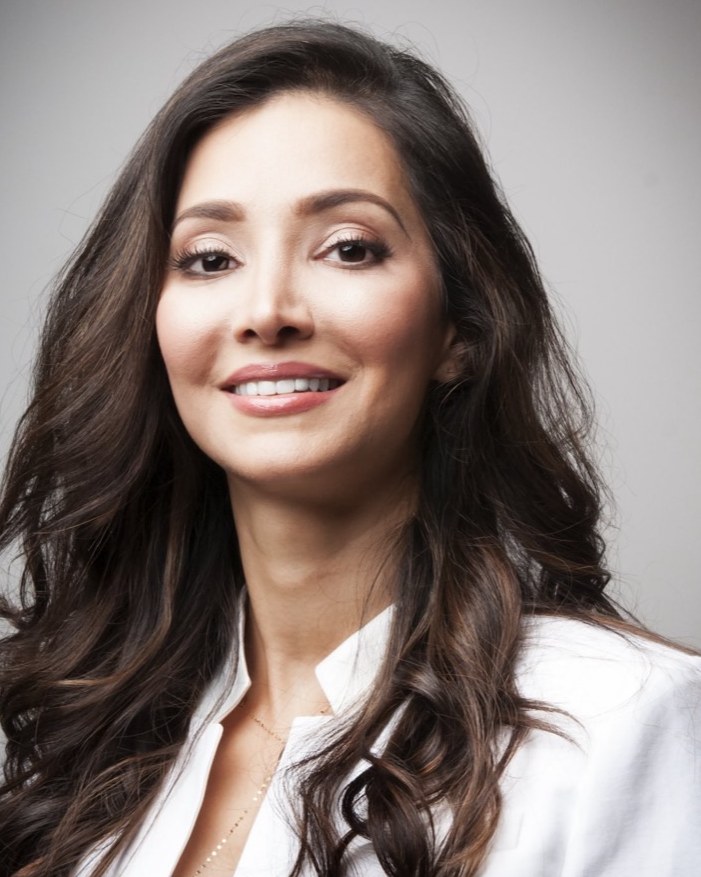
Here is what ANEWU's own pages say, so you can hold them against that checklist. Dr. Abtin Shahriari, DMD, MPH, is an oral and maxillofacial surgeon. His page says he performs the oral surgery and implant procedures at ANEWU himself, including full arch cases, and plans them, so the surgeon who reads your 3D scan is the surgeon in the operatory.
The About page is direct about limits. ANEWU is a surgical practice with no hygiene department and no root canals, and crowns exist only as part of cosmetic work, so you keep your general dentist for routine care. The team page describes an imaging team that captures the 3D scan and an in-house lab that finishes restorations. If another office has told you that you do not have enough bone, the site names bone grafting and zygomatic implants as the two routes that usually remain, says a 3D scan decides which applies, and says not every jaw qualifies for either.
Do you have to leave your general dentist to see an oral surgeon?
No. A referral is a handoff, and your general dentist can stay involved. The American College of Prosthodontists says a referring dentist should communicate specific instructions and provide any necessary surgical template to the dentist doing the surgery, so the plan travels with you.
The same statement warns that implants placed with improper position, orientation or without adequate space for the restoration can compromise function, durability and appearance, and that restoring improperly placed implants can be expensive and burdensome. That is why the surgeon and the dentist who will make the teeth should agree on the plan before surgery, not after it.
If you are weighing a referral, or want to understand a plan another office has given you, a first visit at ANEWU is a free consultation that includes the 3D scan, and no treatment is performed that day. You can read what to expect at your first visit, then book a consultation when you are ready, or call (470) 567-6415.
Sources and further reading
- OMS are the Experts in Face, Mouth and Jaw Surgery MyOMS.org, American Association of Oral and Maxillofacial Surgeons
- Dental Implant Surgery MyOMS.org, American Association of Oral and Maxillofacial Surgeons
- Recognized Dental Specialties National Commission on Recognition of Dental Specialties and Certifying Boards (ADA)
- DDS and DMD MouthHealthy, American Dental Association
- Dental Implants (position statement) American College of Prosthodontists, affirmed November 2014, revisions affirmed 2019
- Does Surgical Experience Influence Implant Survival Rate? A Systematic Review and Meta-Analysis International Journal of Prosthodontics, 2017
- Dental Students' Exposure to Periodontal and Implant Placement Surgeries in U.S. Dental Schools Journal of Dental Education, 2019
- Survival of dental implants placed in a postgraduate educational setting: a retrospective cohort study Journal of Dentistry, 2025
- Zygomatic implants placed in atrophic maxilla: an overview of current systematic reviews and meta-analysis Maxillofacial Plastic and Reconstructive Surgery, 2021
- Failure rates associated with guided versus non-guided dental implant placement: a systematic review and meta-analysis BDJ Open, 2021
- Clinical Success Rates of Dental Implants with Bone Grafting in a Large-Scale National Dataset Journal of Functional Biomaterials, 2026
- About the AAP American Academy of Periodontology
This article is general information about dental and facial procedures, not a diagnosis or medical advice. Every jaw and every health history is different, so the right plan for you can only be set after an exam and imaging with a surgeon.