












Short answer
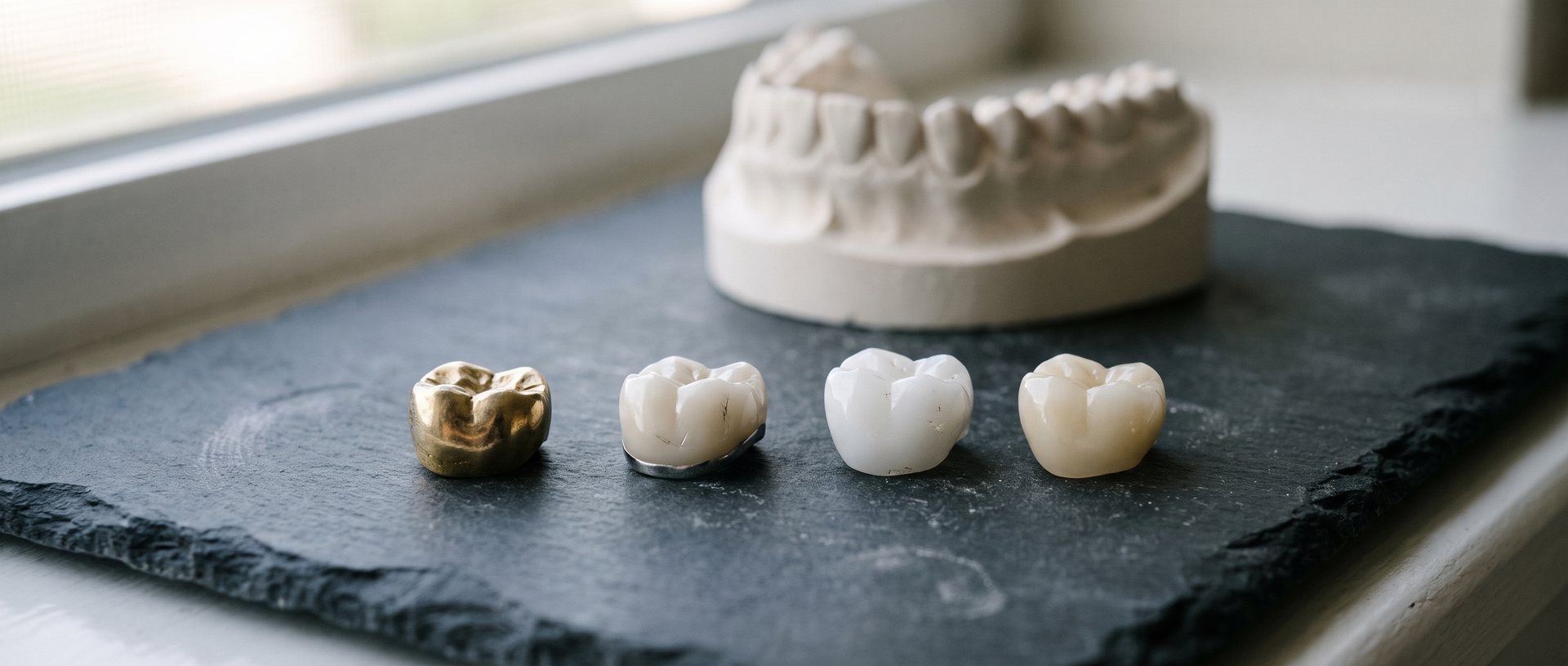
Dental crowns usually last at least 5 years and can last 15 to 20, according to MedlinePlus from the US National Library of Medicine. Long-term studies show the spread: in a 2023 Clinical Oral Investigations study, 80.1% of lithium disilicate back-tooth crowns were still in place after 15 years, and in a 2025 Journal of Prosthetic Dentistry cohort, 86.0% of solid zirconia back-tooth crowns lasted 10 years.
How long do porcelain and zirconia crowns last?
Most porcelain and zirconia crowns in long-term studies were still in place after 10 years. In a 2023 study in Clinical Oral Investigations, 83.5% of lithium disilicate (glass-ceramic) back-tooth crowns survived 10 years and 80.1% survived 15. A 2026 systematic review of 66 studies in the Journal of Dentistry put zirconia single-crown survival at 92.9% to 98.7% over follow-ups of up to 10 years.
Two definitions help read the table. Survival means the crown was still in the mouth at follow-up; success means it also had no complications. The gap can be wide. The same 2026 review pooled 10-year success for zirconia single crowns at 46.1%, with mechanical complications such as chipping and debonding at 53.9%, and it rated the certainty of the evidence very low.
Read the follow-up column before comparing rows, because 5-year figures can flatter. In a 2018 study of 137 zirconia-based crowns at a Japanese university hospital, survival was 98.5% at 5 years but 67.2% at 10, and chipping of the porcelain layered over the zirconia was the most common complication. Your own crown's odds also depend on the tooth under it, where it sits and how hard you bite.
| Crown and tooth | Survival | Follow-up | Study type, year |
|---|---|---|---|
| Lithium disilicate (glass-ceramic), back teeth | 83.5% at 10 years, 80.1% at 15 | 15 years | Clinical study, 34 crowns, 2023 |
| Solid (monolithic) zirconia, back teeth | 86.0% at 10 years | 10 years | Retrospective cohort, 255 crowns in total, 2025 |
| Porcelain-layered zirconia, back teeth | 71.0% at 10 years (gap vs solid not statistically significant) | 10 years | Same 2025 cohort |
| Zirconia-based crowns, front and back teeth | 98.5% at 5 years, 67.2% at 10 | Up to 12 years | Retrospective cohort, 137 crowns, 2018 |
| Zirconia single crowns, pooled | 92.9% to 98.7% | Up to 10 years | Systematic review, 66 studies, 2026 |
| Metal-ceramic, tooth with a living nerve | 97.1% | 5 years | Systematic review, 26 studies, 2024 |
| Metal-ceramic, root-filled tooth with a post | 90.7% to 91.3% | 5 years | Same 2024 review |
| Feldspathic porcelain or zirconia, back vs front teeth | Significantly lower on back teeth | 5 years (estimated) | Systematic review, 67 studies, 2015 |
Do dental crowns last forever?
No study shows dental crowns lasting forever, though some last decades. Cleveland Clinic says crowns can last upwards of 30 years with proper care, while the longest study in the table above followed lithium disilicate crowns for 15 years and found 80.1% still in place. Expect a crown to need attention at some point, and the tooth under it to need regular checks.
Zirconia draws the forever question because it is so strong, but strength is not the whole story. In the 2026 Journal of Dentistry review, more than half of zirconia single crowns had a mechanical problem such as chipping or debonding by 10 years, even though most were still in place. A crown that stays in can still need repair or replacement. Questions to ask your dentist about a new or replacement crown:
- Which material do you suggest for this tooth, and why?
- Is the crown solid or layered with porcelain?
- Is the tooth underneath alive or root-filled, and how much is left?
- Does my bite or grinding put this crown at risk?
- How should I clean the edge, and how often should it be checked?
- If this tooth fails later, what are my options?
Why do crowns fail, and what happens to the real tooth underneath?
Crowns fail through the tooth or through the crown. In a 2003 review in the Journal of Prosthetic Dentistry, the three most common complications of single crowns were the need for root canal treatment (3%), porcelain fracture (3%) and loss of retention (2%). The 2026 zirconia review found secondary decay and nerve inflammation led the biological problems, and chipping and debonding the mechanical ones.
The real tooth under a crown is reshaped to make room, but it is still a living structure with a nerve and a root. MedlinePlus lists the problems that follow: a cavity under the crown, a crown that falls off because the core holding it is too weak, a nerve that needs a root canal, and a crown that chips or cracks. Grinding is a common thread, and MedlinePlus advises a night guard if you clench or grind.
Whether the tooth is alive matters. A 2024 systematic review in the Journal of Prosthodontics found 5-year survival of 97.1% for metal-ceramic crowns on teeth with a living nerve, against 90.7% to 91.3% on root-filled teeth restored with a post. The authors caution that the studies were few and clinical factors were not controlled, so treat the gap as a direction rather than a precise figure.
Can a tooth still rot under a crown?
Yes. A crown covers the tooth above the gum, but the edge where crown meets tooth can still decay. MedlinePlus states that the tooth under a crown can still get a cavity, and the 2026 zirconia review named secondary caries, meaning new decay beside an existing restoration, as a predominant biological complication.
Decay under crowns tends to show up late. In the 15-year study of lithium disilicate crowns, survival fell from 83.5% at 10 years to 80.1% at 15 years, and the authors attributed the decline mainly to decay in the teeth under the crowns. They add that such decay is frequent under metal crowns too, so switching materials does not remove the risk. Cleveland Clinic notes that a crown that does not fit properly can trap bacteria and lead to decay.
Prevention is aimed at the margin. MedlinePlus advises brushing twice a day and flossing once a day, and regular checkups let your dentist examine the crown's edge, where decay starts. On an older crown, ask at each visit whether the margin still looks sealed.
Can you put a crown on a front tooth, and does it last as long?
Yes, crowns are used on front teeth, and most crown types last about as well there as on back teeth. A 2015 systematic review of 67 studies in Dental Materials found that feldspathic porcelain and zirconia crowns survived significantly less well on back teeth, while other types performed similarly. Molars carry more risk: the 2018 zirconia study found significantly more complications on molar crowns than on front-tooth crowns.
Back teeth take more chewing force, and the numbers show it. In a 2025 cohort of 255 back-tooth zirconia crowns, molar crowns had about six times the hazard of crown complications of premolar crowns, and upper crowns about nine times that of lower ones. A 2026 review of 64 studies in the International Journal of Prosthodontics found front and back teeth performed alike for most materials, except feldspathic porcelain and metal-ceramic crowns; our veneers vs crowns vs bonding guide compares its 5-year figures by material.
On front teeth the trade-off is appearance. Cleveland Clinic notes that all-ceramic crowns mimic enamel more closely than any other type, but the 2015 review advised limiting weaker feldspathic ceramics to front teeth. A crown also removes more tooth than a veneer or bonding, so for a sound front tooth with only a cosmetic flaw, ask about those first.
What are the signs a crown needs replacing?
The signs a crown may need replacing are a crown that feels loose or comes off, a crack, chip or sharp edge, a bite that feels wrong, sensitivity or pain that grows instead of fading, and a bad taste or bad breath around the tooth. Cleveland Clinic lists a loose crown, cracks or chips, sharp edges, and bad breath or a bad taste as reasons to call your dentist.
Age alone is not a sign. A crown that is 15 years old, sealed and comfortable can stay, while a 3-year-old crown with a leaking edge cannot. If a crown comes off, keep it, chew on the other side and call your dentist, because the tooth under it needs checking before anything is cemented back. Signs to report:
- The crown feels loose, moves or falls off
- A chip, crack or sharp edge your tongue finds
- Your bite feels off when you close
- Sensitivity to hot or cold that lingers, or pain on biting
- A bad taste or bad breath around the tooth
- Gum soreness or swelling around the crown
When should you call about a crown right away?
Call your dentist right away for swelling that is getting worse, tooth pain that over-the-counter pain medicine does not relieve, or a crown that has come off and left a sharp or very sensitive tooth. Go to an emergency room or call 911 for swelling that is spreading, trouble breathing or swallowing, or a high fever.
A crowned tooth can still become infected. The 2026 zirconia review lists nerve inflammation and apical periodontitis, an infection or inflammation at the root tip, among the main biological complications. Swelling of the gum or face over a crowned tooth deserves a call rather than a wait for a routine visit.
Does getting a crown hurt?
Getting a crown usually does not hurt during the procedure, because the tooth is numbed first. MedlinePlus describes numbing the tooth, the neighboring teeth and the gums so you do not feel anything. Afterwards, Cleveland Clinic says sensitivity to heat and cold for a couple of weeks and sore gums are normal, but not pain that keeps you up at night.
If you feel pain during the visit, say so; Cleveland Clinic notes your dentist can give more anesthetic. A tooth that still has its nerve is the one most likely to be sensitive afterwards, and MedlinePlus says this should go away over time and that it takes a few days to get used to a new crown. Sensitivity that grows instead of fading can mean the nerve is affected and may need a root canal.
What happens when a crown reaches its life span?
When a crown reaches the end of its life, the old crown is removed, the tooth underneath is checked and cleared of decay, and a new crown is made, usually over two visits. If too little sound tooth is left, the plan changes: MedlinePlus notes a tooth with nerve problems may need a root canal, or removal and a dental implant.
At ANEWU, crown work is handled by the cosmetic dentistry team, and the free consultation confirms whether your tooth needs a new crown at all. If imaging shows the tooth underneath is sound, replacement follows the steps below. If the tooth cannot be restored, an implant is one replacement option, and Dr. Abtin Shahriari, an oral surgeon specializing in implant dentistry, performs all implant surgery at ANEWU. ANEWU is not a general dental practice, so keep seeing your regular dentist for checkups. You can book a consultation to have an old crown checked. The replacement visits, step by step:
- Exam and imaging: digital images show the tooth under the old crown, including hidden decay or cracks.
- Preparation: with the tooth numbed, the old crown and any decay are removed, the tooth is reshaped, and a scan or impression is taken.
- Temporary crown: you leave with a temporary while the new crown is made to your shade.
- Fit and bonding: on the second visit, your dentist checks how the crown seats, seals at the gum edge and meets your bite, then bonds it.
Sources and further reading
- A Systematic Review and Meta-analysis Evaluating the Survival, Failure, and Complication Rates of Metal-Ceramic, Veneered, and Monolithic All-Ceramic Tooth-Supported Single Crowns, Part 1 International Journal of Prosthodontics, 2026
- Clinical outcomes of zirconia dental restorations: a systematic review and meta-analysis Journal of Dentistry, 2026
- Survival of fixed prosthetic restorations on vital and nonvital teeth: a systematic review Journal of Prosthodontics, 2024
- Long-term survival of monolithic tooth-supported lithium disilicate crowns fabricated using a chairside approach: 15-year results Clinical Oral Investigations, 2023
- Long-term clinical outcomes of posterior monolithic and porcelain-fused zirconia crowns: a retrospective cohort study Journal of Prosthetic Dentistry, 2025
- Clinical evaluation of zirconia-based all-ceramic single crowns: an up to 12-year retrospective cohort study Clinical Oral Investigations, 2018
- All-ceramic or metal-ceramic tooth-supported fixed dental prostheses? A systematic review of the survival and complication rates. Part I: single crowns Dental Materials, 2015
- Clinical complications in fixed prosthodontics Journal of Prosthetic Dentistry, 2003
- Dental crowns (Medical Encyclopedia) MedlinePlus, US National Library of Medicine, reviewed 2024
- Dental Crowns Cleveland Clinic, last updated 2023
This article is general information about dental and facial procedures, not a diagnosis or medical advice. Every jaw and every health history is different, so the right plan for you can only be set after an exam and imaging with a surgeon.