








Short answer
Pterygoid implants are long dental implants angled through the back of the upper jaw into the dense pterygoid bone behind it, used when the back of the jaw has lost the bone standard implants need. A 2026 Delphi consensus of 55 experienced surgeons agreed on implants 16 to 22 mm long, and the American College of Prosthodontists calls them a scientifically validated, predictable option.
What are pterygoid implants?
A pterygoid implant is a dental implant set at the far back of the upper jaw, passing through the tuberosity behind the last molar into the pterygoid process of the sphenoid bone. The ACP's position statement, reaffirmed in 2023, explains that the tuberosity has the lowest bone density in the mouth but rests against dense cortical bone that can hold an implant.
Their main purpose is to avoid a sinus lift and bone graft. The ACP notes that sinus lifts give good implant survival but bring more surgical morbidity, grafting, cost and time, and do not allow teeth to be attached right away in people with no teeth. Pterygoid implants avoid the thin bone under the sinus by anchoring in the dense plates behind it. The ACP calls them especially helpful in a fixed full upper arch when four implants alone cannot spread the biting forces well enough.
You are most likely to hear about them if you have lost upper back teeth, the bone under the sinus is thin, and you want fixed teeth without months of grafting first. Grafting and zygomatic (cheekbone) implants are the other two common routes in that situation. For how they differ from cheekbone implants, see our zygomatic vs pterygoid comparison rather than a repeat here.
What happens during pterygoid implant surgery?
Pterygoid implant surgery runs in four stages: a 3D scan, placing the implant along a steep planned path, fixed temporary teeth when the case allows, and the final bridge once the bone has healed. In a 2026 Delphi study of 55 surgeons from 25 countries, 98% agreed a CBCT scan is mandatory, and the panel agreed on immediate loading when primary stability, how firmly the implant holds on the day, is adequate.
The angle is what makes this surgery different. The Delphi panel agreed on an entry point behind the second molar, a path tilted 30 to 50 degrees upward and backward and 15 to 35 degrees toward the midline, and a tip ending between the pterygoid plates. That steep, deep path is why the scan comes first. A Delphi study records what experienced surgeons do, and its authors stress that it describes expert practice, not evidence-based recommendations.
Anesthesia is a decision you make with your surgeon. The ACP says pterygoid implants can be placed under local anesthesia in a dental office, unlike zygomatic implants, which usually need sedation or general anesthesia, but the 2026 Delphi panel reached no consensus on anesthesia or sedation. Our guide to sedation for dental implants explains the choices. What you feel and decide at each stage:
- Scan: a CBCT shows whether the pterygoid bone can take an implant. You weigh this route against a graft or cheekbone implants.
- Placement: you open wide for the back of the mouth while the implant goes in at the planned angle, usually alongside other implants in the arch.
- Provisional bridge: if the implants are stable enough, fixed temporary teeth go on soon after surgery. Teeth fitted the same day are provisional, not the final set.
- Final bridge: after the implants have fused with bone, the final fixed bridge is made and fitted.

How long are pterygoid implants?
Pterygoid implants are long: the 2026 Delphi consensus panel agreed on a tapered implant 16 to 22 mm long with a narrow cutting tip. A 2026 meta-analysis in Clinical Implant Dentistry and Related Research included only pterygoid implants of at least 13 mm. The extra length is needed to cross the soft tuberosity bone and reach the dense plates behind it.
The ACP shows why angle and length go together: an implant passed through the junction of those plates at 45 degrees can engage up to 8 to 9 mm of dense bone, with its tip protruding about 2 mm into the pterygoid fossa, a hollow between the plates. If you meant how long they last, failures cluster in the first year (see the risks below), and the ACP notes that data beyond 10 years are scarce for any implant type in use today.
What is pterygoid implant recovery like, week by week?
Recovery after pterygoid implants follows the pattern of other implant surgery, with jaw stiffness added. The ACP names bleeding, trismus (difficulty opening the mouth) and pain as the common surgical complications, all manageable. AAOMS describes some discomfort, swelling and bruising as normal, a soft diet in the early stages, and bone fusing to the implant over several months.
Two things set pterygoid recovery apart. The implant sits near the chewing muscles at the back of the jaw, so trouble opening wide is the complaint to expect and to mention at follow-up if it is not improving. And if a provisional bridge went on, you are chewing on new implants; AAOMS explains that a soft diet keeps pressure off the surgical site while bone grows onto the implant.
When the final bridge goes on varies. In a 2024 systematic review of 38 studies in the Journal of Clinical Medicine, 31.3% of pterygoid implants were loaded immediately and 50.8% were loaded 4 to 6 months after placement. Our full-arch recovery timeline covers eating and returning to work in more detail, and the general post-op instructions describe the first days. Follow the written instructions from your surgeon where they differ.
| When | What is typical | What helps | Source |
|---|---|---|---|
| First 24 hours | Oozing and swelling starting | Ice outside the face, head raised, no straws, spitting or smoking | ANEWU post-op page |
| Days 2 and 3 | Swelling and bruising, sometimes along the jaw or neck | Soft, cool foods; gentle salt-water rinses if directed | ANEWU post-op page |
| First week | Stiffness when opening; soreness that should ease | No strenuous exercise; report pain that worsens | ACP 2023; ANEWU |
| Following weeks | Bone and gum healing around the implants | Soft diet as advised; follow-up visits | AAOMS |
| After several months | Implants fused with bone | Final bridge made and fitted | AAOMS; 2024 review |
What are the risks and disadvantages of pterygoid implants?
The risks of pterygoid implants fall into three groups: problems around surgery such as bleeding, trismus and pain, which the ACP calls manageable; a small chance of losing the implant, mostly in the first year; and a position that is hard to clean and check. A 2026 meta-analysis of 17 studies and 1,915 implants put the overall failure rate at 2.1%.
Failure clusters early. In the 2024 review, which followed pterygoid implants for 62.9 months on average, 155 of the 208 failures happened in the first year, and 94.9% of implants were still in place at the end of it. Against standard implants, a 2026 meta-analysis of six full-arch studies in the International Journal of Oral and Maxillofacial Surgery found 95.25% survival for pterygoid implants and 97.88% for conventional ones.
Rarer events are harder to pin down. The 2024 review reports a few cases such as an implant pushed into the pterygoid fossa, sinus perforation or sinusitis, and palatal numbness that lasted 4 weeks, and the 2026 meta-analysis of 17 studies found complications unevenly reported and rated the certainty of its evidence low to very low.
Day to day, the drawback is access. The ACP notes these implants are harder to reach for both clinicians and patients, and that bone loss around them is hard to judge on x-rays. That puts more weight on cleaning at the back of the bridge and on regular checkups. Implants not joined to others, such as single crowns, also had lower survival in the 2024 review.
Are pterygoid implants safe, and who is not a candidate?
Pterygoid implants are an established option for suitable patients: the ACP calls them scientifically validated and predictable, while naming a learning curve and nearby vital structures as disadvantages. They are not for everyone. The ACP lists trismus or reduced mouth opening as contraindications, and says they are not feasible without a tuberosity or when an impacted upper wisdom tooth blocks access.
Bone loss itself does not rule you out; it is the reason these implants exist. But the ACP is clear that before consent you should hear the advantages, disadvantages, alternative treatments, risks, sequence and approximate cost. Pterygoid implants may not be the right choice if any of these apply:
- You cannot open your mouth wide, or you have trismus
- Your tuberosity is missing, or an impacted upper wisdom tooth is in the way
- You have enough bone for standard implants, which survived better in the 2026 comparison
- You want a single stand-alone implant at the very back of the jaw
- You are not able to clean carefully at the back of a fixed bridge
When should you call your surgeon after pterygoid implant surgery?
Call your surgeon's office right away, without waiting for the next business day, for bleeding that will not stop, severe swelling or a reaction to a medicine, as ANEWU's post-op page advises. For trouble breathing or swallowing, swelling that is spreading, or a high fever, go to an emergency room or call 911.
During office hours, phone the practice if pain, swelling or bleeding gets worse after the first day or two instead of better, if your mouth opens less each day rather than more, if the palate stays numb, if you notice sinus pressure or discharge on one side, or if the provisional bridge or an implant feels loose. The 2024 review reports palatal numbness and sinusitis among complications, and most failures happen in the first year, so reporting early lets your surgeon act sooner.
Where can I get pterygoid implants in Atlanta, GA?
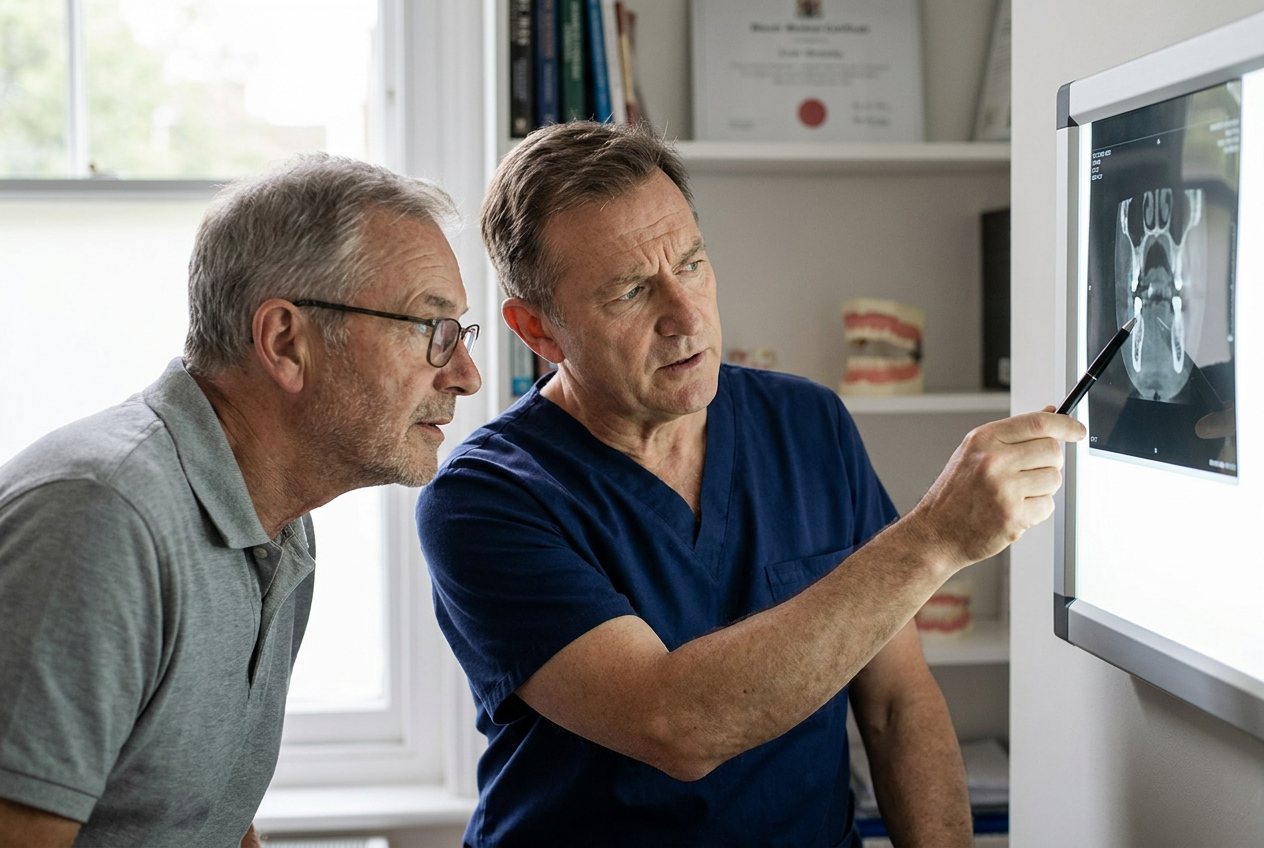
At ANEWU, Dr. Abtin Shahriari, an oral surgeon specializing in implant dentistry, plans and places pterygoid implants, with surgery available at the Buckhead, Cumming and Dawsonville offices. Planning starts at a free consultation with a 3D scan of the back of your upper jaw, including the pterygoid plate, and you look at the plan on screen before anything is decided.
If the scan shows the pterygoid bone can hold an implant at the needed angle, it usually joins other implants in the same arch to carry the bridge. If it cannot, the discussion turns to zygomatic implants or bone grafting, and sometimes both anchors are used. Fixed temporary teeth soon after surgery depend on how firmly the implants hold on the day, and some cases do not qualify. The final bridge is made in the on site lab after healing.
You go home with written aftercare for your procedure, and follow-up visits can be at the office nearest you, because records move between the three. If you would like your own scan read, you can book a consultation. Questions to ask your surgeon, based on the ACP's informed-consent list:
- What are the advantages and disadvantages for my jaw?
- What are my alternatives, such as a graft or cheekbone implants?
- Which risks apply to me?
- What is the sequence of visits, and when do I get fixed teeth?
- What is the approximate total cost?
- What anesthesia or sedation do you plan?
- How will I clean around the back implants?
Sources and further reading
- Use of Implants in the Pterygoid Region for Prosthodontic Treatment (position statement, approved 2017, reaffirmed 2023) American College of Prosthodontists, 2023
- Healing Process for Dental Implants American Association of Oral and Maxillofacial Surgeons, 2026
- Expert consensus on clinical practice in pterygoid implant rehabilitation: a modified Delphi study International Journal of Oral Implantology, 2026
- Indications, Techniques and Complications Associated With Pterygoid Implants: A Systematic Review and Meta-Analysis Clinical Implant Dentistry and Related Research, 2026
- Clinical Outcomes of Pterygoid and Maxillary Tuberosity Implants: A Systematic Review Journal of Clinical Medicine, 2024
- Effectiveness of pterygoid dental implants in the complete arch rehabilitation of the edentulous maxilla: a systematic review and meta-analysis International Journal of Oral and Maxillofacial Surgery, 2026
- Medial Pterygoid Muscles Penetration by Tubero-Pterygoid Implants: Clinical, Anatomical and Statistical Insights Regarding Temporo-Mandibular Disorders Life (Basel), 2026
This article is general information about dental and facial procedures, not a diagnosis or medical advice. Every jaw and every health history is different, so the right plan for you can only be set after an exam and imaging with a surgeon.