








Short answer
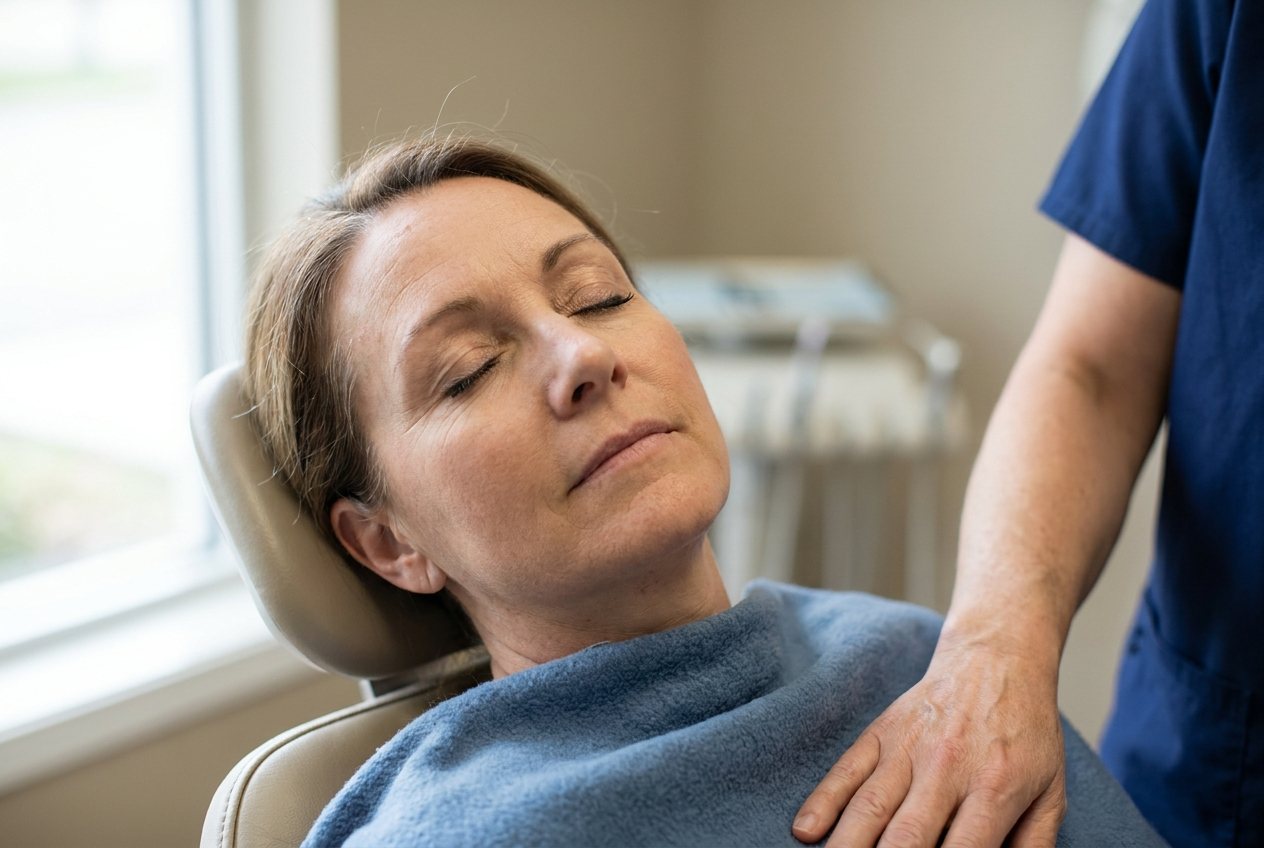
Many people have dental implants placed awake, with local anesthetic numbing the site. Sedation adds calm or sleepiness on top and follows a four-step scale: minimal, moderate, deep and general anesthesia. The step depends on how deeply you are sedated, not on whether the medicine is a gas, a pill or an IV. Ask your surgeon which options are offered and which fits your health.
What kind of sedation is used for dental implants?
In general, the options run from local anesthetic alone to nitrous oxide gas, oral sedation, IV sedation and general anesthesia. Local anesthetic numbs the site, and sedation adds calm or sleepiness on top. ANEWU's FAQ page says implant placement uses local anesthesia and, when appropriate, sedation. It does not list the sedation types, so ask which options your surgeon offers.
The American Dental Association (ADA) says in its 2025 sedation guidelines that the level of sedation is entirely independent of the route of administration. Nitrous oxide combined with other sedatives may produce anything from minimal sedation to general anesthesia. So the name of the method tells you less than the depth your surgeon is aiming for.
That does not make IV and oral sedation identical. The American Association of Oral and Maxillofacial Surgeons (AAOMS), the oral surgeons' professional body, says the intravenous route has the most rapid onset. A 2017 Scottish guideline says the state produced by oral sedation might be comparable to IV sedation but is less controlled and therefore less predictable. With an IV, the team can add small doses until they reach the effect they want, which the ADA calls titration.
| Type | How aware you are | Typical recovery | What to know |
|---|---|---|---|
| Local anesthetic only | Awake, with the site numb | No sedation to wear off | In a 2022 study of 366 patients, about 90% rated pain during surgery as none or mild. |
| Nitrous oxide (gas) | Awake. You hear and respond to the team | Wears off soon after the mask is removed | Not meant to put you to sleep. Some patients feel light-headed or tingly. |
| Oral sedation (pill) | Often minimal, sometimes moderate: you can answer, but coordination may be off | Plan for an escort and a rest day | Less controlled than IV. Depth varies, so ask what is planned. |
| IV sedation | Moderate or deeper, depending on the plan: drowsy to asleep, with limited memory | Monitored recovery, then home with an escort | Needs an IV line. Small doses are added while your response is watched. |
| General anesthesia | Unconscious and not arousable | Probably longer than after IV sedation | Breathing often needs support from the team. |
What are the four levels of sedation?
The American Society of Anesthesiologists (ASA) sets out four points on one scale: minimal sedation, moderate sedation, deep sedation and general anesthesia. What separates them is how easily you can be woken and whether you can keep breathing without help. Your surgeon aims for one level and should be able to rescue you if you drift deeper.
The ASA statement, last amended in October 2024, treats sedation as a continuum and says it is not always possible to predict how an individual patient will respond. For moderate sedation, the ADA guidelines require continuous pulse oximetry and at least one additional person trained in Basic Life Support besides the dentist.
The Scottish guideline's principle of minimal intervention is to use the simplest effective technique for the patient's assessed needs, so ask your surgeon to name the level planned for you and why. Everyday labels such as twilight sedation do not name a level, and the ASA's patient site says the level of sedation may range from minimal to deep.
- Level 1, minimal sedation: you are relaxed and answer normally. Thinking and coordination may be dulled, but breathing and circulation are unaffected.
- Level 2, moderate sedation: you are drowsy and may doze, but you respond purposefully to spoken commands, with or without a light touch. Breathing needs no help.
- Level 3, deep sedation: you cannot be woken easily and respond only after repeated or painful stimulation. Breathing may need support.
- Level 4, general anesthesia: you are unconscious and cannot be woken, even by pain. Breathing often needs support.
Video transcript
A silent animation of the four level sedation scale from the American Society of Anesthesiologists. Level 1, minimal: you are relaxed and answer normally. Level 2, moderate: you are drowsy and may doze, but you respond. Level 3, deep: you are hard to wake and breathing may need help. Level 4, general anesthesia: you are unconscious and cannot be woken. Ask your surgeon which level is planned for you and why.
Do you need to be awake or asleep for dental implant surgery?
You do not have to be asleep. Many patients have implants placed awake under local anesthetic, and others choose sedation to feel drowsy and remember less. In a 2022 study in BMJ Open of 366 implant patients operated on under local anesthesia, about 90% rated pain during surgery as none or mild, and 78.7% rated anxiety that way.
That cross-sectional study came from one implant department at Wuhan University, where an experienced clinician did every operation under local anesthesia. All patients were systemically healthy, so the results may not apply to people with health conditions. After surgery, patients rated pain and anxiety from 0 to 10, with 1 to 3 counting as mild. Of 366 patients, 328 (about 90%) reported no or mild pain and 38 (about 10%) moderate or severe pain. For anxiety, 288 (78.7%) reported none or mild; the other 78, about one in five, reported moderate or severe. So local anesthetic works for most people, not everyone, and nerves are a separate question from pain.
If you want sedation, asleep needs unpacking. The ASA's patient site says that with moderate sedation you will feel drowsy and may even fall asleep, and you may or may not remember some of the procedure. With deep sedation you will probably have little or no memory of it. Under the ASA definitions, only general anesthesia leaves you unable to be woken, even by pain. So asleep can mean three different things; ask which level is planned.
Should you get IV sedation for dental implants?
It depends on how anxious you are, your health and your surgeon's advice. A 2026 systematic review of 15 randomized trials in implant surgery concluded that pharmacological sedation is particularly effective for moderate to severe dental fear, while behavioral approaches such as relaxation and distraction appear beneficial for mild to moderate anxiety.
The 2026 review's abstract reports no figures for how much anxiety fell. One small comparison of IV sedation with local anesthetic alone was a prospective observational study: a 2026 Journal of Dentistry cohort followed 40 patients having three or more implants. Twenty had IV sedation and 20 local anesthetic alone, by clinical decision and patient preference, not randomization. The sedated group reported significantly lower pain and anxiety during surgery and less pain on days 1 to 4, and received several drugs. Treat that as a signal, not proof: with 40 patients and no randomization, the groups may differ in other ways.
Sedation is not for everyone. It needs a responsible adult to take you home and stay with you, and the Scottish guideline says sedation must not be given if the patient or escort seems unwilling or unable to follow those rules. AAOMS says patients in ASA classes I and II (healthy, or mild disease) have acceptable heart and lung reserves for office-based deep sedation and general anesthesia, and that it should be approached with caution for class III (severe disease). Local anesthetic alone may not be enough if your fear is moderate to severe, and nitrous oxide is not meant to put you to sleep. Questions to ask your surgeon follow.
- Which sedation options do you offer at this office, which level is planned for me, and why?
- Who monitors me during surgery, and what training does that person have?
- Given my health history and any past reactions to anesthesia, what are my specific risks?
- What are the written instructions about eating, drinking and my regular medicines before surgery?
- Who needs to drive me home, and how long should someone stay with me?
- If this is a full-arch case such as All-On-4, does the length of surgery change the sedation plan?

How risky is IV sedation?
In two large retrospective studies of oral surgery teams giving IV sedation or anesthesia, adverse events were uncommon but not zero. A 2021 Mayo Clinic study of 17,634 IV sedations found 16 adverse events (0.1%) and no deaths. A 2024 cohort study of 61,237 sedation cases from a network of private oral surgery practices found 25 adverse events. Both describe a pattern, not a promise.
Know what those numbers cover. Both appeared in the Journal of Oral and Maxillofacial Surgery, AAOMS's own journal, and came mainly from oral surgery teams, so they are a view from inside the specialty. The Mayo study looked at one division over 15 years. The 2024 study covered patients aged 14 and older from 2010 to 2022 and found events through chart review of surrogate markers, such as a medication given to treat a problem, so it depends on what was charted. It linked adverse events statistically to one of the medications used. Neither study found a link with age, sex or ASA class.
The AAOMS white paper from 2022, from the surgeons' own professional body, says rare serious complications occur and the anesthetic team must be prepared to recognize, diagnose and treat them. Its list includes nausea and vomiting, problems at the IV site, airway blockage, low blood pressure, slowed breathing and death. More common problems are milder: a 2025 retrospective study of 732 adult oral surgery cases under IV sedation at a Belgian university hospital found that 8.4% had nausea and 1.8% prolonged sedation.
Training is part of the answer. The AAOMS white paper says oral and maxillofacial surgery residents must spend at least 20 weeks on an anesthesia service and graduate with a minimum of 300 cases of general anesthesia or deep sedation. That describes the specialty's standards, not any one office.
How long does it take to recover from IV sedation?
Most patients wake up quickly once the procedure is over and the medicines are stopped, the American Society of Anesthesiologists says, though headache, nausea and drowsiness are possible. After a monitored recovery you go home with an escort. Scottish dental guidance says a responsible adult should stay with you for at least the rest of the day, and ANEWU's instructions say no driving or important decisions until the effects have fully worn off.
The ASA's patient site says you will probably recover faster and go home sooner after IV sedation than after general anesthesia. Before you leave, the team should judge you ready: the Scottish guideline says all discharge criteria must be met first, including stable vital signs, pain addressed, and an escort present with written and verbal instructions.
Leaving the office is not the same as being back to normal. The Scottish guideline says you should travel home by private car or taxi where possible. That is Scottish guidance, not ANEWU policy. ANEWU's post-op page asks you to plan on doing nothing else that day and to have someone with you at home. For soreness and swelling, see our guide to implant surgery pain and recovery, or the full arch recovery timeline.
What does this look like at ANEWU?
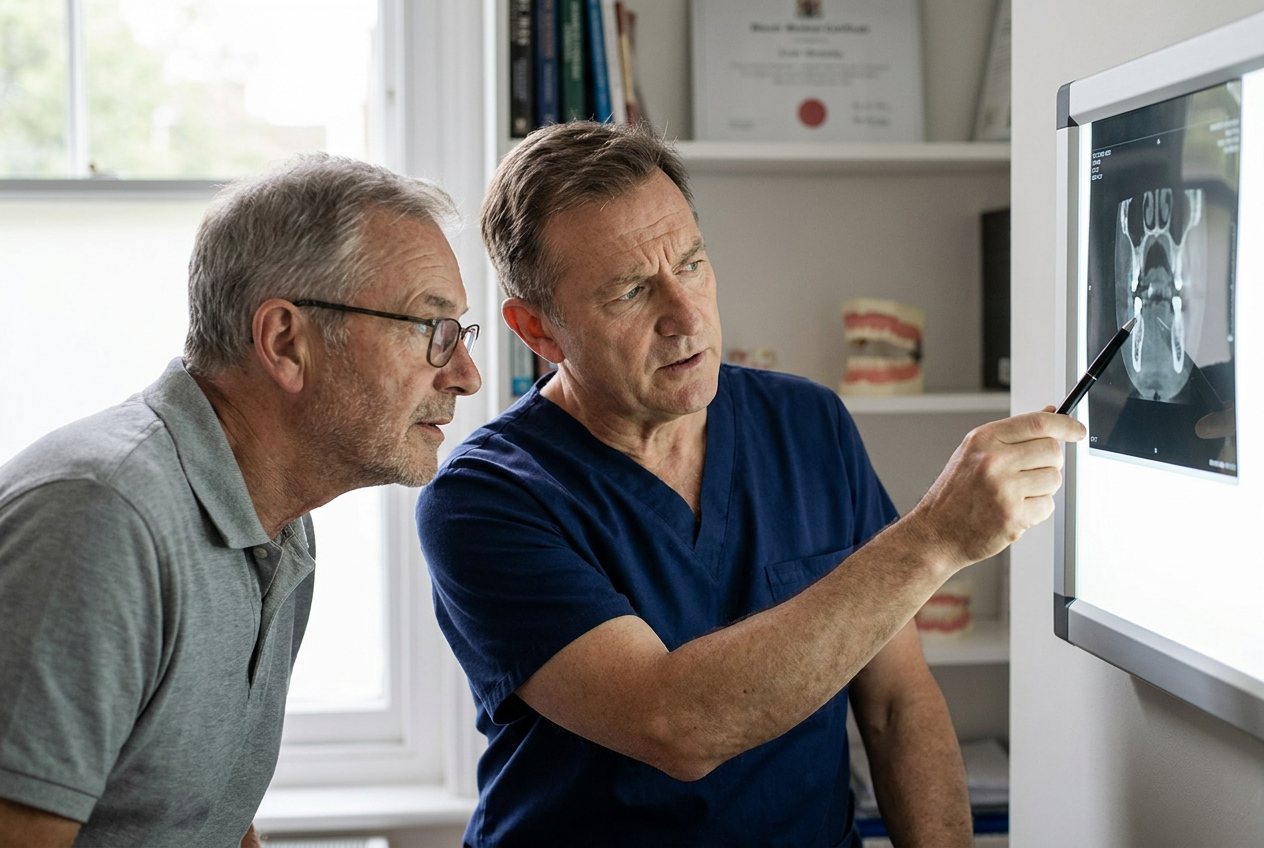
At ANEWU, your first visit is a free consultation with an in-office 3D scan and an exam by an oral surgeon, and no treatment happens that day. The site says anesthesia and sedation options are discussed before any surgery is scheduled, and that implant placement uses local anesthesia and, when appropriate, sedation. Which route suits you is settled before surgery day.
Tell the team at check-in if dental appointments make you anxious, and bring a current list of your medications. The first-visit page says saying so out loud changes how the appointment is paced. According to his page, Dr. Abtin Shahriari performs the oral surgery and implant procedures at ANEWU himself and completed eight years of specialty training, including the University of Pennsylvania and Emory University. The site does not describe his anesthesia training or list which sedation types the office provides, so ask which options he offers for your case and how you would be monitored.
If you are sedated, ANEWU's anesthesia and sedation instructions ask you to follow any fasting instructions given for your plan, arrange a responsible adult to drive you home and stay with you, and tell the team about all medications and supplements. Afterward you rest for the remainder of the day, with no driving, machinery or important decisions until the effects have fully worn off. To talk through your options, book a free consultation.
Sources and further reading
- Statement on Continuum of Depth of Sedation: Definition of General Anesthesia and Levels of Sedation/Analgesia American Society of Anesthesiologists, last amended October 2024
- ADA Guidelines for the Use of Sedation and General Anesthesia by Dentists American Dental Association, adopted October 2025
- Office-based Anesthesia Provided by the Oral and Maxillofacial Surgeon (white paper) American Association of Oral and Maxillofacial Surgeons, 2022
- Conscious Sedation in Dentistry: Dental Clinical Guidance, Third Edition Scottish Dental Clinical Effectiveness Programme, 2017
- IV Sedation, Risks & Side Effects American Society of Anesthesiologists, patient information page, accessed October 2026
- Nitrous Oxide, Laughing Gas MouthHealthy, American Dental Association, accessed October 2026
- Safety of Outpatient Procedural Sedation Administered by Oral and Maxillofacial Surgeons: The Mayo Clinic Experience in 17,634 Sedations (2004 to 2019) Journal of Oral and Maxillofacial Surgery, 2021
- What Is the Incidence of Anesthesia-Related Adverse Events in Oral and Maxillofacial Surgery Offices? A Review of 61,237 Sedation Cases From a Large Private Practice Consortium Journal of Oral and Maxillofacial Surgery, 2024
- Complications of Intravenous [two drug names omitted] Sedation in Children and Adults Undergoing Oral Surgery: A Retrospective Study Journal of Clinical Medicine, 2025
- Patient-reported outcome measures following surgeries in implant dentistry and associated factors: a cross-sectional study BMJ Open, 2022
- Pharmacological vs. non-pharmacological interventions for anxiety control in dental implant surgery: a systematic review Frontiers in Dental Medicine, 2026
- Evaluation of intravenous sedation in dental implant surgeries: A prospective cohort study Journal of Dentistry, 2026
This article is general information about dental and facial procedures, not a diagnosis or medical advice. Every jaw and every health history is different, so the right plan for you can only be set after an exam and imaging with a surgeon.