









Short answer
No upper age limit for dental implants has been established. A 2018 systematic review of studies in people aged 75 and older pooled 97.3% implant survival at 1 year and 96.1% at 5 years, from a small evidence base. Your general health, medicines, jawbone and ability to keep the area clean shape the plan, and a consultation with a 3D scan sorts them out.
Is there an age limit for dental implants?
No upper age limit has been established. A 2018 systematic review and meta-analysis of studies in patients aged 75 and older found 97.3% implant survival at 1 year and 96.1% at 5 years. The practical questions are your health, your medicines, your bone and whether you can keep the area clean.
That review, in Clinical Oral Implants Research, included 60 studies. Seven small ones (5 to 45 patients each) reported only on people aged 75 and older and supply the survival figures; 53 covered medical conditions. The authors called implants in this group a predictable treatment option with a very high rate of survival. Cautions: the 5-year figure rests on 3 studies and 76 implants (confidence interval 87.3% to 98.9%); patients lost to follow-up were left out, and dropout is high in very old patients; survival means the implant is still in the jaw, not that it needed no care.
A 2025 systematic review and meta-analysis in the same journal pooled 27 studies covering 3,892 implants in groups averaging 65 or older. Five-year survival was 96.8% in groups averaging over 75 and 92.1% in groups averaging 65 to 75. That does not show older patients do better: the two sets of studies differed (811 implants in the older set, 3,081 in the younger), none compared ages directly, follow-up averaged 4.4 years, and the authors warn that short follow-up may overestimate survival. They concluded that implants are reliable for older adults, including those over 75.
Is it worth getting dental implants at 70 years old?
It can be, when you are healthy enough for oral surgery and have a problem implants solve, such as a lower denture that will not stay put. In a 2021 meta-analysis, people with implant-held lower dentures reported higher overall satisfaction than those with conventional lower dentures.
In the National Health and Nutrition Examination Survey for 2015 to 2018, the CDC's National Center for Health Statistics found complete tooth loss in 12.9% of US adults aged 65 and over: 8.9% at 65 to 69, 10.6% at 70 to 74 and 17.8% at 75 and over. That shows how common it is, not whether implants suit you.
The 2021 meta-analysis, in Clinical and Experimental Dental Research, pooled randomized trials covering 812 people: 400 with conventional lower dentures and 412 with lower overdentures held by two implants. On overall satisfaction (six trials, 635 people) the overdenture group scored significantly higher, as it did on comfort, speech, chewing and stability, but not on esthetics or hygiene. The average age was 64, so it says less about people in their 80s, and the trials were short. A 2002 McGill consensus statement and a 2009 York consensus statement, both expert opinion rather than trials, put forward two-implant lower-jaw overdentures as the first choice standard of care for people with no teeth.

Do your health conditions and medicines matter more than your age?
Some can matter more. A 2018 systematic review found implant survival negatively affected in cancer patients, namely by radiotherapy, while survival may be similar or higher with cardiovascular disease and high with Parkinson's disease or type 2 diabetes. Age alone did not clearly lower survival in the studies cited here. Your surgeon needs your full medical history and medicine list, because they can change the plan.
The 2018 review's condition findings come from studies of adults of all ages, because none was limited to people 75 and over. The review found no evidence on survival with dementia, respiratory diseases, liver cirrhosis or osteoarthritis. High-dose antiresorptive therapy for bone metastases carried a high risk of complications after implant surgery, while survival was high with low-dose antiresorptive therapy for osteoporosis.
A 2025 systematic review and meta-analysis in Endocrine Practice, done to inform the 2024 International Task Force on Osteonecrosis of the Jaw update, pooled a 0.5% rate of osteonecrosis of the jaw after implant placement in people taking antiresorptive therapy for osteoporosis (21 cohorts). One risk-adjusted report found about 3 extra osteonecrosis cases per 1,000 patients with one type of antiresorptive therapy, at moderate certainty. Implant failure was not clearly higher (very low certainty; 9 studies, 655 people). Follow the written instructions from your surgeon about any medicine.
Does healing take longer when you are older?
Studies of older patients track whether the implant bonds to the jawbone, not how fast you feel recovered, and age alone does not seem to stop that bonding. A 2019 retrospective study in the Journal of Clinical Periodontology, of 444 patients aged 65 and over (1,517 implants), found early implant loss in 0.66% of implants. In 347 matched implants, early loss was 1.44% in older patients and 2.59% in patients aged 35 to 54, not a statistically significant difference.
Early loss means the implant failed to bond with bone by the time teeth were attached. It ranged from 0.34% to 0.83% of implants at ages 65 to 79 and was 2.26% at 80 and over (40 patients). Group differences were not statistically significant, though a multilevel analysis showed weak evidence that loss rises with age (p = 0.09), and early loss could not be linked to any systemic condition or medicine. The authors concluded that ageing does not seem to compromise osseointegration, and if at all, then only slightly and at a later stage of life.
A 2017 review of implants for elderly patients in Periodontology 2000, not a pooled analysis, notes that coexisting medical risk factors are significantly more common in older patients and advises minimally invasive surgery planned with 3D imaging and avoiding two-stage surgical procedures. For recovery detail, read our guide to dental implant surgery pain and recovery.
Can you keep implants clean if your hands or eyesight change?
It depends, so settle it before surgery. In the 2025 review, the groups averaging over 75 had more plaque and more gum bleeding when probed, with no significant difference in bone-level change. Its authors add that implants in very old adults should be considered only after weighing medical risks, benefits and the person's capacity for oral hygiene and access to care. Ask who would clean your teeth if you could not.
Cleaning has to stay possible as hands, eyesight and health change. The 2017 review notes that people aged 85 and older often live with dependency, multimorbidity and frailty, and advises designing implant restorations so they can become low-maintenance, or even be removed, to ease hygiene and comfort late in life. Raise that early, ideally with any family member who would help.
At ANEWU, an All-On-4 bridge is fixed in place and cleaned in place, much like natural teeth, and the team shows you the technique at your follow-up. A mini implant-supported denture lifts out at home for cleaning. In the 2025 review, implants joined by a bar under an overdenture were lost less often than single-attachment ones, though splinting might make cleaning harder with limited vision and dexterity.
Which is better for seniors: dentures or dental implants?
Neither is better for everyone. For a toothless lower jaw, implant-held dentures show clearer benefits than conventional dentures. For the upper jaw, a 2025 review found no evidence that either option is superior. Fixed implant bridges stay in place but need more bone, more surgery and reliable cleaning. The table below lays out the trade-offs.
Use three questions. How much bone do you have, which a 3D scan measures? How well can you keep the area clean? How much surgery are you able and willing to have? Our comparison of implants and dentures goes through the everyday differences.
The 2025 systematic review of six studies, in the Journal of Dentistry, found no significant differences in quality of life or satisfaction between conventional and implant-assisted complete upper prostheses, except in patients who already preferred implants. Small samples and high heterogeneity ruled out a meta-analysis, and the cost and morbidity of implant-assisted prostheses may be greater.
| Option | What it needs | What to weigh |
|---|---|---|
| Conventional denture | No surgery. A well-fitting denture. | Lowest surgical burden. Can slip or click, may need adhesive or remaking. |
| Snap-in denture on implants, including mini implants | A few implants with enough bone (mini implants need less width), plus attachments. | Higher patient-rated stability in lower-jaw trials of two-implant overdentures. Still taken out to clean. Upper jaw less clear. |
| Fixed full-arch bridge (All-On-4, All-On-6) | Four or six implants, enough bone, a 3D scan. | Stays in place, cleaned in place. More surgery than a snap-in denture. |
| Single implants or an implant bridge | Healthy bone and gums at each gap. | Suits one tooth or a few in a row, not a whole arch. |
When is a denture or snap-in denture a reasonable choice?
A conventional denture is reasonable when surgery would carry more risk than benefit, when you prefer to avoid surgery, or when the upper jaw is the main concern. A snap-in denture suits people who want more stability with less surgery than a fixed bridge, and a removable denture suits you when cleaning a fixed bridge would not be realistic.
Medical risk is the first reason: the authors of the 2025 review of older patients add, beyond the data they analyzed, that implants in old and very old adults need careful evaluation of medical risks, benefits and the person's capacity for oral hygiene and access to care. The upper jaw is the second, given the thin evidence above.
Mini implant-supported dentures sit between the two. At ANEWU they are removable dentures that snap onto several narrow implants, often placed with a less invasive procedure than standard implants, and they can suit thinner ridges. Not every ridge has enough bone, and a badly worn denture may need remaking first.
Will Medicare pay for dental implants for seniors?
Original Medicare generally does not. Medicare.gov says that in most cases it does not cover dental services like routine cleanings, fillings, tooth extractions, or items like dentures and implants. Medicare Advantage plans may offer extra benefits that Original Medicare does not, like some dental services, so check your own plan's benefits. Nothing here tells you what your plan will pay.
Medicare may cover some dental services when you are admitted as a hospital inpatient for your dental procedure, because of your underlying medical condition or the severity of the procedure, or when dental care is directly tied to a covered treatment, such as an exam before a heart valve replacement. For covered Part B dental services, you pay 20% of the Medicare-approved amount after the Part B deductible. These are exceptions, so do not assume they cover replacing teeth.
Medicare Advantage plans must cover all medically necessary services that Original Medicare covers and may offer extra benefits like some vision, hearing and dental services. At ANEWU, dental insurance rarely covers implant treatment in full, though some plans contribute toward parts of it. The financing options include CareCredit, Proceed Finance and a monthly payment plan arranged before the procedure; approval for outside financing is the lender's decision.
What does a consultation look like at ANEWU?
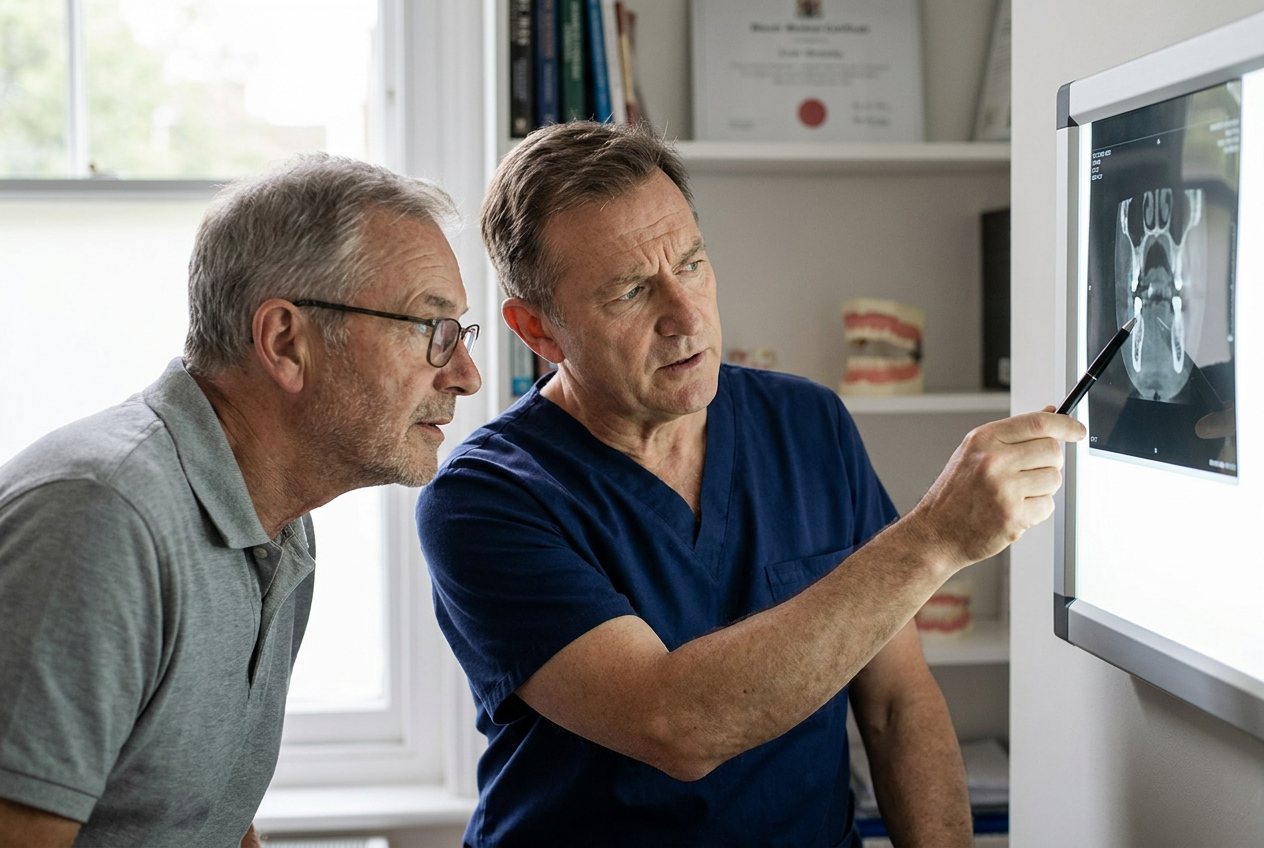
The first visit at ANEWU is a free consultation: the front desk reviews your medical and dental history and current medications, a 3D scan is taken in the office, and an oral surgeon examines you and explains your options. No treatment is performed that day, and you can bring a spouse, adult child or friend.
Dr. Abtin Shahriari, an oral surgeon specializing in implant dentistry, performs the implant exam and reviews your 3D scan at the Buckhead, Cumming and Dawsonville offices. The scan shows how much bone you have, which points toward standard implants, mini implants or bone grafting first. Anesthesia and sedation options are discussed before any surgery is scheduled, with no pressure to decide at the visit. To compare implants with dentures, book a free consultation at any office.
Write your questions down before you come, because they are easy to forget once the scan is on screen. These questions to ask your surgeon also work for a second opinion.
- Which options does my bone support, and which do you not recommend for me?
- How do my health conditions and medicines change the plan?
- What anesthesia or sedation is planned, and why does it suit my health?
- Who would clean this, and what happens if my hands or eyesight change?
- Could I start with a denture or snap-in denture and change course later?
- What will check-ups and long-term care involve?
Sources and further reading
- Effect of advanced age and/or systemic medical conditions on dental implant survival: A systematic review and meta-analysis Clinical Oral Implants Research, 2018
- Implant Survival in Patient Populations With a Mean Age of 65-75 Years Compared to Older Cohorts: A Systematic Review and Meta-Analysis Clinical Oral Implants Research, 2025
- How old is old for implant therapy in terms of early implant losses? Journal of Clinical Periodontology, 2019
- Dental Implant Failure and Medication-Related Osteonecrosis of the Jaw Related to Dental Implants in Patients Taking Antiresorptive Therapy for Osteoporosis: A Systematic Review and Meta-Analysis Endocrine Practice, 2025
- Evaluation of the quality of life and satisfaction in patients using complete dentures versus mandibular overdentures. Systematic review and meta-analysis Clinical and Experimental Dental Research, 2021
- Are patient-reported outcomes improved by implant-assisted maxillary prostheses compared to conventional maxillary dentures? A systematic review Journal of Dentistry, 2025
- Implants for elderly patients Periodontology 2000, 2017
- Mandibular two implant-supported overdentures as the first choice standard of care for edentulous patients: the York Consensus Statement British Dental Journal, 2009
- The McGill consensus statement on overdentures. Mandibular two-implant overdentures as first choice standard of care for edentulous patients Gerodontology, 2002
- Prevalence of Tooth Loss Among Older Adults: United States, 2015-2018 (NCHS Data Brief No. 368) CDC National Center for Health Statistics, 2020
- Dental services Medicare.gov, U.S. Centers for Medicare & Medicaid Services, accessed October 2026
- Compare Original Medicare & Medicare Advantage Medicare.gov, U.S. Centers for Medicare & Medicaid Services, accessed October 2026
This article is general information about dental and facial procedures, not a diagnosis or medical advice. Every jaw and every health history is different, so the right plan for you can only be set after an exam and imaging with a surgeon.