










Short answer
Mini dental implants are narrow implants, usually under 3 mm wide, most often used to anchor a lower denture. A 2025 systematic review of 39 studies estimated about 91% implant survival at seven years, with lower survival in the upper jaw and frequent denture repairs. Evidence for fixed full-arch teeth or single molars is limited, and long-term data are thinner than for standard implants.
What is considered a mini dental implant?
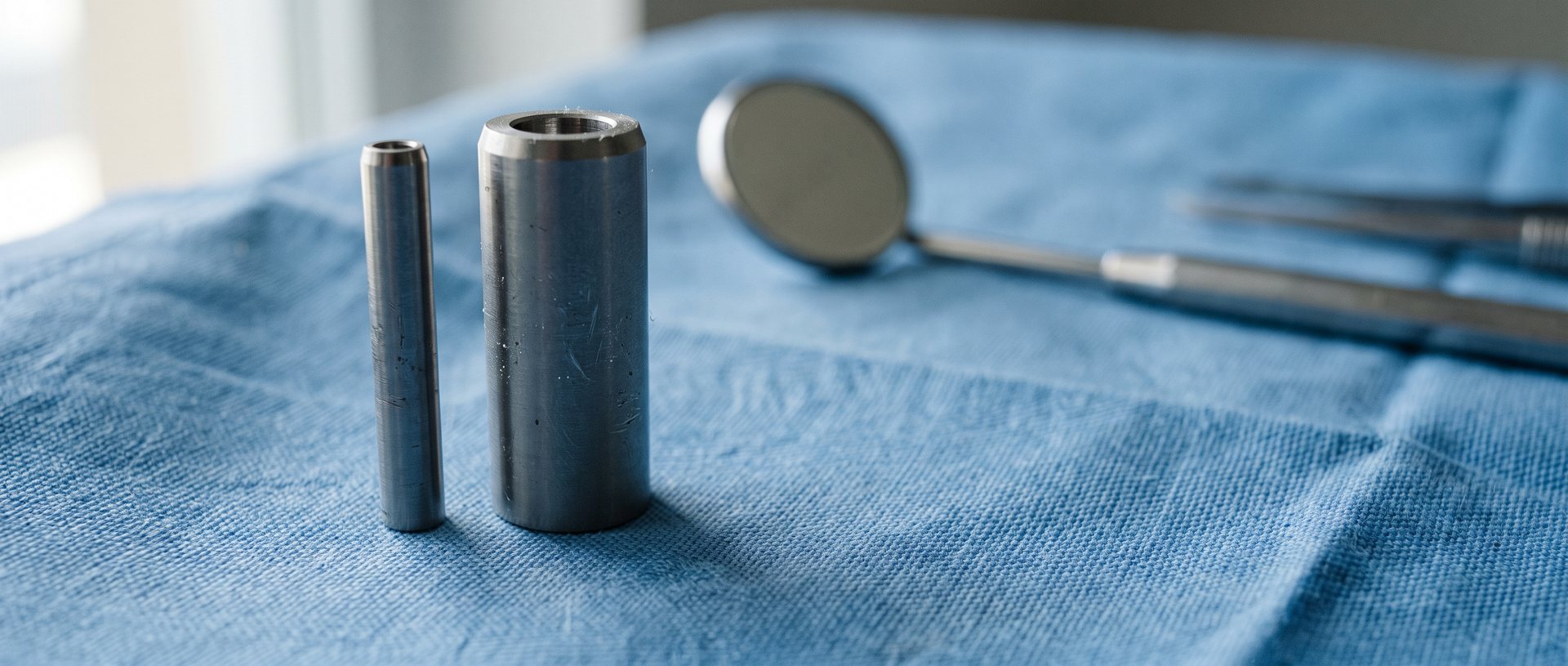
A mini dental implant is a narrow implant, usually defined as one under 3 mm wide. Narrow-diameter implants as a group run up to 3.5 mm, and the International Team for Implantology (ITI) treats anything wider as standard. Definitions vary: a 2018 ITI consensus conference set its mini category at under 2.5 mm.
Minis began as temporary anchors. A July 2025 article on the ITI blog (a clinical overview, not a position statement) notes that they were first used as transitional implants, to steady an interim denture while standard implants healed, and for orthodontic anchorage, with a plan to remove them afterward. Their use as long-term denture anchors came later. In the one 10-year study discussed below, the implants were 1.8 mm wide, well under any cutoff.
FDA clearance applies to individual devices, not to mini implants as a category. Its August 2003 clearance letter found one manufacturer's mini implant system substantially equivalent to devices already on the market, for the indications the letter states: long-term intra-bony applications, with transitional use between roots also allowed. That covers one device and those indications, not every mini implant. The ITI's 2018 consensus report concluded that implants under 2.5 mm showed lower survival than standard implants.
What are the pros of mini dental implants?
The main advantages are that mini implants fit a narrower ridge, which can reduce the need for bone grafting, may be placed without opening the gum, and have lower material costs than standard implants. In lower-jaw denture trials, quality of life improved after minis or standard implants steadied the denture.
Jawbone shrinks after teeth are lost. The ITI blog article notes that this often leaves too little volume for standard implants, and that narrow implants are used as an alternative to bone augmentation. A 2025 review of 39 studies describes grafting as invasive, with its own risks. The article also lists flapless placement, which reduces trauma at surgery, and the potential for immediate loading (a denture attached soon after surgery), which it says can shorten recovery. Treat that early denture as a provisional fit: the 2025 review found relining was often needed afterward, as swelling settles.
What patients notice most is a steadier denture. A 2024 systematic review and meta-analysis of five randomized trials (45 to 120 people each, follow-up from one week to 12 months, all at low risk of bias) found that three trials reported better quality of life after lower dentures were stabilized with either mini or standard implants. The gain came from stabilizing the denture, so it is not a point in favor of the mini design itself. Trials this short say little about the years ahead.

What is the downside of mini dental implants?
The downsides are lower survival than standard implants in pooled data, a possibly higher risk of implant fracture, frequent denture repairs and part replacements, and thinner long-term evidence. A 2018 meta-analysis found significantly lower survival for implants under 3.0 mm than for standard ones (odds ratio 4.54, 95% confidence interval 1.51 to 13.65, a wide range, so the size of the gap is uncertain).
That meta-analysis pooled 16 studies and rated the literature at high risk of bias. Mean survival was 94.7% for implants under 3.0 mm, against 97.3% and 97.7% for the two wider narrow-diameter groups. In the two trials in the 2024 review that reported implant survival (120 and 50 people, each followed for one year), mini survival ranged from 89% to 98% against 99% and above for standard implants. The review did not pool survival and its authors called the rates comparable, so read this as a signal, not a verdict.
Maintenance is the other cost. In the 2025 review of 39 studies, 69 of 477 overdentures with data (14.5%) had a transverse fracture, wear of the attachment's matrix (female) part was reported in 250 of 1,301 parts with data (19.2%), and relining was needed in 105 of 437 (24.0%). The authors say these dentures may need frequent maintenance visits. They add that fractures are common when an existing denture is converted, and that a metal framework might reduce them.
The implant itself can break. The ITI blog article says minis may face a higher fracture risk than standard implants because of the narrow, tapered body, and dense bone can raise that risk during insertion if too much torque is used. One-piece minis also have limited ability to correct poor angulation, so parallel placement matters.
What is the success rate of mini dental implants?
In a 2025 systematic review of 39 studies and 3,787 mini implants holding dentures, 202 of the implants (5.3%) failed and estimated survival at seven years was 91.4%. Survival was lower in the upper jaw (87.1% at five years) than in the lower jaw (92.3% at five years). Follow-up averaged 28 months, so these are medium-term figures.
Survival means the implant stayed in place, not that nothing needed attention. Failures clustered in the first year, at a mean of 9.4 months after placement. Bone around the implants receded gradually, from an estimated mean of 0.518 mm at six months or less to 1.260 mm at 58.8 to 90 months. In lower jaws, survival was 92.2% with two minis and 96.2% with four, and the authors recommend four.
Treat the figures as approximate. The authors list many confounding factors, retrospective designs, small groups and short follow-up, and only 109 of the 1,026 overdentures were in the upper jaw, so the upper-jaw numbers rest on little data. Our guide to dental implant failure rates explains how studies count survival and failure.
What is the average lifespan of mini dental implants?
None of the studies cited here reports an average lifespan for mini dental implants, because follow-up is still short. The 2025 review followed patients for 28 months on average and seven years at most. One 10-year study of 14 people found all 56 implants still in place. A 2013 review found no evidence yet for long-term survival, so treat any promise of a set number of years with caution.
That 10-year study (2024) enrolled 20 people with narrow lower jaws, gave each four 1.8 mm mini implants and a denture with O-ring attachments, and followed 14 of them to 10 years. Mean bone change was 1.12 mm, bone levels were stable after five years, and prosthetic survival was 93%. It had no comparison group and a small sample, so it shows what is possible, not what to expect. Since the 2013 review, others have added medium-term data, but the longest follow-up in the 2025 review was seven years.
Mini or standard implants: who suits which?
Mini implants suit people who want a removable lower denture to stop moving, have a narrow ridge, and would rather avoid a graft. They are not for everyone: the evidence is thin or missing for replacing a single back tooth, holding a fixed full arch, or withstanding heavy grinding, where wider implants (3.3 mm and up) are better documented.
Two findings drive that advice. A 2014 systematic review concluded that mini implants under 3.0 mm are documented only for the edentulous arch and for single teeth outside heavy load, with success rates not available and information on bruxism (grinding) missing, while 3.3 to 3.5 mm implants are well documented in all indications, including load-bearing back teeth. A 2021 systematic review of nine studies of 2.5 to 3.5 mm implants in fully edentulous arches found that every study used removable restorations and none tested fixed ones.
If you are still weighing implants against dentures at all, start with our guide to dental implants vs dentures. It covers that earlier decision, and this post then covers the next one: which kind of implant, how many, and whether a removable or fixed result suits you.
| Feature | Mini implant | Standard implant |
|---|---|---|
| Width | Usually under 3 mm (ITI 2018 mini category: under 2.5 mm) | Wider than 3.5 mm (ITI blog article) |
| Typical use | Holding a removable lower denture | Single teeth, bridges, fixed full arches and dentures |
| Bone width needed | Less, which can reduce the need for a graft | More, so thin ridges may need a graft first |
| Implant survival in two randomized trials (1-year follow-up) | 89% to 98% | 99% and above |
| Evidence base | Mainly denture studies; 28 months average follow-up in the 2025 review | Longer follow-up exists, for example 10-year data in a 2017 meta-analysis of regular-diameter implants in people 65 and over |
| Fracture risk | May be higher, according to the ITI blog article | Lower than minis |
| Fixed full-arch teeth | No data in a 2021 review of 2.5 to 3.5 mm implants | Yes, on four or more implants |
What's the cheapest I can get implants for?
A mini implant can cost less than a standard one, but the price per implant is not the total price. The total depends on how many implants you need, whether your current denture can be reused or must be remade, any grafting, and repairs and replacement parts over the years. This post quotes no dollar figures, because prices vary by case and location.
A 2020 systematic review of nine cost studies found that lower-jaw overdentures on two or four mini implants cost less than overdentures on two standard implants, and that implant overdentures cost more than conventional dentures but were more cost-effective. It also noted a lack of long-term data on aftercare cost and survival for minis. That gap matters, because the 2025 review recommends four minis rather than two in a lower jaw and reports frequent relining and attachment wear.
So ask each practice for a written total: the scan, surgery, denture work, follow-up visits, and what replacing worn attachments costs. A lower quote that leaves out a denture remake or follow-up care may not be the lower price.
What does this look like at ANEWU?
At ANEWU, mini implants anchor dentures, as described on our mini implant-supported dentures page. Your first visit is a free consultation with an in-office 3D scan, and an oral surgeon examines you and explains your options. Dr. Abtin Shahriari plans the number and position of any mini implants from that scan. No treatment is done at that visit.
If minis suit your jaw, they are placed in a single appointment, and your existing denture is fitted with matching attachments or a new denture is made. A badly worn denture may need remaking first. The bite and fit are then adjusted, and a follow-up visit checks how the denture seats. You still take the denture out to clean it. Not every ridge has enough bone width even for minis. Then bone grafting can rebuild the ridge, in the upper jaw zygomatic implants can anchor in the cheekbone, and a fixed arch such as All-On-4 is another route when there is more bone.
Cost depends on how many mini implants your case needs and whether your current denture can be retrofitted or must be remade. Dental insurance rarely covers implant treatment in full, though some plans contribute toward parts of it. ANEWU accepts CareCredit and Proceed Finance and can arrange a monthly payment plan, and your consultation covers the cost of your own treatment plan. Questions to ask your surgeon are listed below. To see whether minis fit your jaw, book a free consultation.
- How wide are the implants you propose, and why that number of them?
- Can my current denture be reused, and will it have a metal framework?
- What happens, and what does it cost, if an implant fails or an attachment wears out?
- Does my grinding or clenching change the plan?
- Would wider implants, bone grafting or a fixed arch suit my jaw better?
Sources and further reading
- Clinical and radiographic outcomes of mini-implant-retained maxillary and mandibular overdentures: a systematic review and meta-analysis Clinical Oral Investigations, 2025
- Narrow-diameter implants: A systematic review and meta-analysis Clinical Oral Implants Research, 2018
- Group 1 ITI Consensus Report: The influence of implant length and design and medications on clinical and patient-reported outcomes Clinical Oral Implants Research, 2018
- Systematic review on success of narrow-diameter dental implants International Journal of Oral & Maxillofacial Implants, 2014
- Mini implants for definitive prosthodontic treatment: a systematic review Journal of Prosthetic Dentistry, 2013
- One-Piece Mini Dental Implant-Retained Mandibular Overdentures: 10-Year Clinical and Radiological Outcomes of a Non-Comparative Longitudinal Observational Study Journal of Functional Biomaterials, 2024
- Use of Narrow-Diameter Implants in Completely Edentulous Patients as a Prosthetic Option: A Systematic Review of the Literature BioMed Research International, 2021
- Retention of Mandibular Complete Overdentures using Mini Dental Implants and Standard Diameter Implants: A Systematic Review and Meta-Analysis of Randomised Controlled Trials Oral Health & Preventive Dentistry, 2024
- A comparison of cost and cost-effectiveness analysis of two-implant-retained overdentures versus other removable prosthodontic treatment options for edentulous mandible: A systematic review Journal of Indian Prosthodontic Society, 2020
- Dental implants in the elderly population: a systematic review and meta-analysis Clinical Oral Implants Research, 2017
- Mini implants as retainers for mandibular overdentures ITI Blog, International Team for Implantology, July 2025
- FDA 510(k) clearance letter K031106 for a mini dental implant system (August 12, 2003) U.S. Food and Drug Administration, 2003
This article is general information about dental and facial procedures, not a diagnosis or medical advice. Every jaw and every health history is different, so the right plan for you can only be set after an exam and imaging with a surgeon.