







Short answer
No. Whitening gel lightens natural enamel, not crowns, veneers, bonding, implant crowns or dentures; the American Dental Association's whitening overview, updated in 2026, says tooth-colored restorations do not whiten, only natural teeth do. A restoration that no longer matches can be polished free of surface stain or replaced. If you plan new work, whiten first and match the new restoration to your whitened shade.
Can anything whiten crowns?
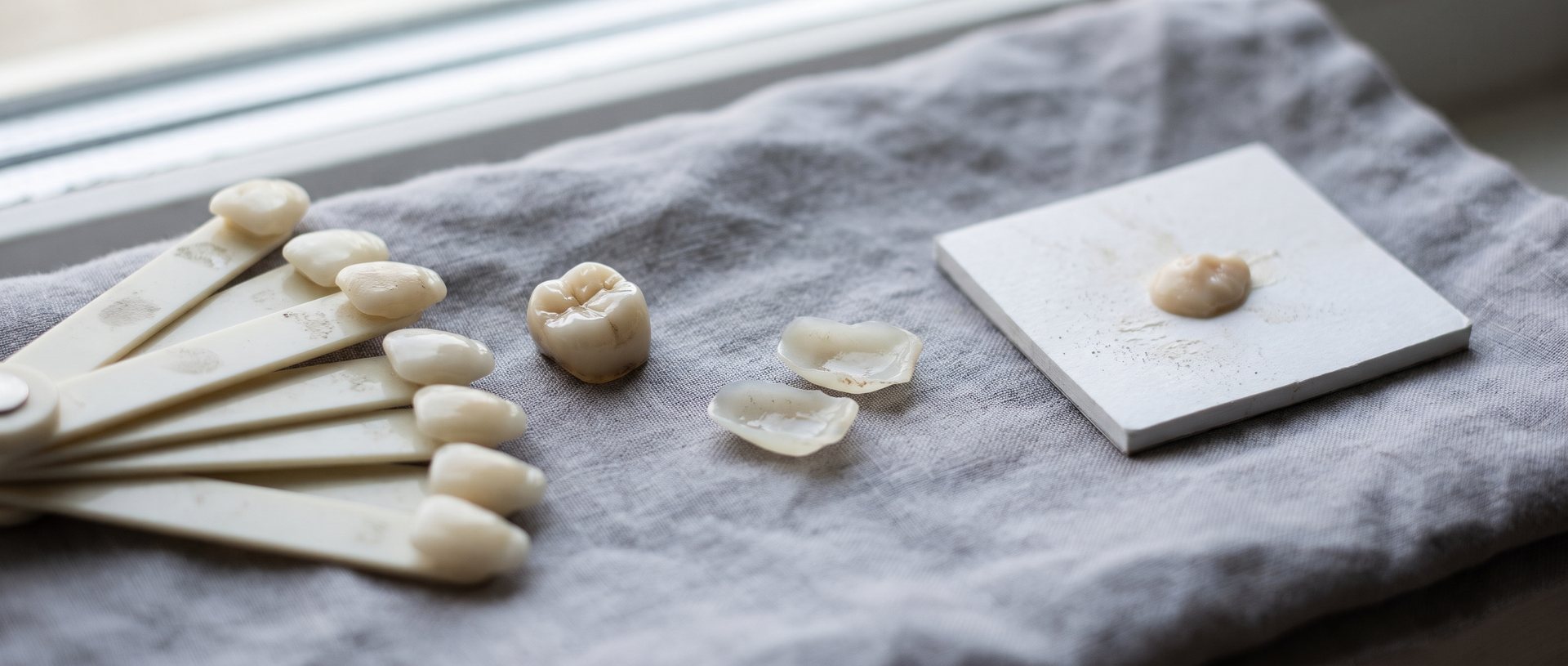
Nothing lightens the built-in shade of a crown. A crown is a custom cap fitted over the whole visible tooth, and a veneer is a thin shell bonded to its front. Bleaching gel works on natural enamel, and the ADA says tooth-colored restorations, including crowns and implants, will not change color. What can brighten a crown, veneer or bonded tooth is removing surface stain with professional polishing, and when the shade itself is wrong, replacing the restoration.
The table goes material by material. Most studies of bleaching on restorations are lab tests on small discs, not mouths, and they are marked as such. A 2004 systematic review in Dental Materials found that bleaching can affect the physical properties, margins and color of restorative materials in lab studies, but found no clinical reports of bleaching damaging existing restorations enough to need replacing.
| Material | Does bleaching change its shade? | What can brighten it | If it no longer matches after whitening |
|---|---|---|---|
| Natural enamel | Yes; yellow tones usually bleach well, brown less, gray may not (ADA) | In-office or take-home whitening; cleaning for surface stain | Not applicable: this is what whitening changes |
| Composite bonding or composite veneers | Not the way enamel does (ADA); in a 2024 lab study, bleached resin shifted measurably in whiteness but stained more easily afterward | Professional polishing of surface stain | Re-surface or replace the resin in the new shade |
| Porcelain veneers or crowns | No perceivable change in a 2024 lab study, though the surface roughened | Cleaning and polishing of surface stain | Replace the restoration to match |
| Zirconia crowns | No; tooth-colored restorations do not change color (ADA) | Cleaning and polishing of surface stain | Replace the crown to match |
| Implant crowns | No; the ADA names crowns on implants among restorations that keep their color | Cleaning and polishing of surface stain | Replace the crown on the implant |
| Dentures | No; whitening is for natural teeth only (ADA) | Daily brushing with a soft brush and a non-abrasive cleanser (ADA) | Replace the denture teeth or the denture |
Why do crowns or veneers look darker after whitening, and do they turn yellow?
Crowns and veneers look darker after whitening because the teeth around them get lighter while the restoration keeps the shade it was made in. ANEWU's whitening page warns about exactly this next to an existing crown. Porcelain itself is color-stable, so when a crown seems to yellow, look first at surface stain, a stained edge and the natural teeth beside it.
Composite is the material that changes. A 2026 review in the International Journal of Periodontics and Restorative Dentistry describes composite resins as vulnerable to discoloration, wear and marginal staining, often needing periodic repolishing or repair, while ceramics show better color stability. Porcelain veneers can still discolor at the edge: a 2025 meta-analysis of 29 studies in the Journal of Esthetic and Restorative Dentistry recorded marginal discoloration in 19.64% of feldspathic and 17.89% of leucite-reinforced veneers at about 10 years, against 1.9% for lithium disilicate.
The mismatch can also run the other way. The ADA explains that with age, enamel thins and more of the yellowish dentin underneath shows through, so natural teeth can drift darker than a crown made years ago. If your crown or bonding no longer matches, the usual fix depends on which way the mismatch runs:
- A crown or veneer now darker than freshly whitened teeth: it will not follow the new shade, so replacing it to match is the usual fix, or you stop whitening at a shade closer to it.
- A crown lighter than natural teeth that have yellowed: whitening the natural teeth can bring them back toward the crown, one of the few mismatches whitening helps.
- A stained edge on bonding: polishing may lift surface stain, while deeper edge staining is repaired or the resin is redone.
- One front crown that stands out as darker: an exam checks the crown, its edge and the tooth under it, and a new crown in your current shade is the usual answer.
Can stains be removed from veneers or crowns?
Yes, surface stain on veneers, crowns and bonding can often be reduced with professional cleaning and polishing, but polishing cannot change the shade a restoration was made in. The ADA's whitening overview says a wide range of surface stains on teeth can be reduced mechanically, by brushing with a whitening toothpaste or by professional prophylaxis, the cleaning and polishing done at a dental visit.
Composite clearly benefits from polishing. In a 2024 lab study of resin-based materials in BMC Oral Health, repolishing reduced the staining that built up after coffee exposure. Porcelain holds surface stain less, so lasting discoloration on a veneer tends to show at its edge. The 2025 veneer meta-analysis graded marginal discoloration from slight surface staining to severe staining that penetrates along the margin, and deep margin staining is usually a repair or replacement question rather than a polishing one.
Be careful with home products. The ADA notes that whitening toothpastes rely mainly on abrasives to remove stain, and its denture advice is to use a non-abrasive cleanser so surfaces do not get scratched. Ask your dentist which toothpaste suits your veneers, crowns or bonding before you switch.
Can dental bonding be whitened?
No, dental bonding does not whiten the way natural teeth do. The ADA's patient guide says whitening does not work on caps, veneers, crowns or fillings, and bonding is made of the same tooth-colored composite used for fillings. Bleaching bonded teeth lightens the enamel around the resin, so the bonding can end up looking darker. ANEWU's bonding page therefore puts whitening before any resin is shaped.
Lab studies add nuance. In the 2024 study, in-office bleaching did shift the whiteness of resin samples measurably, but both in-office and at-home bleaching also left them more prone to picking up stain afterward, and repolishing reduced that stain. The 2004 review found bleaching can affect the physical properties and margins of restorative materials in lab tests. If your bonding is stained rather than the wrong shade, polishing may be enough; if the shade is wrong, the resin is re-surfaced or replaced in the new color.
Bonding can also solve a whitening problem. ANEWU's bonding page lists a tooth that stays darker after whitening among the reasons to consider bonding, and the ADA notes that gray teeth, and discoloration from medication or an injury, may not respond to bleaching. In those cases, covering the tooth is often the realistic option.
In what order should whitening and veneers or crowns be done?
Whitening comes first, then any new veneer, crown or bonding is matched to the whitened shade. ANEWU's veneers page sets that order because porcelain will not lighten after it is made, and its crowns page says the same about crown shades. Our guide to what a smile makeover includes shows where aligners and other steps fit around whitening.
Timing matters as well as order. The ADA's library overview notes research suggesting bleaching may change the enamel surface and weaken how well composite or ceramic bonds to it, so your dentist decides when new work is bonded. If you whiten again later, your restorations will not follow, so choose a shade you are happy to keep.
- 1. Exam: existing crowns, veneers and fillings are noted, since they will not change color.
- 2. Whitening: in-office or with custom take-home trays, after any planned aligner treatment.
- 3. Shade match: new veneers, crowns or bonding are made to the shade you reached.
- 4. Replacement: old work that no longer matches is redone, if you choose.
What happens if I put a whitening strip on a crown?
Nothing happens to the crown. A whitening strip's peroxide lightens enamel, and the ADA's library overview notes that only natural teeth are affected by the bleaching agent. The strip does lighten the natural teeth it touches, so a crown or veneer can stand out more than before. Over-the-counter products cannot fix a mismatch, because the mismatch is in the restoration.
Over-the-counter strips also carry lower peroxide concentrations than dentist products, as the ADA's patient site notes, and the same overview cites a 2005 study in which an over-the-counter method took 16 days to match the whitening of a seven-day tray system and a one-day in-office treatment. If you use strips, the ADA advises talking to your dentist first and choosing a product with the ADA Seal of Acceptance, and it warns that overuse can damage enamel or gums.
Is whitening safe, and what disqualifies you from teeth whitening?
For most adults, whitening's side effects are mild and short-lived. The ADA lists temporary tooth sensitivity and gum inflammation as the most common, says mild to moderate sensitivity can affect up to two-thirds of users early in treatment, and notes that with strips or trays it usually resolves by the fourth day after treatment. What rules people out is usually the mouth, not the product.
A 2018 Cochrane review of 71 trials of home whitening found sensitivity and oral irritation were the most common side effects, more frequent at higher concentrations but mild and transient, though the review rated its evidence low to very low certainty overall. A 2025 meta-analysis in Operative Dentistry found sensitivity was less intense with at-home trays than in-office whitening, though the risk of getting it was similar and the evidence quality was low.
What can rule you out or change the plan: being a child who still has baby teeth (the ADA reports that the American Academy of Pediatric Dentistry discourages full-arch cosmetic bleaching then), front restorations you do not plan to replace, gray stains or discoloration from medication or injury, an allergy to bleaching ingredients, and untreated decay or unhealthy gums (ANEWU's whitening page asks for healthy enamel and gums). When to call right away:
- Call the office if sensitivity is severe or lasts more than a few days after you stop, or if your gums blister or stay sore.
- Call the office soon if one tooth darkens on its own; the ADA lists bleeding inside the tooth or a dying pulp among causes of deep discoloration.
- If a darkened tooth also brings swelling, pus or a fever, call right away; the NHS treats a very swollen mouth, trouble breathing, speaking or swallowing, or difficulty opening your mouth as reasons for emergency care.
What does whitening look like at ANEWU if you already have crowns or veneers?
At ANEWU, whitening starts with a free consultation where your existing crowns, veneers and bonding are noted, because they will keep their original shade. You can then choose an in-office session of about an hour or custom trays you wear at home for one to two weeks, and the cosmetic dentistry team plans and monitors either one.
On the day, the team notes your starting shade against a set of sample tabs, checks your gums and shields them before any gel touches your teeth. If there are no restorations in your smile line, whitening may be the only step. If a crown, veneer or bonded tooth will sit beside whitened teeth, you can expect the plan to whiten first and match any new work afterward. If one tooth is still darker than the rest after whitening, the whitening page says covering it is the next step to discuss.
That team works in the same practice as Dr. Abtin Shahriari, who leads the oral surgery side, with offices in Buckhead, Cumming and Dawsonville. Because whitening is elective, insurance usually does not pay for it; ANEWU takes CareCredit and Proceed Finance. For the first 48 hours, the whitening page asks you to avoid coffee, tea, red wine and dark sauces. To plan whitening around the work you already have, book a free consultation, and check what to expect at your first visit before you come. Questions to ask your dentist before you whiten:
- Which of my visible teeth are crowns, veneers or bonding, and what are they made of?
- Will whitening make any of them stand out?
- Should I whiten and replace them, or leave them as they are?
- How long should I wait after whitening before new work is bonded?
- In-office or take-home trays: which is gentler for my sensitivity?
- Can my restorations be polished, or do they need replacing?
- Is any decay or gum problem treated first?
Sources and further reading
- Teeth Whitening American Dental Association, MouthHealthy patient information page, accessed November 2026
- Oral Health Topics: Whitening American Dental Association, ADA Library and Archives, last updated November 2026, accessed November 2026
- Dentures American Dental Association, MouthHealthy patient information page, accessed November 2026
- Dental abscess NHS, page last reviewed March 2026, accessed November 2026
- Home-based chemically-induced whitening (bleaching) of teeth in adults Cochrane Database of Systematic Reviews, 2018
- At-home vs In-office Bleaching: An Updated Systematic Review and Meta-analysis Operative Dentistry, 2025
- Effects of Different Concentrations of Carbamide Peroxide on Color, Surface Roughness, and Hardness of CAD/CAM Dental Ceramics Clinical and Experimental Dental Research, 2024
- Effect of bleaching and repolishing on whiteness change and staining susceptibility of resin-based materials BMC Oral Health, 2024
- Esthetic Solutions for Anterior Teeth: Composite Resins or Dental Ceramics? International Journal of Periodontics and Restorative Dentistry, 2026
- Survival and Complication Rates of Feldspathic, Leucite-Reinforced, Lithium Disilicate and Zirconia Ceramic Laminate Veneers: A Systematic Review and Meta-Analysis Journal of Esthetic and Restorative Dentistry, 2025
- Effect of bleaching on restorative materials and restorations: a systematic review Dental Materials, 2004
This article is general information about dental and facial procedures, not a diagnosis or medical advice. Every jaw and every health history is different, so the right plan for you can only be set after an exam and imaging with a surgeon.