








Short answer
Dental implants abroad can turn out well, but safety depends on the clinic, the surgeon and whether the plan allows for healing. Implants usually heal for months before final teeth go on: a 2013 Cochrane review notes conventionally loaded implants stay load-free for 3 to 8 months. CDC advises coordinating local follow-up care and bringing home a complete set of records.
Is it safe to get dental implants in Mexico?
Whether dental implants in Mexico are safe depends on the specific clinic, the surgeon's training, the implant system and the follow-up plan, not on the country, and the same is true anywhere. CDC's Yellow Book says accreditation is no promise of a good outcome, and that infections are the most common complications after medical travel. With implants, time is the practical risk: treatment spans months, and problems can appear after you fly home.
CDC's 2026 Yellow Book chapter on medical tourism advises researching the facility and the individual professional as fully as you can, and notes that dentists in destination countries might not be under the same licensing oversight as dentists in the United States. That is a reason to check training and credentials yourself, not a verdict on any clinic or country. The rest of this guide is a checklist you can use with any clinic, at home or abroad, plus the records and follow-up plan that protect you once you are back.
Can I get dental implants abroad, and how many trips does it take?
You can, but rarely in one trip, because implants need time to fuse with bone before the final teeth go on. A 2013 Cochrane review notes that conventionally loaded implants are kept load-free for 3 to 8 months, and Cleveland Clinic gives 3 to 9 months for fusing. Even when temporary teeth are fitted soon after surgery, they are provisional, and the final set follows healing, usually on a later trip.
A 2018 systematic review for the ITI Consensus Conference sorted implant treatment by when the implant goes in (right after extraction, after a few weeks, or into healed bone) and when it is loaded. The combinations it rated scientifically and clinically validated all build in a healing wait. Flights matter too: a 2023 review in the British Dental Journal recommends waiting about a week to fly after most dental treatment and six weeks after a sinus lift, with minimums of 72 hours after implant surgery and two weeks after a sinus lift, though its evidence comes mostly from military aircrew.
- Records to bring home after every trip: the implant brand, system and model for each implant, with its size and position.
- The abutment and screw type, and whether the teeth are screwed or cemented on.
- Copies of every x-ray and 3D scan, from before and after surgery.
- Treatment notes in English: what was placed, any graft material and any medicines given.
- The written plan for the remaining steps, with dates and costs, and the warranty terms.
| Phase | What usually happens | Wait before the next step |
|---|---|---|
| 1. Planning | Exam, x-rays or a 3D scan, written plan and itemized quote | None, but keep copies of every scan |
| 2. Extraction, if needed | Tooth removed; the socket may be grafted | Implant at once in some cases, after weeks to a couple of months, or once bone heals (Cochrane 2010) |
| 3. Bone graft, if needed | Thin bone or a low sinus floor is built up | Some grafts go in with the implant (Cochrane 2010), others heal first; fly no sooner than 2 weeks after a sinus lift (2023 review) |
| 4. Implant surgery | Implants placed; a provisional tooth or bridge may be fitted | 3 to 9 months for bone to fuse (Cleveland Clinic); fly no sooner than 72 hours (2023 review) |
| 5. Final teeth | Abutments attached, final crown or bridge fitted, bite adjusted | May need a second minor surgery (Cleveland Clinic) and fitting visits |
| 6. Upkeep | Cleaning, checkups and x-rays | For as long as you have implants; FDA advises regular visits |

Can you get good dental implants abroad?
You can, if you choose the clinic for its people, its plan and its aftercare, not only the price. CDC advises researching the facility and the professional in advance and knowing whether follow-up care happens at the same facility. The Academy of General Dentistry suggests asking for providers' résumés beforehand so you can judge their training and experience.
Use the list below with any clinic, anywhere, including clinics near home. Line up a local dentist or oral surgeon for follow-up before you book, because CDC advises coordinating local follow-up care so your care continues after you return.
- Questions to ask your surgeon or clinic before you book: who places the implants, who makes and fits the teeth, and what is their training and licence?
- Which implant system and parts will you use, and can a dentist at home get parts for it?
- Will the plan be built from a 3D scan, and will I get copies of every scan and x-ray?
- How many trips, how long is each stay, and how much healing time sits between them?
- What does the price include: scans, extractions, grafts, temporary teeth, final teeth and follow-up visits?
- What does the warranty require, and does it cover care by a dentist at home?
- Who do I contact if something goes wrong after I fly home?
- When can I safely fly after each procedure?
Are dental implants cheaper abroad, and what should you compare besides price?
Quotes abroad are often lower, which is why many people travel, but the fair comparison is the total cost of finished, maintained teeth. CDC advises confirming which services the quoted price includes and warns that some providers charge substantial fees for follow-up care. Add travel and lodging for every trip, time off work, and the cost of any repair at home.
Besides price, compare the number of trips, the implant system, who restores the teeth and who looks after them for years afterwards. Upkeep is not optional: a 2025 AO/AAP systematic review of 102 studies found peri-implant mucositis, gum inflammation around implants, in 46% of implant patients and peri-implantitis, a more serious infection around the implant, in 21%. That makes regular cleanings near home part of the real cost, as our guide to caring for dental implants explains. Our guide to dental implant costs in Georgia lists what a complete quote should cover.
What happens if I have a problem after I get home?
If something feels wrong after you return, do not wait for your next trip: CDC says medical travelers should not delay care for a suspected complication. A local dentist or oral surgeon can examine you, and records naming the implant system help, because a 2024 systematic review notes that the many implant systems in use make an implant hard to identify when records are missing.
Parts are system-specific. A 2022 systematic review of 40 studies on single crowns in the Journal of Prosthodontics found that original abutments fit more precisely and resisted leakage and movement better than non-original ones, recommended original parts, and called for long-term studies in patients. If no local office can source parts for your system, a repair may mean new components or more work. A 2020 Academy of General Dentistry article encourages dentists to request treatment records when a patient returns, so bring them to the first visit. Call right away for any of these:
- An implant that feels loose or painful, which FDA says to report to your dental provider right away, or a loose crown or bridge
- Pus, swelling, bleeding gums or a fever around an implant
- Swollen glands in your neck along with any of those signs
- Emergency room or 911: trouble breathing, speaking or swallowing, a lot of swelling in your mouth, a swollen eye, trouble opening your mouth, or a high fever with spreading swelling, the emergency signs in NHS guidance
Do dental implants abroad come with a warranty?
Some clinics offer a written warranty, but what it covers varies, so read the written terms before you pay. A 2020 Academy of General Dentistry article quotes a dentist describing a patient whose implants placed abroad became infected and carried no warranty, which cut deeply into the expected saving. Check whether a warranty covers parts only or the surgery and repairs too, and what it requires of you.
Questions worth asking about any implant warranty: must repairs be done at the same clinic, and who pays for the trip back? Does it lapse if you miss checkups or use a dentist at home for cleanings? Does it cover the implant, the abutment and the teeth, or only some of them? This is not legal advice; the written terms decide what you are owed, so keep a signed copy with your records.
Is dental tourism worth it?
Dental tourism can be worth it for a healthy adult with a straightforward plan, time for every trip and a local dentist lined up for follow-up. It is a weaker fit when the plan needs grafts or sinus lifts, when health conditions slow healing, or when you cannot get back if something goes wrong. The Academy of General Dentistry's central advice is to do your research first.
Who this is not for: people who need extractions and grafting and cannot plan for months between trips; people with unmanaged diabetes, active gum disease or a smoking habit, which Cleveland Clinic lists among reasons implants may not suit or may heal poorly; and anyone who cannot take unplanned time off for a return visit. If you are going anyway, the checklist and the records list above are what protect you most, along with a local dentist who knows your plan.
What does a consultation at ANEWU include if you are comparing options?
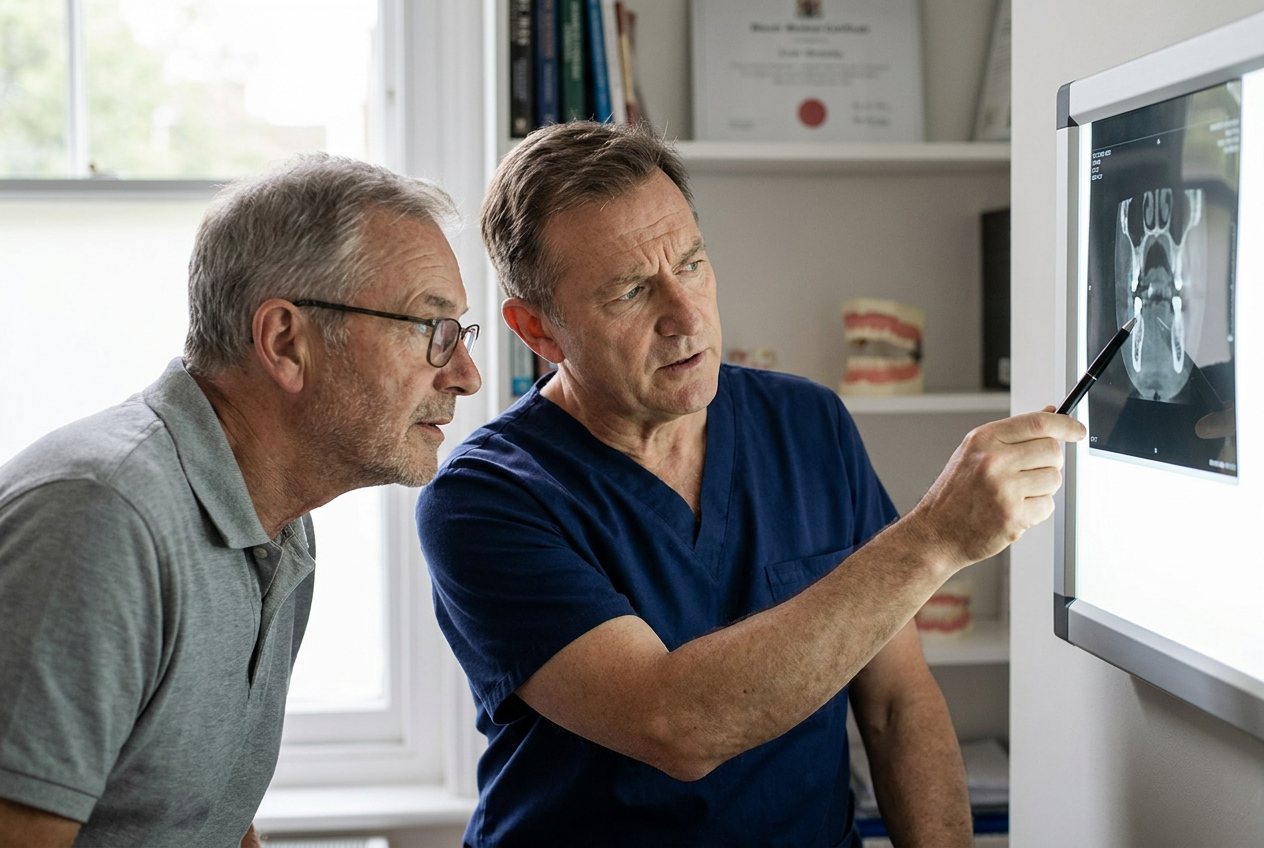
If you want a local plan to compare with a quote from abroad, ANEWU's first visit is a free consultation that includes an in-office 3D scan. Dr. Abtin Shahriari reviews the scan with you and explains which options your anatomy supports, and the cost of the recommended plan is reviewed at the same visit, before you leave.
Nothing is booked until you decide, so you can leave with a plan and compare it with any other quote. To see your own scan and the options it supports, you can book a free consultation.
- Step 1: bring your medication list, insurance card and any recent x-rays from another office; the front desk reviews your medical and dental history.
- Step 2: a 3D scan in the office maps bone height and width, the nerve in the lower jaw and the sinus floor.
- Step 3: Dr. Abtin Shahriari explains the options in plain language, including anything that would need to happen first.
- If grafting is needed first, you hear it at this visit, so you can see how many stages the plan has.
- Step 4: cost is reviewed before you leave. If you go ahead at ANEWU, CareCredit, Proceed Finance or a monthly payment plan is arranged before treatment.
Sources and further reading
- Medical Tourism (CDC Yellow Book 2026, Health Care Abroad) Centers for Disease Control and Prevention, 2025
- Dental Implants: What You Should Know U.S. Food and Drug Administration, content current as of 2021
- Worth the Trip? A Look at Dental Tourism Academy of General Dentistry, 2020
- Interventions for replacing missing teeth: different times for loading dental implants Cochrane Database of Systematic Reviews, 2013
- Interventions for replacing missing teeth: dental implants in fresh extraction sockets (immediate, immediate-delayed and delayed implants) Cochrane Database of Systematic Reviews, 2010
- Implant placement and loading protocols in partially edentulous patients: A systematic review Clinical Oral Implants Research, 2018 (6th ITI Consensus Conference)
- Dental tourism and the risk of barotrauma and barodontalgia British Dental Journal, 2023
- Accuracy of Original vs. Non-Original Abutments Using Various Connection Geometries for Single Unit Restorations: A Systematic Review Journal of Prosthodontics, 2022
- Accuracy of Artificial Intelligence Models in Dental Implant Fixture Identification and Classification from Radiographs: A Systematic Review Diagnostics, 2024
- Prevalence, incidence, systemic, behavioral, and patient-related risk factors and indicators for peri-implant diseases: An AO/AAP systematic review and meta-analysis Journal of Periodontology, 2025
- Dental Implants Cleveland Clinic, last updated 2026
- Dental abscess NHS, reviewed March 2026
This article is general information about dental and facial procedures, not a diagnosis or medical advice. Every jaw and every health history is different, so the right plan for you can only be set after an exam and imaging with a surgeon.