













Short answer
A gap between the front teeth, called a diastema, is fixed by matching the treatment to its size and cause: bonding for a small gap between well-shaped teeth, aligners or braces for a large gap or spacing across the arch, and veneers or bonding when the teeth are narrow. In a 2014 study in the Journal of Applied Oral Science, closed midline gaps reopened slightly in 60% of patients.
Can a diastema be fixed?
Yes, a diastema can be fixed, and the fix that suits you depends on the gap's size and cause. Small gaps between well-shaped teeth suit bonding, large or multiple gaps suit tooth movement, and narrow teeth suit added width. In a 2026 Journal of Dentistry study, 96% of resin gap closures survived over a mean follow-up of about seven years.
Use the table as a starting map, not a diagnosis, and do not compare cells directly. The bonding figure comes from a 2026 retrospective study of 147 restorations in 53 patients, the veneer figure from a 2021 Journal of Clinical Medicine review that pooled 25 studies, and the relapse and retainer figures from single studies of 30 and 29 patients.
| Your gap | Usual first step | Visits | Reversible? | How long results usually last |
|---|---|---|---|---|
| Small gap, well-shaped teeth, healthy gums | Bonding | Usually one | Usually yes, little or no enamel removed | 96% of bonded closures survived a mean of about 7 years (2026 study); edges may need polishing or repair |
| Large gap between the two front teeth | Aligners or braces, then a little bonding if the shape needs it | Months of trays or braces, plus checks | Yes, no enamel removed | Midline gaps reopened in 60% of patients after retention ended, about 0.5 mm on average across the group (2014 study) |
| Spacing across the whole arch | Aligners or braces | Usually 6 to 18 months of trays (ANEWU's aligner page) | Yes, no enamel removed | A retainer is needed to hold the result |
| Gap that reopened after braces | Close it again, then a fixed or removable retainer | Usually a short series of trays for a small reopening | Yes | Bonded retainers lasted 17 years on average (2015 study) |
| Small or peg-shaped teeth | Bonding or veneers to add width, sometimes after aligners share out the space | One for bonding, typically two for veneers | Bonding usually yes; veneers no | Veneers: 95.5% estimated survival at 10 years (2021 review) |
| Gap from gum disease or a bite problem | Treat the gums or bite first | Depends on the treatment | Depends on the treatment | Closure waits until the cause is under control |
What causes a gap between front teeth?
A gap between front teeth usually comes from a mismatch between tooth size and the space in the jaw, a missing or undersized tooth, a thick frenum, tongue or clenching habits, or gum disease. Cleveland Clinic groups these into inherited traits (absent or undersized teeth, an oversized frenum), habits (clenching, an abnormal swallowing pattern) and advanced gum disease.
The frenum, the band of tissue that joins the upper lip to the gum, is assessed before any closure is planned. In a 2022 systematic review of 11 studies, published in the International Journal of Pediatric Otorhinolaryngology, the frenum types tied to a midline gap were the two that reach into the gum between the front teeth. Cleveland Clinic also names a swallowing habit in which the tongue pushes on the front teeth instead of the palate, a pressure that can open a space over time.
Gum disease is the cause to rule out first in an adult. The National Institute of Dental and Craniofacial Research (NIDCR) says advanced gum disease destroys the bone supporting the teeth, which may cause looseness and shifting. Tooth size matters too: if the teeth are narrow for the jaw, the space is real, and closing it means either moving teeth or adding width to them.
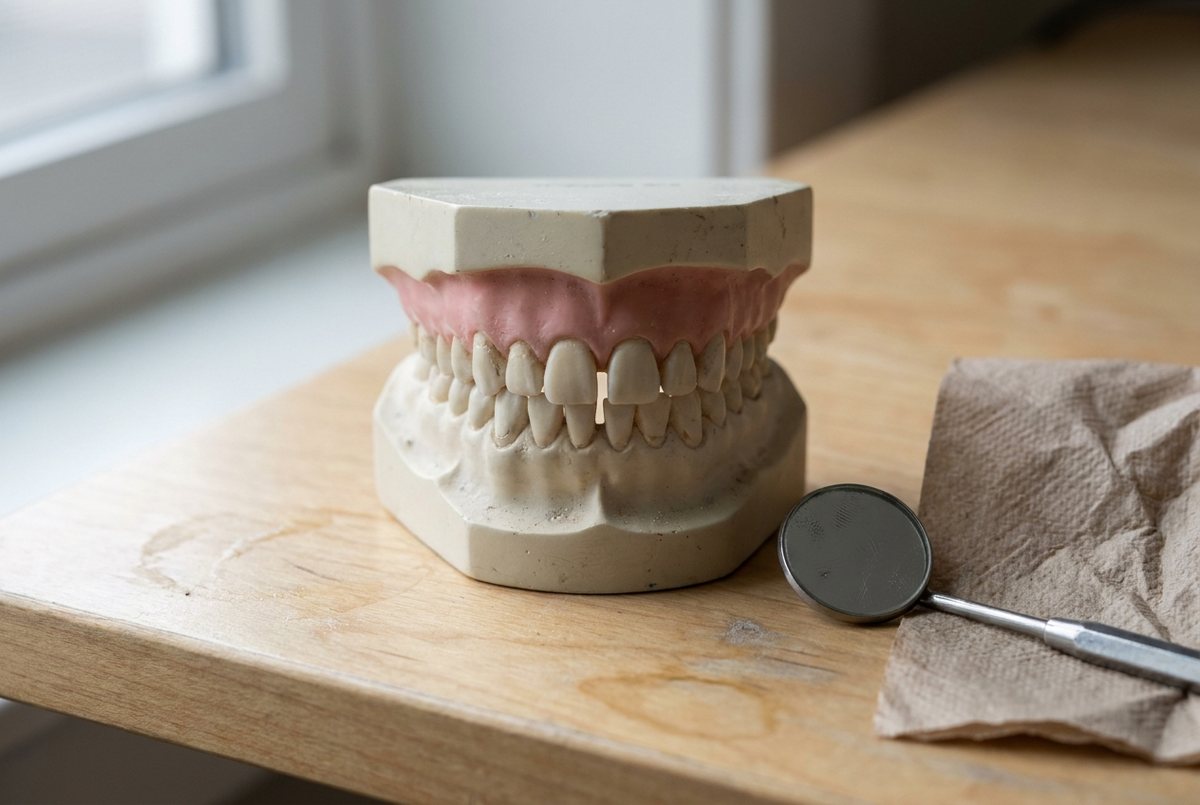
Is it normal for a 7-year-old to have a gap in their teeth?
Yes, a gap between a 7-year-old's front teeth is usually a normal stage of development. A 2021 systematic review in the International Journal of General Medicine describes the midline gap of the so-called ugly duckling stage as part of how the adult teeth come in, and Cleveland Clinic notes that many children's gaps close by themselves as the adult teeth erupt.
Gap size is the signal to watch. The same review notes that the larger the gap, the less likely it is to close untreated, and that a gap over 2 mm is unlikely to close on its own after the side incisors and canines erupt. In children under 12, it found extra teeth and frenum shape among the most common causes. A US national survey from 1988 to 1991, published in the Journal of Dental Research in 1996, found gaps of 2 mm or more in 19% of 8 to 11-year-olds but in 6% of 12 to 17-year-olds. The rest of this post is about adults.
Should you invest in bonding or braces to close the gap in your front teeth?
Bonding is the quicker, lower-commitment choice for a small gap between well-shaped teeth, while braces or clear aligners suit a large gap or spacing across several teeth. Bonding adds tooth-colored resin to the sides of the teeth and leaves them where they are. Orthodontic treatment moves the teeth together and leaves their width alone.
In the 2026 study of 147 resin space closures, 96% survived over a mean follow-up of 7.05 years, ranging from 2 to 17 years. The most common problems were discolored edges and a shape that deteriorated, both repairable and both more frequent the longer people were followed, so plan on periodic polishing and touch-ups. The American Dental Association notes that composite veneers are not as stain- or wear-resistant as porcelain ones.
The honest limit of bonding is width. Resin closes a gap by making teeth wider, so a 4 mm gap split between two front teeth adds 2 mm to each, and teeth that were already broad can end up looking square or oversized. That is why a large gap is often narrowed by moving the teeth first, then finished with a small amount of bonding. Veneers can spread the width across more teeth, but the ADA warns that veneer treatment cannot be reversed, since enamel is removed to place them.
Can a diastema be fixed with braces or clear aligners?
Yes, braces or clear aligners can close a diastema by moving the teeth together, which keeps their natural width and removes no enamel. Clear aligners are thin, removable plastic trays worn in sequence, with each tray nudging the teeth a little further. ANEWU's clear aligner page says most cases take 6 to 18 months and that a small gap is a short series.
Aligners have limits. If teeth have far to travel or the bite is badly off, ANEWU's page says braces usually do the job instead, and trays only work if they stay in for most of the day, which the page puts at 20 to 22 hours. Tooth movement also cannot fix teeth that are simply too narrow. A typical sequence for closing a gap by moving teeth runs like this:
- 1. Exam: gums, frenum, bite and tooth size are checked before anything is planned.
- 2. Records: a scan or impressions map how far each tooth has to move.
- 3. Movement: trays are changed in order, or braces adjusted, over a period of months.
- 4. Retention: a retainer holds the teeth once the gap is closed.
- 5. Finishing: any bonding to even out shape is done once the teeth are in their final position.
Will the gap come back?
A closed gap can come back, especially a midline gap between the two upper front teeth. In a 2014 Journal of Applied Oral Science study that followed 30 patients past the end of retention, the midline gap reopened in 60% of them; the average reopening was 0.49 mm across the group and 0.78 mm in those whose gap returned. A 2023 Cochrane review notes that without retention, teeth tend to drift back.
The 2014 study found that wider gaps before treatment were more likely to reopen, while gaps between the central and side incisors stayed closed. Retainers are the main defense. In a 2015 study in the American Journal of Orthodontics and Dentofacial Orthopedics, which followed 29 people with a retainer bonded behind the two front teeth, the retainers lasted 17 years on average, with about a 2% chance of breaking in any given year, and the 11 people examined showed no sign of harm to the gums around those teeth.
The evidence on retainer choice is thin. The 2023 Cochrane review of 47 trials could not say which retainer works better, because the evidence was low to very low certainty, most trials measured outcomes after less than a year, and aligner studies were left out. Bonding and veneers do not relapse in the same way, since the teeth are not moved. If gum disease opened the gap, Cleveland Clinic advises getting the infection under control before closing it.
What does a gap in front teeth signify?
In most adults, a long-standing gap signifies nothing about health: Cleveland Clinic says most clinicians regard a diastema as part of the normal range of dental development, and one that rarely harms oral health. A new gap, or one that is getting wider, is different. It can be a sign of gum disease and is a reason to see a dentist soon.
A gap caused by gum disease tends to come with other signs. NIDCR lists red, swollen or tender gums that bleed easily, gums that pull away from the teeth, and loose or sensitive teeth. Such a gap is a health problem first and a cosmetic one second. Infection around a tooth can be urgent: the NHS advises urgent dental care for a suspected abscess and emergency care for the last signs below. When to call right away:
- Call the office soon if a gap appears or widens over a few weeks, a front tooth feels loose, or your gums bleed, swell or pull back.
- Call the office right away if you have gum pain with swelling, pus, a bad taste or a high temperature, which can mean an abscess.
- Go to an emergency room if you find it hard to breathe, speak or swallow, have a lot of swelling in your mouth, have trouble opening your mouth, or have a swollen or painful eye.
What happens at your consultation at ANEWU?
At ANEWU, your gap is assessed at a free consultation at the Buckhead, Cumming or Dawsonville office. You explain what bothers you, the team checks your teeth, gums and bite, and you leave knowing which treatment fits, the order of the steps and the cost. Nothing is drilled or placed at that visit, and you decide in your own time.
What comes next depends on the exam. If your gums are healthy and the gap is small, bonding is usually a single visit: the resin is sculpted at the chair, and little or no enamel is removed. If the gap is large or several teeth are spaced, clear aligners planned from a 3D scan of your bite are the usual first step, and if braces would serve you better, the consultation is where you find out. If the exam finds active gum disease or decay, that is treated before any cosmetic work.
If you want several changes, a smile makeover puts them in order: teeth are aligned first if needed, whitened next, and any bonding, veneers or crowns are made last to match. That planning sits with ANEWU's cosmetic dentistry team, which shares the practice with the oral surgery team of Dr. Abtin Shahriari. Insurance usually does not pay for cosmetic bonding and often leaves out adult aligners; ANEWU takes CareCredit and Proceed Finance. To talk it through, book a free consultation and look over what to expect at your first visit. Questions to ask your dentist or surgeon about a gap:
- What is causing my gap, and does anything need treating first?
- If I bond it, how much wider will each tooth get?
- Would moving the teeth first give a more even result?
- Which option leaves my enamel untouched, and which cannot be reversed?
- Which retainer will I need, and for how long?
- What upkeep should I expect: polishing, repairs or replacement?
- What will insurance and financing cover?
Sources and further reading
- Diastema: Definition, Causes & Treatment Cleveland Clinic, patient information page, last updated March 2026, accessed November 2026
- Veneers American Dental Association, MouthHealthy patient information page, accessed November 2026
- Periodontal (Gum) Disease National Institute of Dental and Craniofacial Research, NIH, accessed November 2026
- Dental abscess NHS, page last reviewed March 2026, accessed November 2026
- Retention procedures for stabilising tooth position after treatment with orthodontic braces Cochrane Database of Systematic Reviews, 2023
- Etiological Factors of the Midline Diastema in Children: A Systematic Review International Journal of General Medicine, 2021
- Association between superior labial frenum and maxillary midline diastema: a systematic review International Journal of Pediatric Otorhinolaryngology, 2022
- Postretention stability after orthodontic closure of maxillary interincisor diastemas Journal of Applied Oral Science, 2014
- Long-term bonded retention after closure of maxillary midline diastema American Journal of Orthodontics and Dentofacial Orthopedics, 2015
- Clinical performance of direct composite resin for anterior space closure: A retrospective evaluation Journal of Dentistry, 2026
- Long-Term Survival and Complication Rates of Porcelain Laminate Veneers in Clinical Studies: A Systematic Review Journal of Clinical Medicine, 2021
- Prevalence and distribution of selected occlusal characteristics in the US population, 1988-1991 Journal of Dental Research, 1996
This article is general information about dental and facial procedures, not a diagnosis or medical advice. Every jaw and every health history is different, so the right plan for you can only be set after an exam and imaging with a surgeon.